News
|
 |
SIPRI at the 2026 Munich Security Conference
SIPRI had an active presence at the 2026 Munich Security Conference (13–15 February), co-hosting side events, participating in high-level bilateral meetings and engaging with international media outlets. Across these events, SIPRI experts contributed research-based insights on sustaining multilateral conflict management, strengthening links between development and security, and addressing evolving geopolitical pressures.
Read more
|
|
 |
SIPRI briefs Stockholm policy community on escalation risk in contemporary warfare
On 27 January, researchers from the SIPRI Weapons of Mass Destruction (WMD) Programme briefed a delegation of policymakers and experts on multidomain nuclear escalation risk. SIPRI researchers explored global governance approaches to these issues, drawing on findings from dialogues convened as part of research supported by the Global Challenges Foundation and other SIPRI work on the AI–space and space–nuclear nexuses. The discussion focused on identifying means of effectively reducing risk.
Read more | Read the SIPRI publication on multidomain nuclear escalation risk
|
|
 |
SIPRI and CACDA host workshop in Beijing on space and strategic stability
On 3–4 February, SIPRI and the China Arms Control and Disarmament Association (CACDA) held a closed-door expert workshop in Beijing, China, on the theme ‘Space and Strategic Stability’. The workshop brought together experts with legal, technical, policy and military backgrounds from Canada, China, Germany, Norway, Poland, the United Kingdom and the United States. The discussions covered developments in the space domain, related threat perceptions, and strategic signalling and deterrence in space, and identified potential risk-reduction measures to maintain stability in outer space.
Read more | Read the SIPRI publication on stability in outer space
|
|
 |
SIPRI kicks off dialogue series on human security
On 28–29 January, SIPRI and the United Nations Trust Fund for Human Security launched a Nordic Dialogue series in Stockholm to discuss the future of human security in a changing geopolitical landscape. The public panel emphasized that human security should not be treated as a competing priority to national security but rather as a framework that broadens how security is defined, measured and addressed, while helping to create the conditions for conflict prevention, resilience and peaceful societies.
Read more
|
|
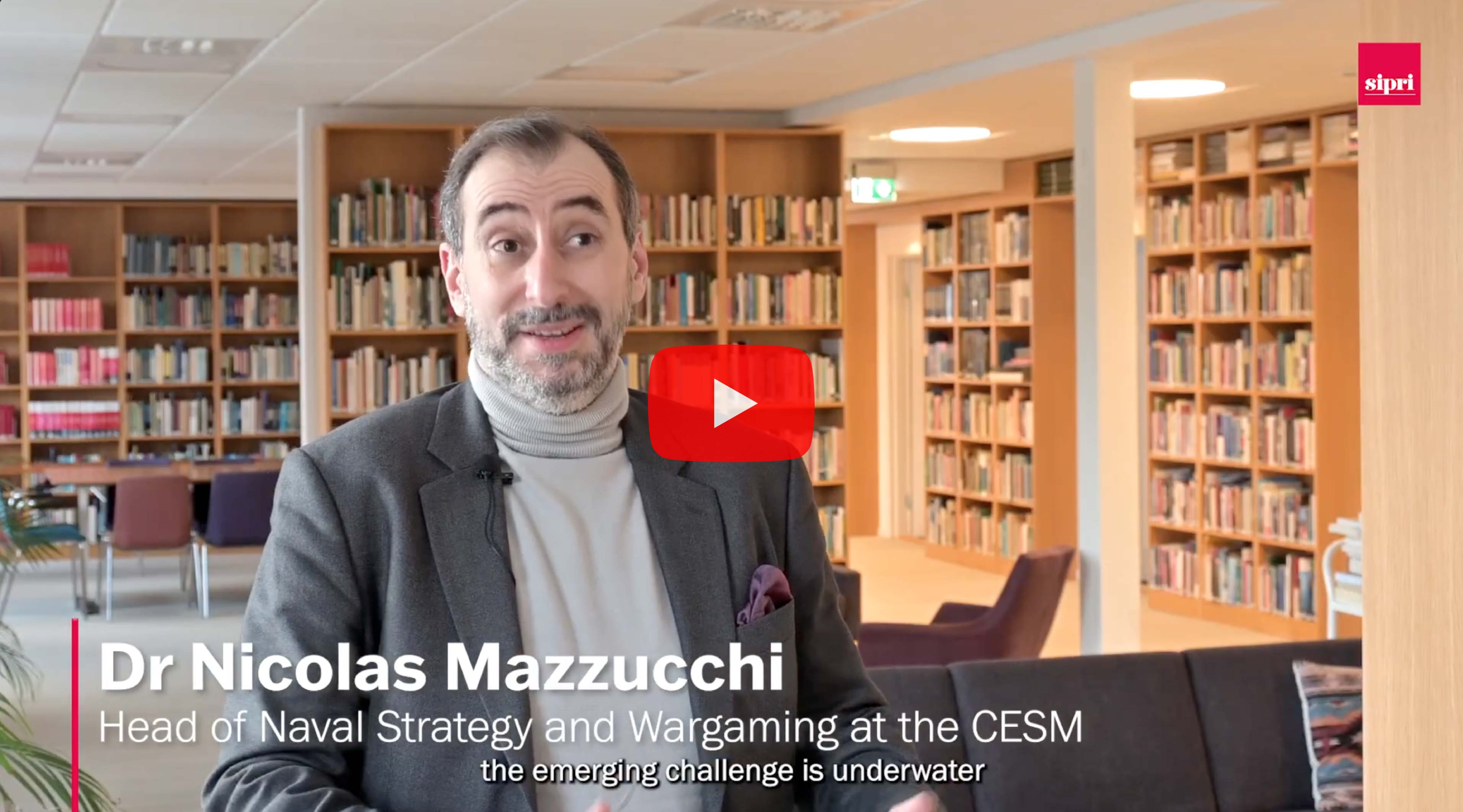 |
SIPRI Spotlight: Dr Nicolas Mazzucchi—Head of Naval Strategy and Wargaming at the CESM
As part of the SIPRI event with the French Embassy on maritime hybrid threats in the Baltic Sea, SIPRI interviewed Dr Nicolas Mazzucchi, Head of Naval Strategy and Wargaming at the French Navy Centre for Strategic Studies. In the interview, Nicolas reflects on the growing security risks beneath the Baltic Sea, highlighting the vulnerability of critical underwater infrastructure and the strategic implications of seabed warfare. He discusses the need for stronger civilian–military cooperation, enhanced intelligence-sharing and technological innovation, and explains why collaboration between NATO and the EU offers grounds for cautious optimism in securing Europe’s ‘green waters’.
Watch the SIPRI Spotlight interview | Read more about the event on maritime hybrid threats in the Baltic Sea
|
|
|
Upcoming events
|
SIPRI and the Stimson Center to host event on arms transfers in a changing global order
11 March 2026
SIPRI and the Stimson Center will host a virtual discussion on the geostrategic implications of recent trends in global arms transfers. Under the title ‘The Re-making of International Security: Arms Transfers Trends in a Changing Global Order’, the event will feature newly released SIPRI data on recent trends in international arms transfers.
Read more
|
|
SIPRI to co-host military AI course
21–22 May 2026
SIPRI is co-hosting ‘Military AI: International Law and Governance’, a two-day capacity-building course organized in collaboration with the Asser Institute. The course will take place on 21–22 May 2026 at the Asser Institute in The Hague, the Netherlands. It builds on the first edition of the course held in 2025 and aims to deepen understanding of the challenges and opportunities posed by military applications of artificial intelligence.
Read more
|
|
SIPRI to co-host 2026 Armament and Disarmament Summer School
24–28 August 2026
SIPRI and the Alva Myrdal Centre for Nuclear Disarmament at Uppsala University, in cooperation with the Odesa Center for Nonproliferation, are now inviting applications to the 2026 Armament and Disarmament Summer School, to be held in Stockholm and Uppsala on 24–28 August 2026.
Read more
|
|
|
Recent events
|
SIPRI co-hosts conversation on women’s leadership in peace and diplomacy
19 February 2026
The Embassy of Ireland in Sweden and SIPRI hosted an event on women’s leadership in peace and diplomacy to mark St Brigid’s Day, a celebration highlighting women in diplomacy, peace, mediation and leadership.
Read more
|
|
SIPRI advances gender-responsive humanitarian action in eastern Chad
11 February 2026
SIPRI convened a workshop hosted by the UN Office for the Coordination of Humanitarian Affairs. The workshop took place in N’Djamena, Chad, and convened key actors involved in the humanitarian response in eastern Chad, including representatives from the UN system, national authorities and non-governmental organizations.
Read more
|
|
SIPRI co-hosts discussions on maritime hybrid threats in the Baltic Sea
10 February 2026
SIPRI, the French Navy Centre for Strategic Studies and the French Embassy in Stockholm jointly hosted a ‘Franco-Swedish Day on Maritime Hybrid Threats in the Baltic Sea’. The event brought together Swedish and French maritime experts to exchange views and experiences regarding hybrid threats and how to curb them.
Read more
|
|
SIPRI researchers inform global military AI summit
4–5 February 2026
Spain hosted the third REAIM Summit—a multistakeholder gathering dedicated to international dialogue on the responsible development and use of AI in the military domain. SIPRI’s Governance of AI programme was on the ground, contributing to the conversations, with two of its members sharing insights from their recent work.
Read more
|
|
SIPRI co-hosts intensive online course on evolving challenges of WMD non-proliferation and disarmament
20–23 January 2026
SIPRI and the European Union Non-Proliferation and Disarmament Consortium held an intensive online course on the impact of contemporary geopolitical challenges and novel technologies on the proliferation, development and risk of use of WMDs—and the mechanisms to address them, including efforts towards arms control and disarmament.
Read more
|
|
|
|
|
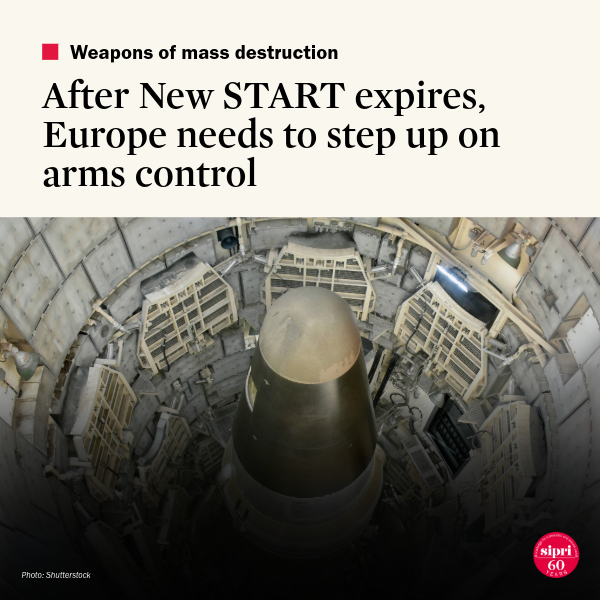 |
After New START expires, Europe needs to step up on arms control
The expiry of the 2010 Treaty on Measures for the Further Reduction and Limitation of Strategic Offensive Arms (New START) earlier this month ended the last treaty limiting US and Russian strategic nuclear arsenals, ushering in a period of heightened nuclear risk. Without constraints or transparency measures, a renewed arms race—now increasingly involving China—is likely, alongside reduced predictability and greater crisis instability. The collapse of bilateral arms control will also weaken the Nuclear Non-Proliferation Treaty and exacerbate proliferation pressures, with serious implications for European security. This SIPRI Essay urges European leaders to pursue risk-reduction measures and revive arms control efforts to help stabilize an increasingly dangerous nuclear landscape.
Read the SIPRI Essay
|
|
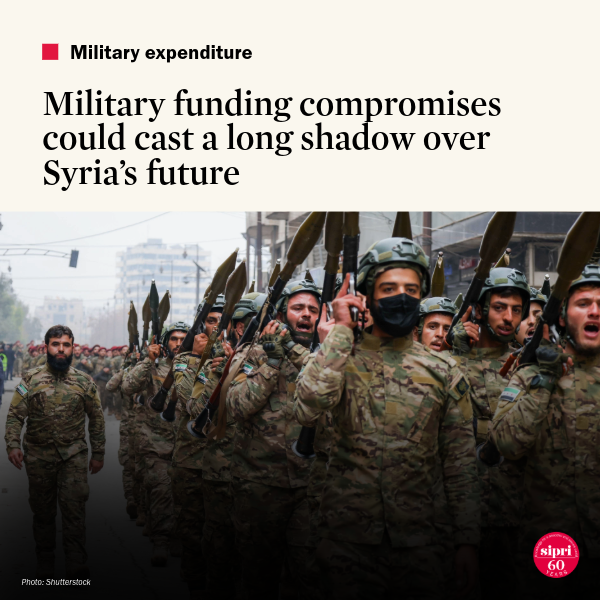 |
Military funding compromises could cast a long shadow over Syria’s future
This month’s agreement between the Syrian Armed Forces and the Syrian Democratic Forces could advance the Transitional Government’s goal of building ‘One Syria, One Army, One Government’. However, beyond the political and security challenges of integrating or disarming armed groups, the design of Syria’s military funding architecture will be decisive. Off-budget financing—long used during the civil war—risks entrenching opacity, corruption, fragmentation and dependence on external actors, while undermining efforts to centralize control. Establishing a transparent, sustainable, on-budget system for military funding would strengthen state authority, support fiscal recovery and shape the balance of power ahead of constitutional negotiations. Decisions taken now are likely to have lasting implications for Syria’s stability and future governance.
Read the SIPRI Topical Backgrounder
|
|
 |
SIPRI experts were recently featured in these external outlets:
|
|
|
Publications
|
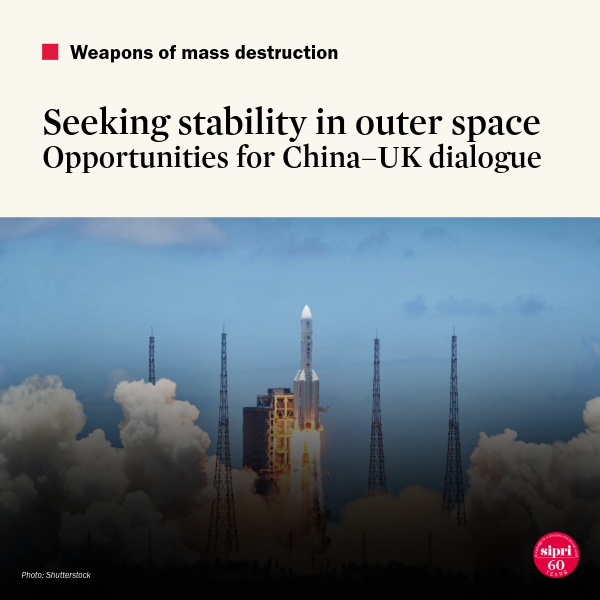 |
Seeking Stability in Outer Space: Opportunities for China–UK Dialogue
Space systems are critical enablers for military and civilian services. While a number of states are conducting space activities, Chinese views on outer space warrant particular attention given China’s status as the second-largest user of space and its pursuit of space capabilities. As outlined in this paper, the United Kingdom, with its own space security interests and capability development, is well positioned to foster common understandings on space security issues with China.
Read the SIPRI Research Policy Paper
|
|
 |
AI in Chinese, Indian and US Nuclear Postures, Norms and Systems
This report presents a systematic survey of the extent to which China, India and the United States have integrated AI into their respective nuclear postures, norms and systems. It finds that while China and India have released limited official information on their nuclear command, control and communications structure, the USA has historically issued prolific government documents. Despite these differences, all three possess numerous official releases relating to AI and even its military applications. This survey is intended to serve as a baseline for future engagement with and among China, India and the USA on AI and nuclear confidence-building measures.
Read the report
|
|
 |
Responsible Procurement of Military Artificial Intelligence
This report examines the intersection of military procurement and responsible military AI. The report investigates why and how states are adapting their procurement processes to accelerate military AI adoption, and why and how states should seize these opportunities to give effect to their legal obligations and high-level political commitments related to responsible military AI. The report recommends that states should (a) adapt their procurement processes to give effect to high-level obligations and commitments to responsible development and use of military AI; (b) develop and publish documents articulating clear expectations for suppliers of military AI capabilities; and (c) address the responsible procurement of military AI in international policy discussions.
Read the report
|
|
 |
Future-proofing Civilian CSDP in a Challenging Strategic Environment: Seven Questions for Debate
Despite repeated efforts, much-needed improvements to increase the strategic impact of the European Union’s (EU) Civilian Common Security and Defence Policy (civilian CSDP) have failed to materialize. Simultaneously, the formulation of strategic guidance in Brussels has stalled. This state of affairs risks civilian CSDP’s credibility and legitimacy in addressing the EU’s foreign policy priorities and security challenges. Against this backdrop, this research policy paper provides decision makers with seven questions for discussion. These questions touch on civilian CSDP’s future as a crisis management tool, its functional and geographical prioritization, the breadth of mission mandates, host country relations and other aspects that have remained largely unresolved following two civilian CSDP compacts.
Read the SIPRI Research Policy Paper
|
|
 |
Gendered dimensions of climate-related security risks in the OSCE area
This report examines how climate change is exacerbating security risks across the OSCE region through gendered and intersectional pathways. Drawing on policy mapping and stakeholder interviews, it shows that climate-related security risks are highly context-specific but share common structural drivers—including inequality, weak institutions and political marginalization. Gender, age, class, disability and rural–urban divides shape differentiated vulnerabilities, yet remain insufficiently addressed in climate and security policy frameworks.
Read the report
|
|
|
|
|
|
Accurate, dependable information is more important than ever. Invest in the facts.
Support SIPRI
|
|
 |
| SIPRI is an independent international institute dedicated to research into conflict, armaments, arms control and disarmament. Established in 1966, SIPRI provides data, analysis and recommendations, based on open sources, to policymakers, researchers, media and the interested public. |
|
|