The independent resource on global security

The SIPRI Top 100 Arms-producing and Military Services Companies, 2024

December 2025
Stockholm
SIPRI
summary
The combined arms revenues of the world’s largest arms-producing and military services companies (the SIPRI Top 100) increased by 5.9 per cent in 2024 to reach $679 billion, the highest level ever recorded by SIPRI. The total arms revenues of the Top 100 went up by 26 per cent over the decade 2015–24.
The rise in the total arms revenues of the Top 100 in 2024 was mostly due to overall increases in the arms revenues of companies based in Europe and the United States. There were year-on-year increases in all the geographical areas covered by the ranking apart from Asia and Oceania, which saw a slight decrease, largely as a result of a notable drop in the total arms revenues of Chinese companies.
Key facts
- The arms revenues of the SIPRI Top 100 arms-producing and military services companies totalled $679 billion in 2024, an increase of 5.9 per cent in real terms compared with 2023.
- The 39 Top 100 companies headquartered in the United States increased their arms revenues by 3.8 per cent year-on-year to reach $334 billion in 2024.
- The combined arms revenues of the 26 European companies in the Top 100 went up by 13 per cent to $151 billion.
- The two Russian companies for which data was available increased their total arms revenues by 23 per cent to an estimated $31.2 billion as they continued to ramp up production to satisfy domestic orders stemming from the war in Ukraine.
- The total arms revenues of the 23 companies based in Asia and Oceania in the Top 100 decreased by 1.2 per cent to $130 billion. The regional drop was due to a 10 per cent decline in the combined arms revenues of Chinese arms companies, as corruption allegations led to several major arms contracts being postponed or cancelled.
- With total arms revenues of $31.0 billion in 2024, there were nine companies based in the Middle East in the Top 100—the highest number from the region ever listed in the yearly ranking. The arms revenues of the eight Middle Eastern companies for which consistent data was available grew by 14 per cent between 2023 and 2024.
The combined arms revenues of the world’s largest arms-producing and military services companies (the SIPRI Top 100) increased by 5.9 per cent in 2024 to reach $679 billion (see annex 1), the highest level ever recorded by SIPRI.1 The total arms revenues of the Top 100 went up by 26 per cent over the decade 2015–24 (see figure 1).
The rise in the total arms revenues of the Top 100 in 2024 was mostly due to overall increases in the arms revenues of companies based in Europe and the United States. There were year-on-year increases in all the geographical areas covered by the ranking apart from Asia and Oceania, which saw a slight decrease, largely as a result of a notable drop in the total arms revenues of Chinese companies.
Expanding Arms Production Capacity
In 2024 the growing demand for military equipment around the world, primarily linked to rising geopolitical tensions, accelerated the increase in total Top 100 arms revenues seen in 2023. More than three quarters of companies in the Top 100 (77 companies) increased their arms revenues in 2024, with 42 reporting at least double-digit percentage growth. Two companies more than doubled their arms revenues: Czechoslovak Group (+193 per cent; rank 46) and SpaceX (+103 per cent; rank 77).
As governments around the world ramp up arms procurement, in some cases adding to already lengthy backlogs in orders, many companies in the Top 100 have begun to put in place measures aimed at expanding their production capacity. For example, based on available information, at least 38 companies expanded in 2024 by creating new subsidiaries, acquiring other businesses, or establishing new production plants or production lines. Of the 38 companies identified, 17 were based in Europe, 15 in the USA, 4 in Asia and Oceania and 2 in the Middle East. Notably, this means that at least 65 per cent of European arms companies in the Top 100 were expanding production capacity in some form in 2024. It is likely that other arms companies beyond the 38 identified also expanded their production capacity during the year—including most Russian companies and some privately owned companies—but it is not possible to make an assessment due to a lack of publicly available information.
In 2024 the growing trend in acquisitions was particularly noticeable among US companies. The number of US companies in the Top 100 in 2024 (39 companies) was the lowest since 2014, which can partly be explained by ongoing consolidation within the Top 100. For example, in 2024 Amentum (rank 19) acquired Jacobs Engineering Group’s critical communications technology division, while British company BAE Systems (rank 4) acquired the aerospace division of US company Ball Corporation.
Regional Developments in the Top 100
North America
The combined arms revenues of the 40 companies in the Top 100 in North America (i.e. Canada and the USA) totalled $336 billion in 2024 and accounted for 49 per cent of the Top 100’s total arms revenues.
In 2024 the 39 companies in the Top 100 based in the United States increased their arms revenues by 3.8 per cent to reach a total of $334 billion (see figure 2), accounting for almost half of all Top 100 arms revenues (see figure 3). Of these 39 companies, 30 recorded year-on-year increases in their arms revenues. Four of the world’s top five arms companies—Lockheed Martin (rank 1), RTX (rank 2), Northrop Grumman (rank 3) and General Dynamics (rank 5)—were based in the USA and all four increased their arms revenues in 2024.
General Dynamics recorded the biggest increase among these four companies in 2024 as its arms revenues went up by 8.1 per cent to $33.6 billion. This can mainly be attributed to revenue growth related to the USA’s Columbia-class and Virginia-class nuclear-powered submarine programmes, although there were growing concerns in 2024 about the persistent cost overruns and production delays affecting both programmes.
While delays and cost overruns have long been characteristics of military modernization efforts globally, they have been especially pronounced in the USA, diverting even more of the government’s resources away from other spending priorities and undermining long-term military budgeting and planning. The USA’s submarine programmes are notable examples of this long-standing issue. In 2024, for instance, the Columbia-class submarine programme was estimated to be up to $17.0 billion over budget, with production of the first vessel being at least 16 months behind schedule.
In 2024 Lockheed Martin, the world’s largest arms producer, recorded its first increase in arms revenues since 2020. Its arms revenues rose by 3.2 per cent in 2024 to reach $64.7 billion. The company’s increased revenues in 2024 were partly attributable to deliveries of F-35 combat aircraft that had been delayed since 2023 because of setbacks in the production of the advanced Block 4 version. The delays were mostly related to the integration of hardware and software upgrades. The 110 F-35s delivered in 2024 were delayed by an average of 238 days per aircraft. In addition to delays, the F-35 programme has been affected by systematic cost overruns. The latest available estimate from the US Department of Defense (DOD), published in December 2023, put the programme’s total acquisition cost (including development and procurement) at $485 billion, which was $89.5 billion more than the baseline estimate from 2012 and around $43.0 billion more than the estimate from December 2022. Lockheed Martin is the primary contractor for post-production maintenance and sustainment of the F-35, the costs of which have also grown. In 2023 the DOD revised the F-35 programme’s projected total sustainment costs to almost $1.6 trillion, compared with an estimate of $1.1 trillion in 2018.
Northrop Grumman also came under scrutiny in 2024 because of production delays and cost overruns. It is the primary contractor responsible for developing and producing new land-based intercontinental ballistic missiles under the USA’s Sentinel programme. The DOD’s estimate from 2024 put the total cost of the programme at $141 billion, a cost overrun of 81 per cent from the original projection of $78 billion made in 2020. In 2024 the results of a mandatory review showed that the programme had breached critical cost-growth thresholds set out in legislation aimed at curtailing cost growth in US arms procurement processes. Even though the Sentinel programme had breached the thresholds, which in most cases would result in the termination of a programme, the DOD announced that the programme would continue as there was no possible alternative procurement option. In 2024 Northrop Grumman’s arms revenues rose by 3.3 per cent to $37.9 billion.
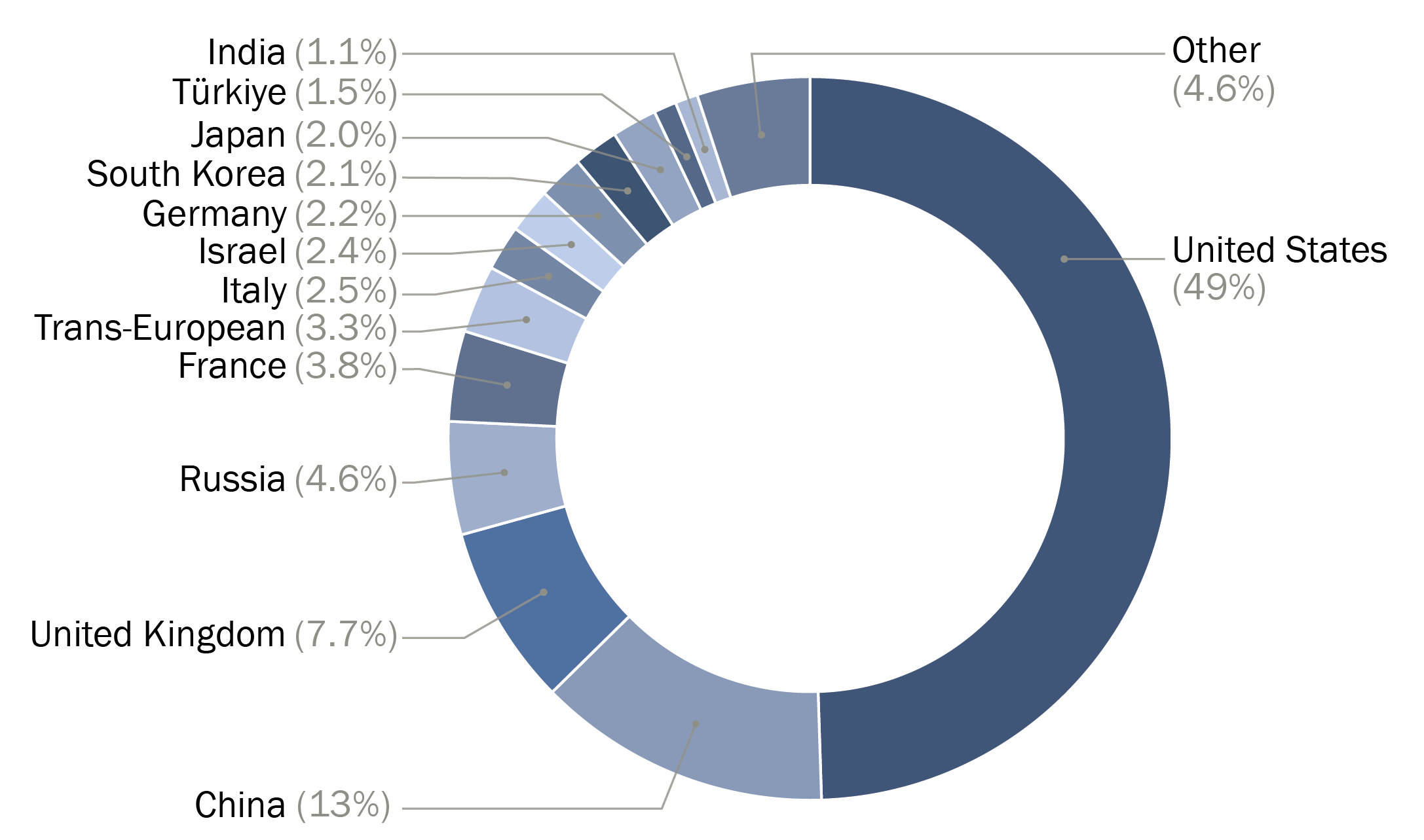
Figure 3. Share of the total arms revenues of companies in the SIPRI Top 100 for 2024, by country
Note: The Top 100 classifies companies according to the country in which they are headquartered. This means that the arms revenues of an overseas subsidiary are counted towards the total for the parent company’s country. The Top 100 does not encompass the entire arms industry in each country covered, only the largest companies. The category ‘Other’ consists of companies based in Canada, Czechia, Indonesia, Norway, Poland, Singapore, Spain, Sweden, Taiwan, Ukraine and the United Arab Emirates. The respective aggregate arms revenues of these companies comprise less than 1.0% of the Top 100 total. Shares may not add up to a total of 100% due to rounding.
Source: SIPRI Arms Industry Database, Dec. 2025.
Boeing (rank 6) is another major US arms company that has been affected by production delays and cost overruns in recent years. The two most prominent cases are the KC-46A tanker aircraft and the T-7A trainer aircraft. Operational losses from the two production programmes totalled $3.8 billion in 2024, with the KC-46A programme also projected to be subject to a seven-year delay compared with the original baseline estimate. In 2024 Boeing’s arms revenues fell by 4.6 per cent to $30.6 billion.
The delays and cost overruns affecting many large US arms companies may worsen in the coming years as a result of a shortage of materials essential to the production of advanced military equipment. In their annual reports for 2024, several companies emphasized the severe operational risks posed by limited access to critical materials (see box 1).
Box 1. Escalating trade restrictions on critical materials increase complications for arms producers
In October 2025 China introduced new export controls on rare earths, expanding the list of critical materials subject to export restrictions. This marked another escalation in the ongoing tit-for-tat trade confrontation between China and the United States. Since 2020, China has steadily tightened exports of critical materials, many of which are essential to the production of advanced military equipment. Controlling roughly 60–70 per cent of rare earth mining and about 90 per cent of processing, China holds a near-monopoly on the supply chain.
After negotiations with the USA, China agreed to suspend the October 2025 export controls on rare earths for one year. However, the earlier rounds of Chinese export controls—especially those on gallium and germanium implemented in 2023—compounded by limited access to Russian critical materials since 2022, already present severe arms-production challenges for many companies. In 2024 several of the world’s largest arms companies cited restrictions on critical materials as a major risk to their operations. For example, in its 2024 annual report, Lockheed Martin (rank 1) warned that Chinese export bans could disrupt its production network. Meanwhile, in Europe, Leonardo (rank 12) listed gallium and germanium as ‘irreplaceable’, while Thales (rank 15) and Rheinmetall (rank 20) highlighted the significant potential cost of restructuring supply chains to circumvent trade restrictions. To mitigate these risks, many arms companies have already started to pursue supply-chain diversification, and some countries have sought to improve their domestic mining and processing capacities. For example, European producers such as Airbus (rank 13) and Safran (rank 29), which previously depended on Russia to meet half of their titanium needs, have sought alternative sources, while some companies, including Dassault Aviation (rank 40), Rolls-Royce (rank 23) and Safran, are stockpiling critical materials.
Should they continue to escalate, the tit-for-tat export restrictions seen over the past few years risk triggering serious supply bottlenecks at a time of surging global demand for military equipment. Price shocks are already evident: in late 2024 a 97 per cent cut in China’s exports of antimony drove prices up by 200 per cent. Efforts to increase mining and processing capacity will take years to reach the scale required to meet demand. Current shortages will continue to extend production timelines and inflate procurement costs that in some cases may already be well over budget.
Europe
The combined arms revenues of the 26 companies in the Top 100 based in Europe (excluding Russia) increased by 13 per cent year-on-year to reach $151 billion. They accounted for 22 per cent of the Top 100’s total arms revenues. Almost all European arms companies recorded increasing (23 companies) or stable (2) arms revenues in 2024 as governments continued to invest in arms procurement and companies ramped up production to meet growing demand.
The seven companies in the Top 100 based in the United Kingdom had combined arms revenues of $52.2 billion in 2024, a 6.6 per cent increase from 2023. They accounted for 7.7 per cent of total Top 100 arms revenues in 2024. BAE Systems was the fourth largest arms company in the world in 2024, which is the first time that a company based outside the USA has been among the top five since 2017. The acquisition of Ball Corporation’s aerospace division for $5.5 billion contributed to the 6.9 per cent year-on-year growth in BAE Systems’ arms revenues.
In 2024 the arms revenues of the four companies based in France in the Top 100 reached $26.1 billion, an increase of 12 per cent compared with 2023. Three of the four recorded double-digit percentage growth in arms revenues between 2023 and 2024, while the fourth—Naval Group (rank 36)—had stable arms revenues. The arms revenues of Thales (rank 15) rose by 11 per cent to reach $11.8 billion in 2024. The increase was partly driven by growing demand for its artificial intelligence (AI) and quantum-related technologies. Safran (rank 29) increased its arms revenues by 15 per cent year-on-year to $5.3 billion. In 2024 it acquired the French AI specialist company Preligens, later renamed Safran AI, to develop the application of AI in aerospace and arms production. After a sharp decline in 2023, the arms revenues of Dassault Aviation (rank 40) increased by 30 per cent in 2024 to reach $4.3 billion.
With combined arms revenues of $22.7 billion, there were three trans-European companies in the Top 100 for 2024. The arms revenues of aircraft producer Airbus (+1.2 per cent; rank 13), missile producer MBDA (+7.8 per cent; rank 30) and land systems producer KNDS (+14 per cent; rank 42) all went up in 2024. Notably, the value of KNDS’s order intake grew by 40 per cent to $12.1 billion in 2024, following an increase of 118 per cent in 2023.
The arms revenues of the two companies in the Top 100 based in Italy totalled $16.8 billion in 2024, a year-on-year rise of 9.1 per cent. Leonardo (rank 12), the second largest European arms company in the Top 100 (after BAE Systems), increased its arms revenues by 10 per cent to $13.8 billion. In 2024 Leonardo established a joint venture with German company Rheinmetall (rank 20) to develop a main battle tank and a new infantry fighting vehicle for the Italian armed forces. It also started a joint venture with BAE Systems and several Japanese companies, including Mitsubishi Heavy Industries (rank 32) and Mitsubishi Electric Corporation (rank 76), to develop a sixth-generation combat aircraft.
In 2024 four companies based in Germany were in the Top 100. Taken together, their arms revenues increased by 36 per cent to $14.9 billion. Of the four, Diehl (rank 67) recorded the largest year-on-year percentage increase in arms revenues: up by 53 per cent to $2.1 billion. The ongoing war in Ukraine continued to drive up demand for Diehl’s military equipment. In 2024, as part of Germany’s efforts to support Ukraine, Diehl delivered materiel that included ground-based air defence systems. The company also signed a framework agreement to supply 155-millimetre artillery shells to Germany, which was Diehl’s largest-ever order for ammunition. Rheinmetall (rank 20) increased its arms revenues by 47 per cent in 2024 to reach $8.2 billion. The sharp rise was driven by growing demand for armoured vehicles and ammunition linked to the war in Ukraine. Rheinmetall’s revenues from Ukraine itself more than doubled in 2024, going up to $1.4 billion, as it leveraged its joint venture with JSC Ukrainian Defense Industry (rank 52).
Czechoslovak Group (rank 46), the only arms company in the ranking based in Czechia, recorded the Top 100’s largest year-on-year percentage increase in arms revenues. The 193 per cent increase, taking the company’s arms revenues to $3.6 billion in 2024, was partly attributable to the start of the Czech Ammunition Initiative, a government-led project to source artillery shells for Ukraine. In 2024 just over half of the company’s arms revenues (51 per cent) were linked in some way to Ukraine.
The only company from Ukraine in the Top 100 was JSC Ukrainian Defense Industry (rank 52), which increased its arms revenues by 41 per cent to reach $3.0 billion in 2024, driven by demand stemming from the ongoing war with Russia.
Russia
For the third consecutive year, only two Russian companies were listed in the Top 100 due to a lack of available data. Seven of the companies previously listed independently in the SIPRI Arms Industry Database are part of the state-owned holding company Rostec (rank 7): High Precision Systems, KRET, Russian Electronics, Russian Helicopters, United Aircraft Corporation, United Engines Corporation and UralVagonZavod. Despite Rostec having no direct manufacturing capacity, SIPRI has included the company in the Top 100 since 2022 as a proxy for some of the companies that were previously listed. The other Russian company included in the Top 100 for 2024 was United Shipbuilding Corporation (USC; rank 41).
In 2024 the combined arms revenues of Rostec and USC increased by 23 per cent to reach an estimated $31.2 billion, as a sharp rise in domestic demand was enough to more than offset the revenues lost due to falling arms exports. Rostec’s arms revenues went up by 26 per cent year-on-year to $27.1 billion. Its arms revenues as a share of total revenues also rose, from 65 per cent in 2023 to 70 per cent in 2024. USC’s arms revenues increased by 6.5 per cent in 2024 to reach an estimated $4.1 billion.
Russian arms production remained at a high level in 2024, more than two years after the full-scale Russian invasion of Ukraine, especially in sectors such as ammunition, armoured vehicles, artillery, missiles and uncrewed aerial vehicles (UAVs). For example, Russia reportedly produced 1.3 million 152-mm artillery shells in 2024, compared with 250 000 in 2022—an increase of 420 per cent. It also reportedly increased production of the 9M723 (Iskander) short-range ballistic missile, used extensively in strikes against Ukraine, from 250 in 2023 to 700 in 2024.
However, as a result of the multilateral trade sanctions imposed on Russia, sectors such as aircraft production faced supply shortages in 2024. Russian companies remain heavily reliant on foreign electronic components—which now fall under the scope of the sanctions—for their arms production. Moreover, despite major recruitment drives since 2022, the Russian arms industry does not have enough skilled labour to support the projected rates of production needed to sustain Russia’s war aims. Companies have therefore been developing partnerships with universities in an attempt to mitigate the shortfall. For instance, in October 2024 Rostec agreed a partnership with Moscow State University in the field of advanced technologies such as quantum and industrial engineering.
Asia and Oceania
In 2024 the total arms revenues of the 23 companies in the Top 100 based in Asia and Oceania went down by 1.2 per cent to $130 billion. The decrease was almost entirely the result of a substantial drop in the arms revenues of Chinese companies, which accounted for 13 per cent of the Top 100’s total arms revenues in 2024. Most other Top 100 companies in the region recorded year-on-year increases (12 of 15).
The combined arms revenues of the eight companies in the Top 100 based in China decreased by 10 per cent to $88.3 billion in 2024. This was the biggest aggregate percentage decrease of any country with companies listed in the Top 100 for 2024. Six of the eight companies recorded falling arms revenues in 2024 amid multiple allegations of corruption in the procurement process, which led to delays in new procurement and reviews of existing contracts. AVIC (rank 8) remained China’s largest arms producer, although its arms revenues decreased by 1.3 per cent to $20.3 billion as a result of a slowdown in deliveries of military aircraft. NORINCO (rank 11), China’s biggest land systems producer, reported the sharpest decline among all companies in the Top 100. Its arms revenues fell by 31 per cent to $14.0 billion, as the government reviewed or delayed major contracts with NORINCO following the removal of the chair of the company’s board and the head of its military division in 2024 based on allegations of corruption. CASC (rank 17), China’s main aerospace and missile manufacturer, saw its arms revenues drop by 16 per cent to $10.2 billion. This was largely due to the postponement of military satellite and launch-vehicle projects after its president was dismissed in late 2023 based on corruption allegations. CSSC (rank 14), the world’s biggest military shipbuilder, was one of the two Chinese arms companies in the Top 100 to report arms revenue growth in 2024. Its arms revenues rose by 8.7 per cent to $12.3 billion.
Taken together, the four companies in the Top 100 based in South Korea increased their arms revenues by 31 per cent to $14.1 billion in 2024, continuing the strong upward trend from the previous year. Hanwha Group (rank 21) increased its arms revenues by 42 per cent to reach $8.0 billion as a result of rising exports and domestic deliveries of self-propelled howitzers, multiple-launch rocket systems and 120-mm self-propelled mortars. For the first time, its arms revenues from exports exceeded domestic revenues. Korea Aerospace Industries (rank 70) was the only South Korean company in the Top 100 that reported a decline in arms revenues. They fell by 11 per cent to $2.0 billion due to a year-on-year reduction in deliveries of military aircraft.
The five companies in the Top 100 based in Japan had combined arms revenues of $13.3 billion in 2024, a 40 per cent increase compared with 2023. All five companies reported double-digit percentage growth in arms revenues, driven by strong domestic demand amid Japan’s ongoing military build-up programme. Mitsubishi Heavy Industries (rank 32), Japan’s largest arms producer, increased its arms revenues by 37 per cent to $5.0 billion, mostly from sales of aircraft and missile systems.
The aggregate arms revenues of the three companies in India in the Top 100 rose by 8.2 per cent to $7.5 billion in 2024. Hindustan Aeronautics (rank 44) remained the biggest arms producer in India, with arms revenues of $3.8 billion, which were 0.3 per cent lower than in 2023. Bharat Electronics (rank 58) recorded the biggest increase in arms revenues among Indian companies in the Top 100. They went up by 24 per cent to $2.5 billion as a result of orders from the Indian government for radars and electronic warfare systems.
For the first time, a company based in Indonesia entered the Top 100. DEFEND ID (rank 96) increased its arms revenues by 39 per cent in 2024 to $1.1 billion, as it directly benefited from the continued consolidation of Indonesia’s arms industry and rising domestic procurement.
The Middle East
With total arms revenues of $31.0 billion in 2024, there were nine companies based in the Middle East in the Top 100—the highest number from the region ever listed in the yearly ranking. The arms revenues of the eight Middle Eastern companies for which consistent data was available grew by 14 per cent between 2023 and 2024. In 2024 demand linked to conflicts, especially the wars in Gaza and Ukraine, continued to be a major driver of arms revenue growth for Middle Eastern companies.
The total arms revenues of the three companies in the Top 100 based in Israel increased by 16 per cent to $16.2 billion in 2024. The increase can be attributed both to Israel’s ongoing military operations in Gaza and high global demand for Israeli military equipment such as advanced UAV and counter-UAV capabilities. For example, in 2024 Elbit Systems (rank 25) reported that 65 per cent of its $22.6 billion order backlog was from international contracts, including deals with European countries for long-range UAVs. The company’s arms revenues went up by 14 per cent year-on-year to $6.3 billion. Elbit was awarded more than $5.0 billion in new contracts by the Israeli defence ministry following the onset of Israel’s military campaign in Gaza in October 2023. Israel Aerospace Industries (rank 31) remained Israel’s second largest arms producer. Its arms revenues went up by 13 per cent in 2024 to reach $5.2 billion. In 2024 Rafael (rank 34) increased its arms revenues by 23 per cent to $4.7 billion. The value of its order backlog rose to $17.8 billion as Iran’s large-scale missile attacks on Israel in April and October 2024 pushed demand for Rafael’s military equipment, particularly its missile defence systems, to unprecedented levels.
With the inclusion of MKE (rank 93), there were five companies based in Türkiye in the Top 100 for 2024—the highest number of Turkish companies ever listed in the yearly ranking. Their arms revenues totalled $10.1 billion in 2024, up by 11 per cent from 2023. Of the five companies, ASELSAN (rank 47) recorded the largest percentage increase in arms revenues (+24 per cent), taking its arms revenues to $3.5 billion in 2024. The increase was mainly due to a 65 per cent rise in exports in 2024. Exports also played an important role for Baykar (rank 73). About 95 per cent of the company’s $1.9 billion in arms revenues in 2024 came from exports. After two years of fast-paced growth, largely driven by Ukraine’s exceptional demand for the Bayraktar TB-2 UAV in the early stages of its full-scale war with Russia, Baykar’s arms revenues fell by 12 per cent in 2024.
EDGE Group (rank 37), a state-owned conglomerate based in the United Arab Emirates, recorded arms revenues of $4.7 billion in 2024. The company had been excluded from the Top 100 since 2020 due to a lack of publicly available data.
Annex 1. The SIPRI Top 100 Arms-Producing and Military Services Companies in the World, 2024
About the SIPRI Arms Industry Database
This fact sheet is based on data from the SIPRI Arms Industry Database, which presents a more detailed data set for the years 2002–24 and is available on the SIPRI website. The database includes public and private companies but excludes manufacturing or maintenance units of the armed services.
The SIPRI Top 100 listing includes the 100 companies with the largest arms revenues during the year covered and for which SIPRI can access sufficient data. Unless otherwise specified, only companies with operational activities in the field of arms and military services are included, not holding or investment companies. Military research and development divisions at academic institutions are also excluded. Depending on data availability for each year, up to nine Chinese companies are included in the database from 2015 onwards. The data for all years is revised annually based on new information. Therefore, data in this fact sheet replaces all relevant data for all years in previous SIPRI publications.
Unless otherwise specified, all revenue figures are expressed in constant (2024) United States dollars and all changes are expressed in real terms (i.e. they have been adjusted for inflation). Comparisons between 2023 and 2024—where data for both years is available—are based on the list of companies in the ranking for 2024 (i.e. the annual comparison is between the same set of companies). Longer-term comparisons are based on the sets of companies listed in the respective year (i.e. the comparison is between a different set of companies).
Definitions
‘Arms revenues’ refer to revenues generated from sales of military goods and services to military customers domestically and abroad. Military goods and services are defined by SIPRI as goods and services that are designed specifically for military purposes and include relevant technologies. Military goods are military-specific equipment; they do not include general purpose goods, such as fuel, office equipment and uniforms. Military services include technical services, such as information technology; maintenance, repair and operational support; services related to the operation of the armed forces, such as intelligence, training and logistics management; and armed security in conflict zones. Military services do not include the peacetime provision of purely civilian services, such as healthcare, catering and transportation; however, they do include supply services to operationally deployed forces.
The SIPRI definition of ‘arms revenues’ serves as a guideline as there is no generally agreed standard definition. In some cases, the data on arms revenues represents what a company considers to be the ‘defence’ share of its total revenues. In other cases, SIPRI uses the figure for the total revenues of a ‘defence’ division, which may include some unspecified civilian business. When such data is not reported by a company, arms revenues are estimated by SIPRI based on, for example, contract awards and general information on a company’s arms-production and military services programmes.
‘Country’ refers to the country in which the ownership and control structures of the company are located (i.e. the location of a company’s headquarters).
Endnotes
- 1 ‘Arms revenues’ are revenues generated from sales of military goods and services to military customers. Unless otherwise stated, arms revenues (including 2023 figures) are reported in constant (2024) US dollars and all percentage changes are expressed in real terms. For further detail see ‘About the SIPRI Arms Industry Database’ on the back page of this fact sheet.
ABOUT THE AUTHOR(S)/EDITORS

Lorenzo Scarazzato was a Researcher in the SIPRI Military Expenditure and Arms Production Programme.

Dr Nan Tian is a Senior Researcher and Programme Director of the SIPRI Military Expenditure and Arms Production Programme.

Dr Diego Lopes da Silva is a Senior Researcher in the SIPRI Military Expenditure and Arms Production Programme.

Xiao Liang is a Researcher in the SIPRI Military Expenditure and Arms Production Programme.

Zubaida A. Karim is a Research Assistant in the SIPRI Military Expenditure and Arms Production Programme.

Jade Guiberteau Ricard is a Research Assistant in the SIPRI Military Expenditure and Arms Production Programme.
When peace is under threat, accurate information is more important than ever.
Invest in the facts