|
| |
|
News | Events | Commentaries | Publications | Vacancies
|
News
|
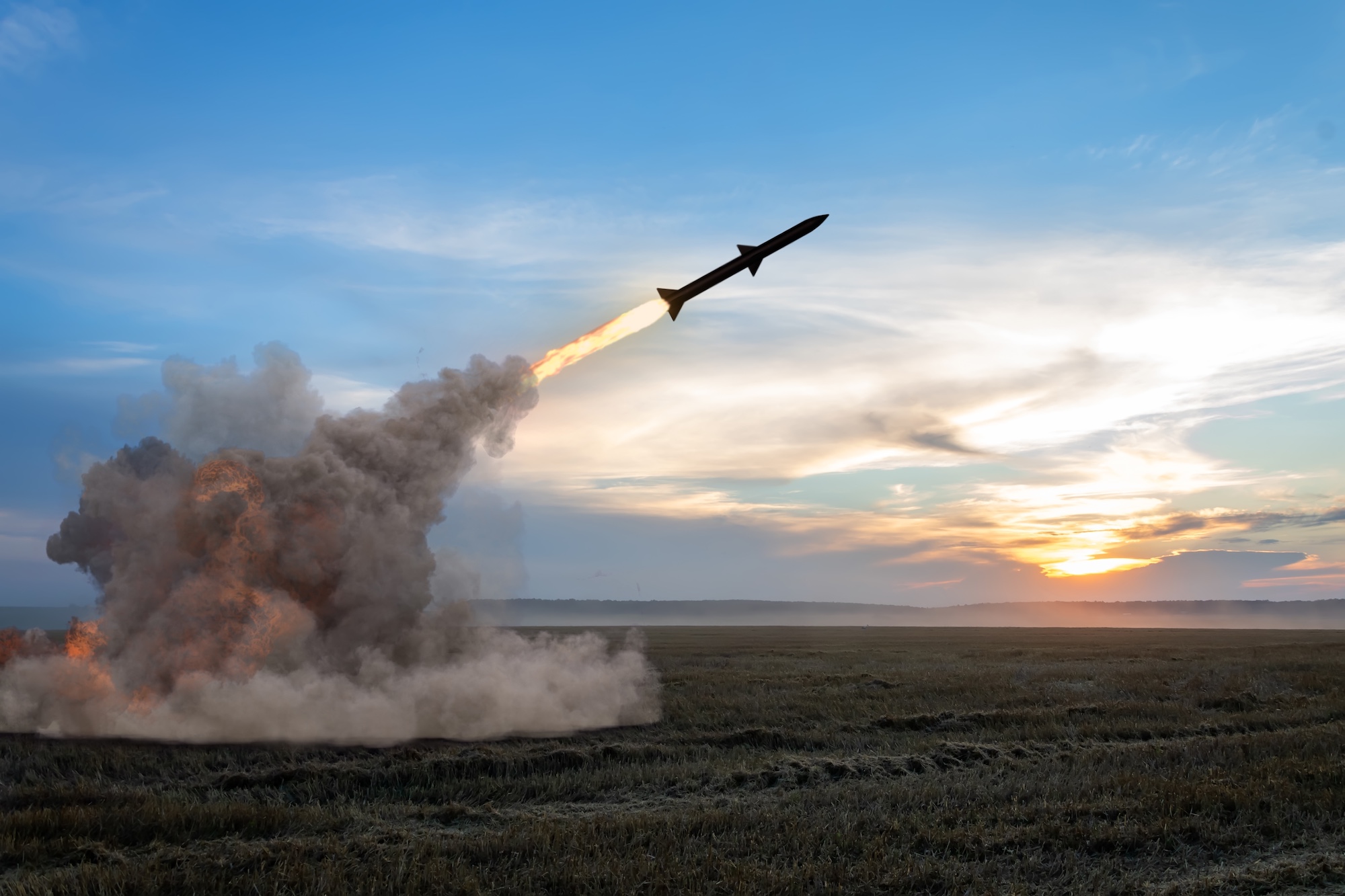 |
New data on international arms transfers—Global arms flows jump nearly 10 per cent as European demand soars
This month SIPRI released new data on international arms transfers. The volume of major arms transferred between states increased by 9.2 per cent between 2016–20 and 2021–25. States in Europe more than trebled their arms imports, making it the biggest recipient region. Total exports by the United States, the world’s largest supplier of arms, increased by 27 per cent. This included a 217 per cent increase in US arms exports to Europe.
Read more | Read the SIPRI Fact Sheet | Access the SIPRI Arms Transfers Database
|
|
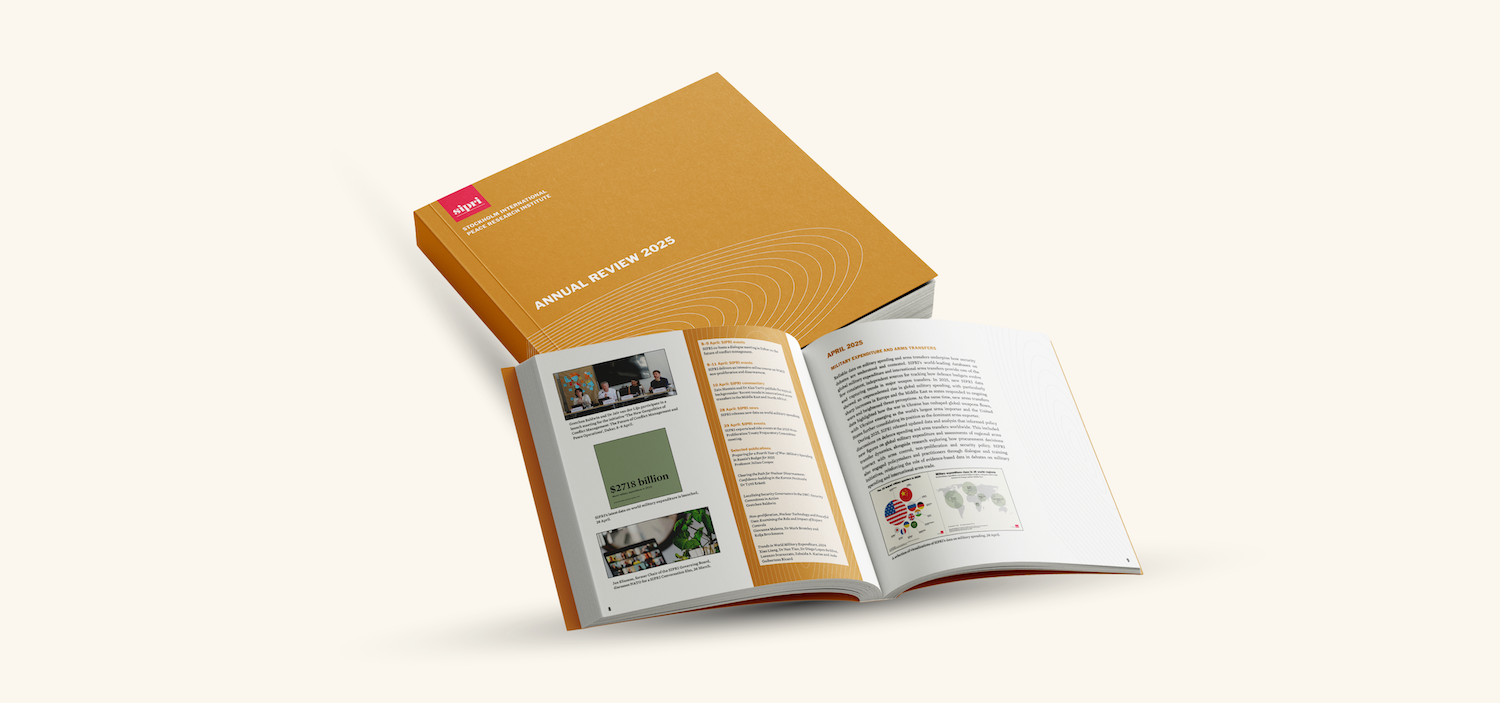 |
Annual Review 2025—out now
This month SIPRI released its Annual Review 2025. The review highlights SIPRI’s work across a range of themes and topics, including European security, developments in conflict and peace operations, global rearmament, the security implications of emerging technologies, and climate-related security risks. In a year marked by continued geopolitical tensions, rising military spending and ongoing conflicts, SIPRI continued to deliver on its mission by providing data, evidence-based policy analysis and forums for dialogue aimed at supporting international peace and security.
Read more | Download Annual Review 2025
|
|
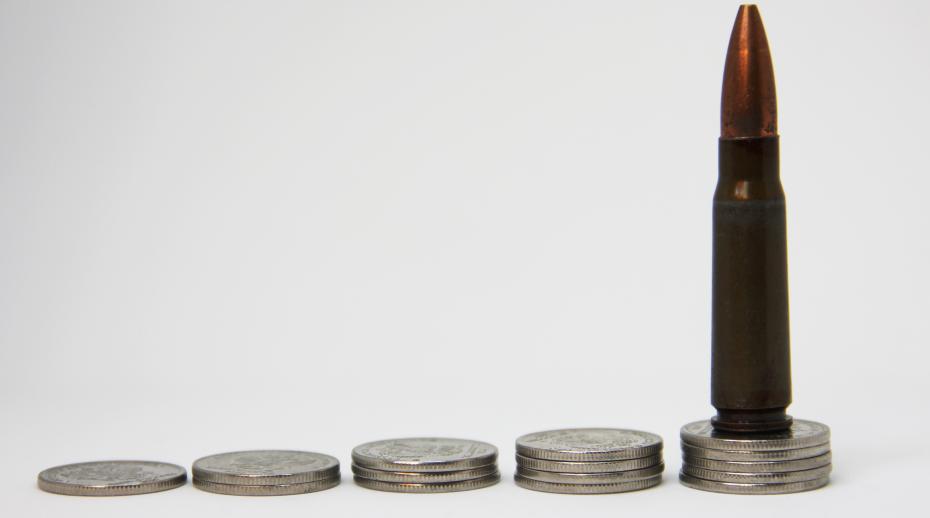 |
SIPRI publishes new insights into Russian military budget
As the Russia–Ukraine War enters its fifth year, with few signs of an ending, SIPRI published a new paper that provides unique insights into Russia’s military spending and budget. In the paper, Professor Julian Cooper looks at Russia’s federal budget funding of the war and how it has changed over time. The paper’s publication comes one month before SIPRI launches its annual update of the SIPRI Military Expenditure Database on 27 April. The database is the most comprehensive, consistent and extensive publicly available data source on military expenditure.
Read more | Download the paper | Access the SIPRI Military Expenditure Database
|
|
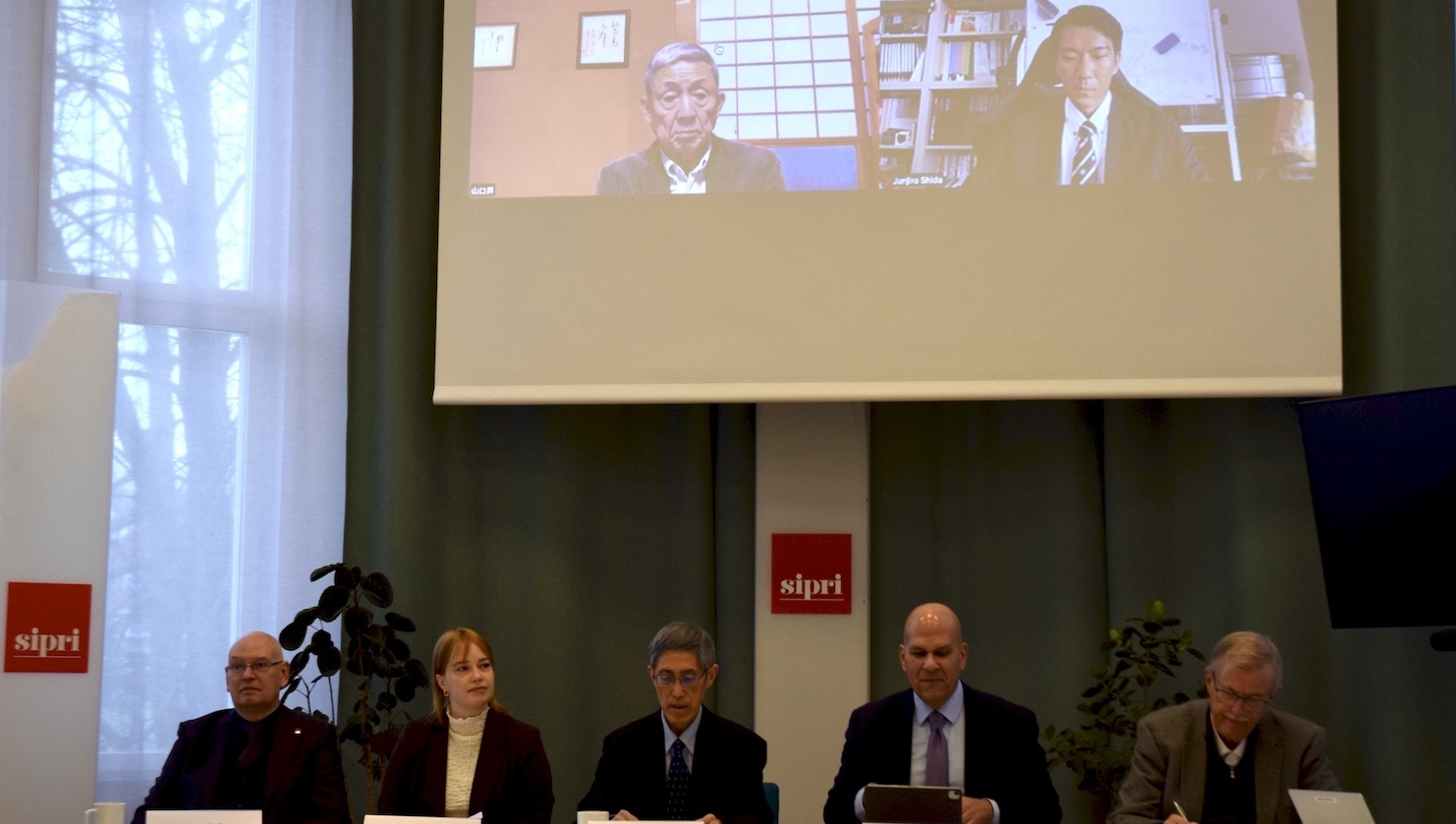 |
SIPRI hosts seminar on maritime hybrid threats in the Indo-Pacific and Nordic-Baltic regions
On 26 February, SIPRI, with support from the Ministry of Foreign Affairs of Japan, hosted a seminar on ‘Managing Maritime Hybrid Threats in the Indo-Pacific and Nordic-Baltic Regions’. In a changing geopolitical environment, middle powers, including the Nordic/Baltic states and Japan, continue to face a range of security challenges. The seminar aimed to deepen understanding of the threats in question, the shared interests and the opportunities for enhanced security cooperation between the Nordic/Baltic states and Japan.
Read more
|
|
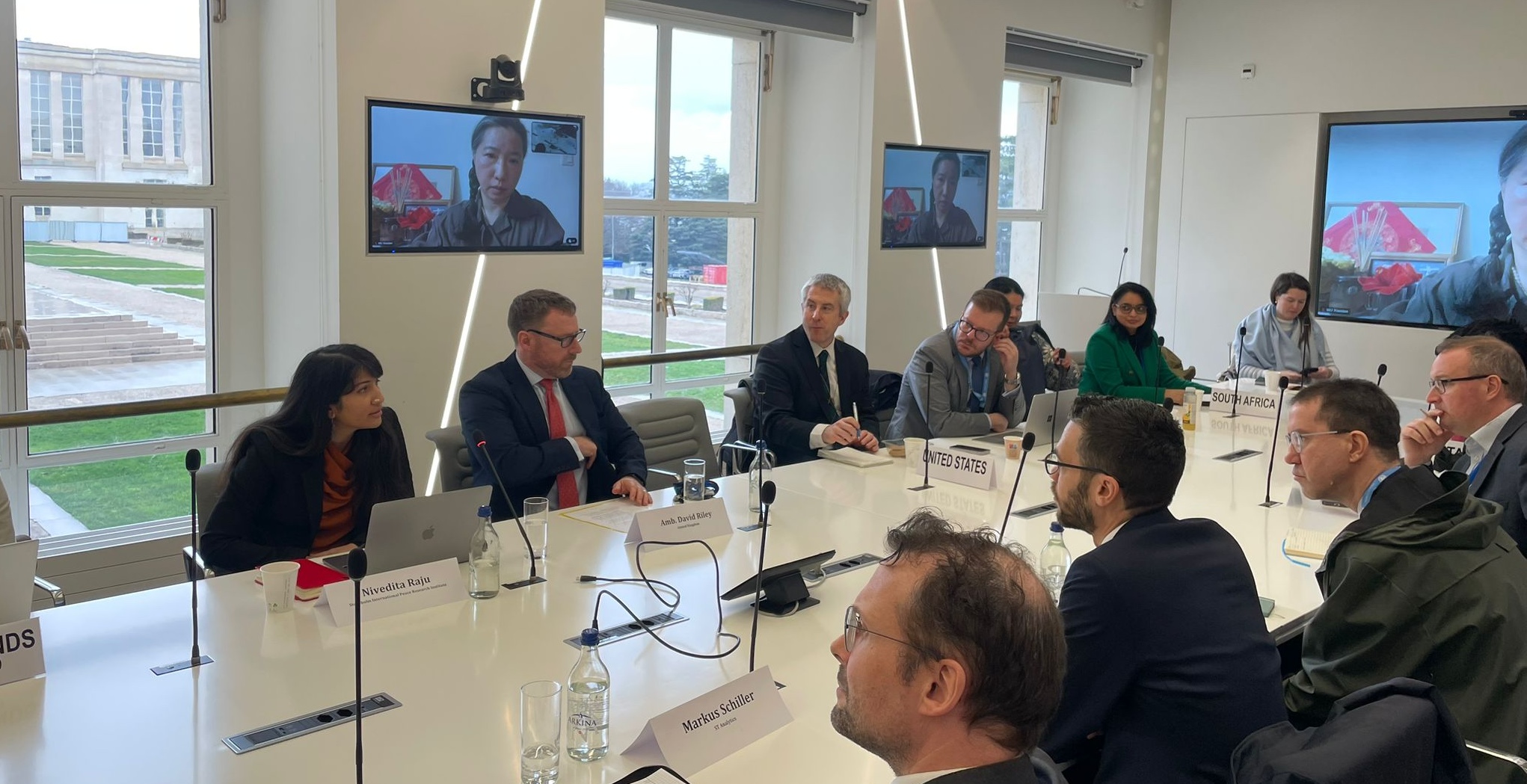 |
SIPRI hosts Geneva briefing on stability in space
On 19 February, SIPRI convened a briefing on stability in space at the United Nations Office at Geneva. SIPRI Researcher Nivedita Raju moderated the discussion, which brought together diplomats, technical experts and researchers to examine emerging challenges in the space domain. As space systems play an increasingly critical role in both civilian and military services, perceived threats to these systems can fuel escalation across domains and heighten the risk of misperception and miscalculation. The event provided a platform to identify concrete, cooperative steps to strengthen transparency, reduce risks and reinforce norms for responsible behaviour in outer space.
Read more
|
|
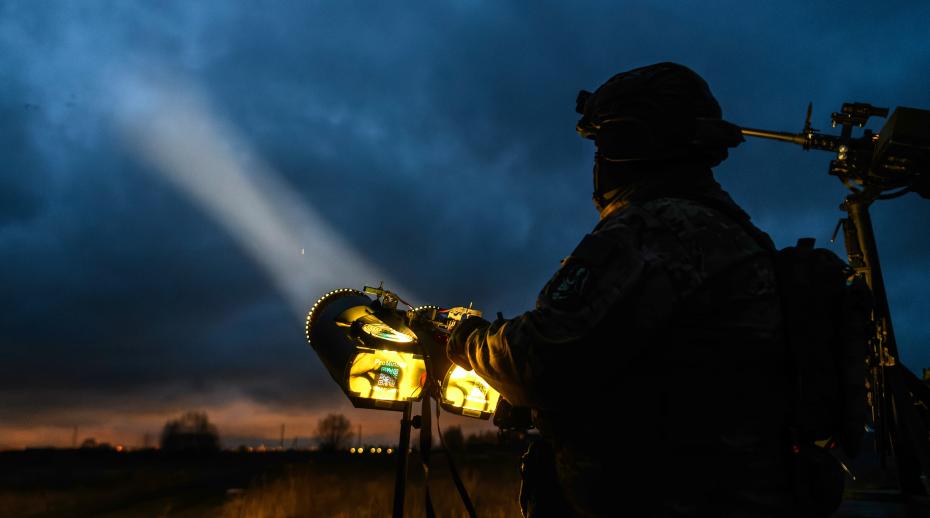 |
SIPRI to co-host military AI course
SIPRI is co-hosting ‘Military AI: International Law and Governance’, a two-day capacity-building course organized in collaboration with the Asser Institute. The course will take place on 21–22 May at the Asser Institute in The Hague, the Netherlands. It builds on the first edition of the course held in 2025 and aims to deepen understanding of the challenges and opportunities posed by military applications of artificial intelligence.
Read more
|
|
|
Upcoming events
|
SIPRI to co-host intensive course on WMD non-proliferation and disarmament in June
23–25 June 2026
SIPRI and the EU Non-Proliferation and Disarmament Consortium will host a course on weapons of mass destruction (WMD) non-proliferation and disarmament in an era of technological convergence. This intensive, in-person course will take place in Stockholm and is now open for applications.
Read more
|
|
|
Recent events
|
SIPRI and the Stimson Center host event on arms transfers in a changing global order
11 March 2026
On 11 March, SIPRI and the Stimson Center hosted a virtual discussion on the geostrategic implications of recent trends in global arms transfers. The event featured newly released SIPRI data on recent trends in international arms transfers.
Read more | Read more about SIPRI’s work on international arms transfers
|
|
SIPRI experts contribute to the Raisina Dialogue 2026
5–7 March 2026
This month, SIPRI participated in the Raisina Dialogue 2026, a major international conference on geopolitics and geoeconomics held in New Delhi, India. Karim Haggag, SIPRI Director, contributed to several discussions during the conference, including the opening panel ‘The Global Crossroads: Assertion, Accommodation, Advancement’. Dr Caroline Delgado, SIPRI Programme Director, moderated the panel discussion ‘Recipes for Resilience: Food Security and Geopolitics’.
Read more
|
|
SIPRI co-organizes workshop on the future of conflict management in South East Asia and the Pacific
5–6 March 2026
SIPRI co-organized a workshop on the future of conflict management and peace operations in South East Asia and the Pacific. The workshop was held in Bangkok, Thailand, and formed part of the New Geopolitics of Conflict Management initiative, a long-standing collaboration between SIPRI and the Friedrich-Ebert-Stiftung.
Read more
|
|
SIPRI at the CCW GGE on autonomous weapons
3 March 2026
SIPRI and the Department of National Defence of Canada held a side event at the Convention on Certain Conventional Weapons Group of Governmental Experts on lethal autonomous weapon systems in Geneva, to present findings and recommendations from SIPRI’s new report titled ‘Responsible Procurement of Military Artificial Intelligence’.
Read more | Read the report
|
|
SIPRI continues dialogue series on human security in Helsinki
3–4 March 2026
The Nordic Dialogues on Human Security series continued this month in Helsinki, discussing how human-centred approaches can support Finland’s security and foreign policy objectives in a rapidly shifting geopolitical landscape. SIPRI and the UN Trust Fund for Human Security, together with the Finnish Institute of International Affairs, convened policymakers, researchers and practitioners for a series of conversations on the future of human security. This was the second in the series of dialogues; the first took place in Stockholm in January.
Read more | Read about the first event in the series
|
|
|
|
|
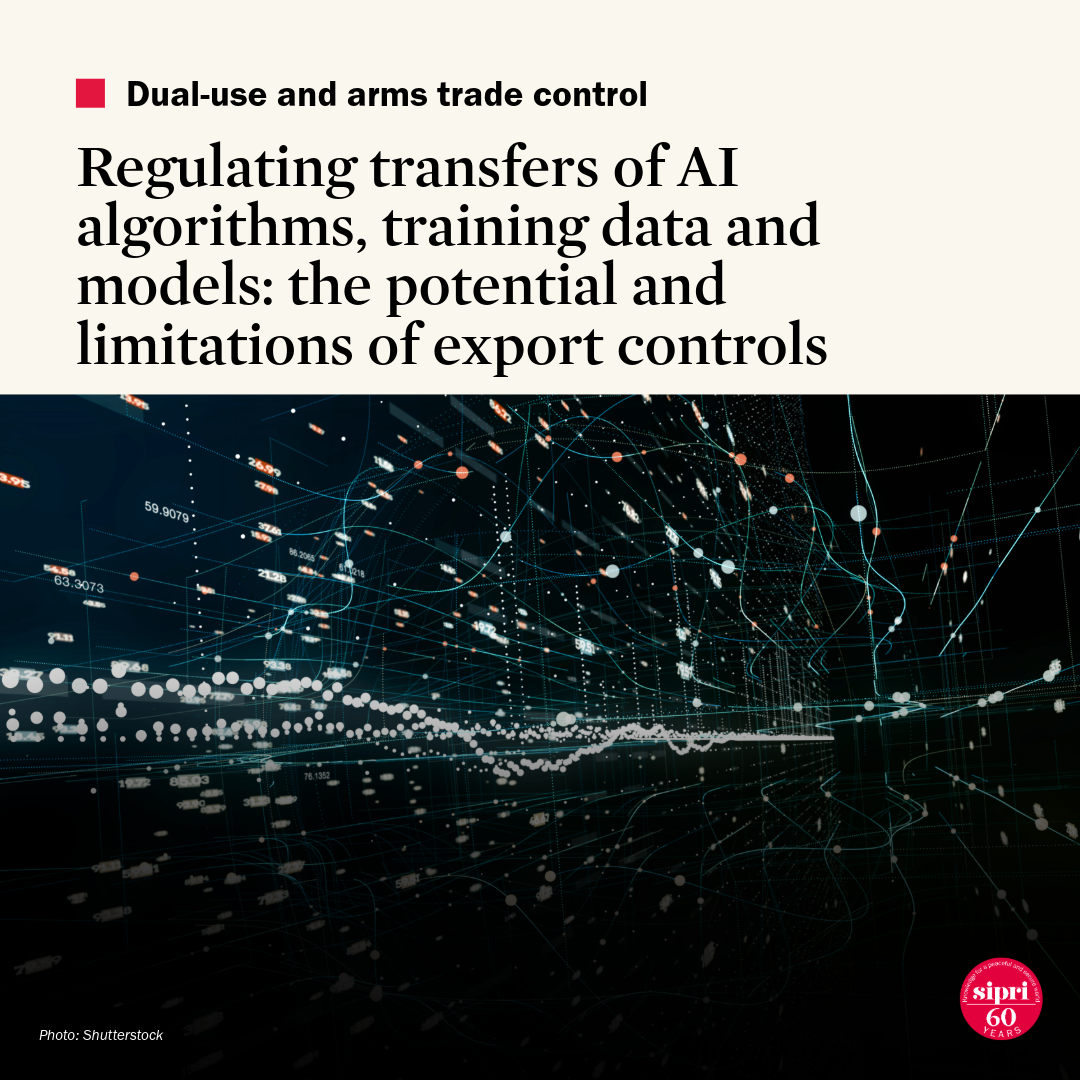 |
Regulating transfers of AI algorithms, training data and models: the potential and limitations of export controls
States and arms manufacturers are increasingly looking to ‘civilian’ software, data and technology to use in the development of military and security systems and for integration into complete systems. This topical backgrounder discusses how export controls currently apply to AI algorithms, training data and models and how exporters can approach the task of classification. It suggests some steps that could be taken at national and international levels to make export controls more effective in governing the transfer of AI algorithms, data and models.
Read the SIPRI Topical Backgrounder
|
|
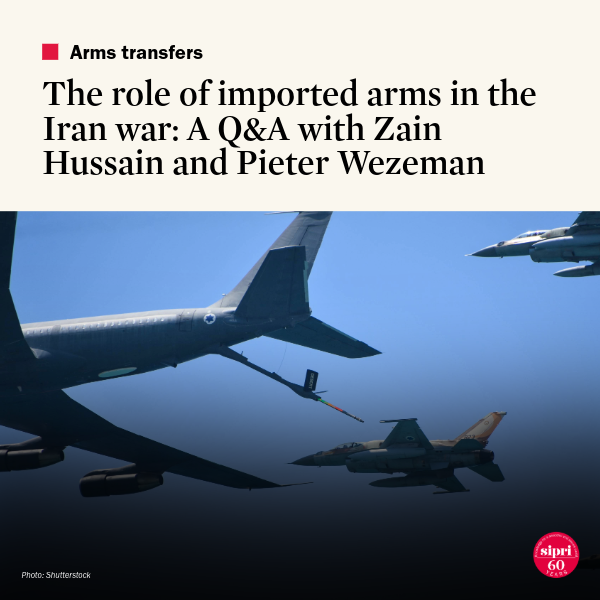 |
The role of imported arms in the Iran war: A Q&A with Zain Hussain and Pieter Wezeman
Imported arms have significantly shaped developments in the Middle East since Israel and the United States launched coordinated attacks on Iran last month. In this Q&A, Zain Hussain and Pieter Wezeman of the SIPRI Arms Transfers Programme discuss what the latest SIPRI arms transfers data can tell us about how arms imports have featured in the conflict, as well as implications for arms supplies beyond the region.
Read the SIPRI Q&A
|
|
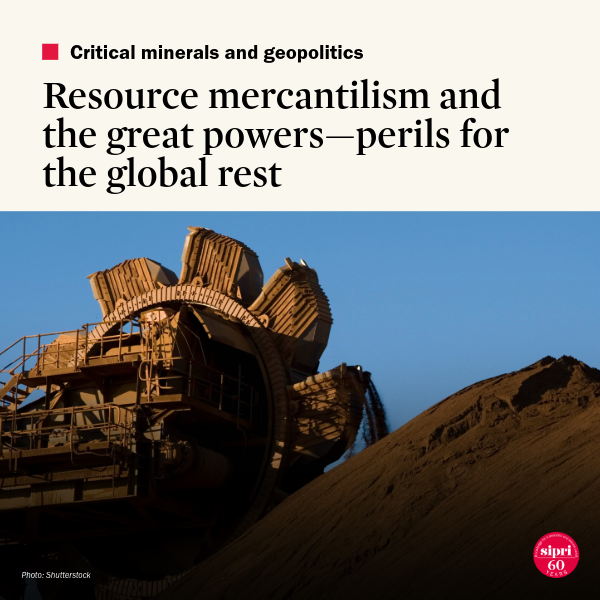 |
Resource mercantilism and the great powers—perils for the global rest
The USA, China and Russia—today’s great powers—have all developed ambitions to access, secure and even capture overseas resources and the associated markets in the name of strategic interests. They have deployed a series of instruments, but violent resource appropriation and territorial control have also become features of the wider great power resource scramble that can be characterized as new mercantilism-driven geopolitics. This essay explores the growing trend towards resource mercantilism among the great powers and lays out some of the resulting perils that face the global rest.
Read the SIPRI Essay
|
|
 |
SIPRI experts were recently featured in these external outlets:
- ‘Brobyggarna: regionala aktörer som formar Mellanösterns diplomati med Charlotta Sparre’ , with Charlotta Sparre on the Geopodden podcast (in Swedish), published on 23 March 2026.
- ‘Peace, justice, and food system transformation’, by Dr Caroline Delgado, published in The Elgar Companion to Food System Transformation for Sustainable Development by Edward Elgar Publishing Ltd in March 2026.
- ‘War with Iran: What the world debated in New Delhi’, with Karim Haggag on the Deep Dish on Global Affairs Podcast, published by the Chicago Council on Global Affairs on 12 March 2026.
- ‘Conflict, climate and crisis: Rethinking food security in a fragile world’, by Dr Caroline Delgado, published in Environmental Security: Approaches, Issues and Actors by Routledge in January 2026.
|
|
|
Publications
|
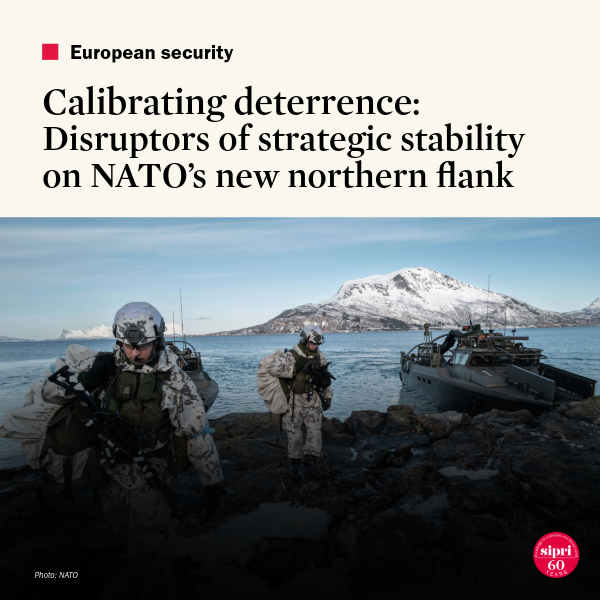 |
Calibrating Deterrence: Disruptors of Strategic Stability on NATO’s New Northern Flank
Geostrategic conditions on the North Atlantic Treaty Organization’s (NATO) northern flank have evolved considerably in recent years. Finland’s and Sweden’s accession to NATO, changes in force posture, and advances in military technology are all developments in the High North and the Arctic that could potentially impact strategic stability. This report aims to inform readers about the various factors that might affect strategic stability in the region by providing an overview of the capabilities and activities that may be considered disruptors of strategic stability. The report gives recommendations on managing disruptors in the absence of strategic dialogue.
Read the SIPRI report
|
|
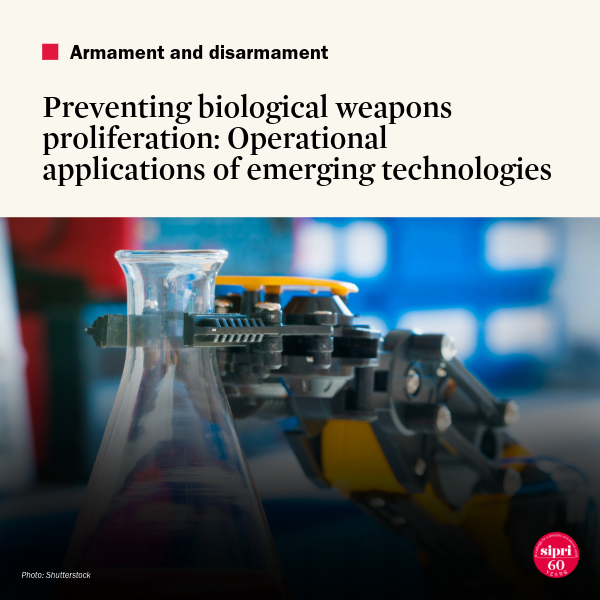 |
Preventing Biological Weapons Proliferation: Operational Applications of Emerging Technologies
Advances in artificial intelligence (AI) and distributed ledger technology (DLT) are reshaping how biological research, data and materials are managed. Emerging technologies are often discussed as potential sources of risk in the life sciences, but they may also provide tools to strengthen key functions of the biological weapons prohibition regime. This paper discusses applications of AI and DLT that could help strengthen key regime functions and presents recommendations, including steps that states and other stakeholders could take to support responsible and equitable adoption and deployment of AI- and DLT-enabled tools to strengthen the prohibition regime.
Read the SIPRI report
|
|
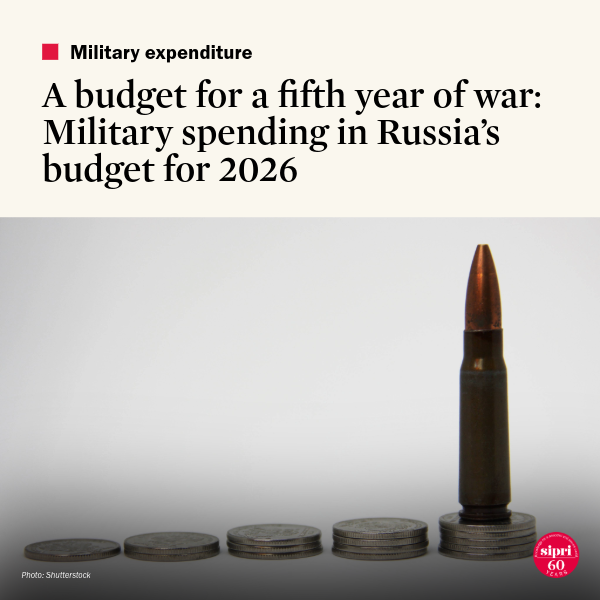 |
A Budget for a Fifth Year of War: Military Spending in Russia’s Budget for 2026
Russia’s federal budget funding of the Russia–Ukraine War and other military spending reached about 16 trillion roubles in 2025, or 7.5 per cent of GDP. This paper looks at Russia’s federal budget funding of the war and how it has changed over time. The paper concludes that the pressure on the Russian economy that was increasingly visible during 2025 is unlikely to stop the war in Ukraine. The economic effects of the Iran war, launched by Israel and the United States last month, make this even more certain, as higher oil prices should greatly ease Russia’s budget situation this year.
Read the SIPRI Insights Paper
|
|
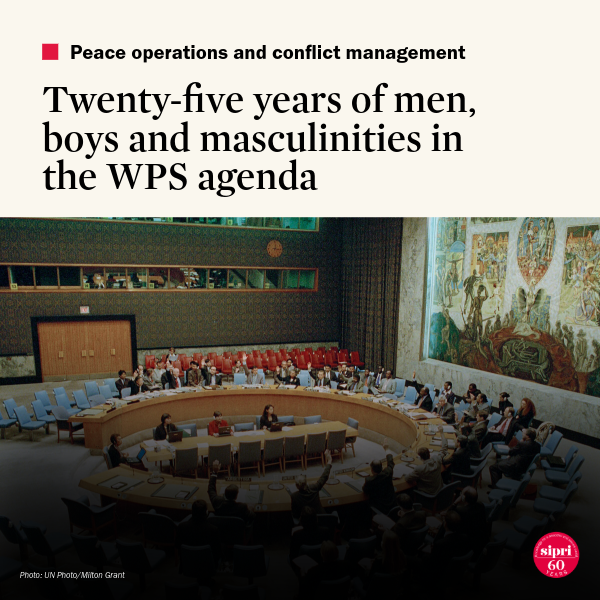 |
Twenty-five Years of Men, Boys and Masculinities in the WPS Agenda
The conflation of ‘gender’ with ‘women’ is a persistent problem in peace and security, including in the women, peace and security (WPS) agenda’s policy and implementation ecosystem. Decision makers still resist a definition of gender that includes men and boys, as well as LGBTQ+ people. Despite this, the gendered experiences of these groups and how those experiences are formed are critical to understanding social cohesion, insecurity and armed conflict and its effects more widely. This paper explores how men and boys can be considered in the WPS agenda’s implementation beyond simply ‘adding men and stirring’.
Read the SIPRI Research Policy Paper
|
|
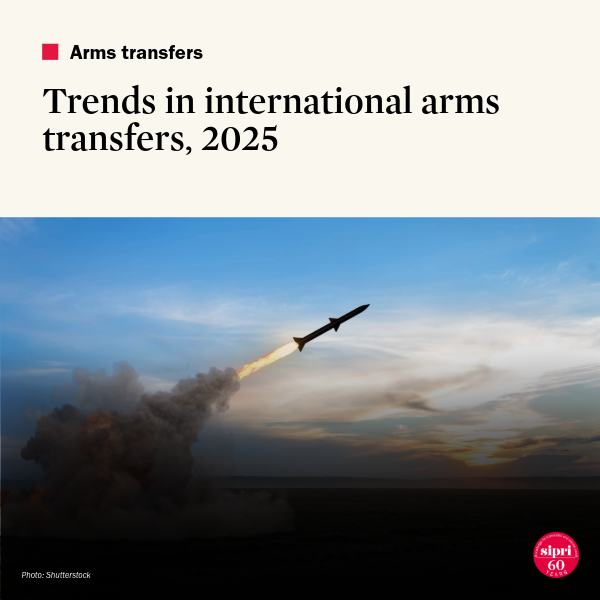 |
Trends in International Arms Transfers, 2025
From 9 March 2026 the freely available SIPRI Arms Transfers Database
includes updated data on transfers of major arms for 1950–2025. Based on this new data, this fact sheet presents key trends in arms exports and arms imports, and highlights selected issues related to transfers of major arms. The global volume of major arms transferred between states in 2021–25 was 9.2 per cent higher than in the previous five-year period (2016–20). This was the biggest increase since 2011–15.
Read the SIPRI Fact Sheet
|
|
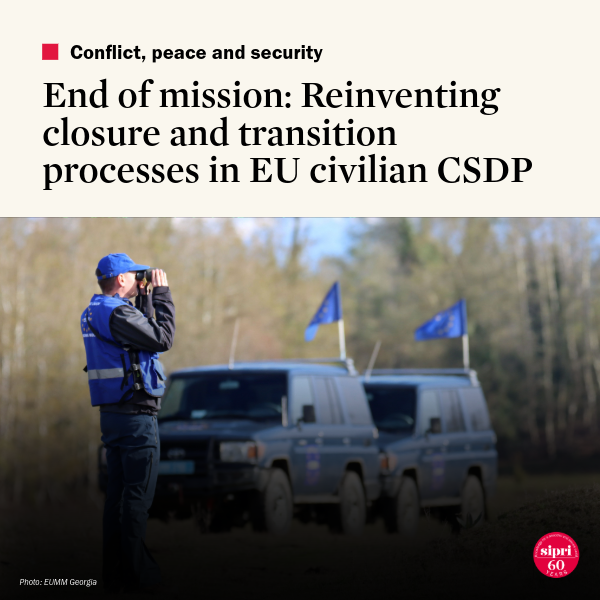 |
End of Mission: Reinventing Closure and Transition Processes in EU Civilian CSDP
European Union civilian Common Security and Defence Policy (EU CSDP) missions were designed as time-limited tools. Yet many persist for years—tying up scarce resources and limiting new deployments. This paper argues that the EU needs an updated closure and transition policy to react to new priorities in the absence of matching budget growth. Closure and transition should also be linked to evidence, partners and funding so that handovers are orderly and sustainable. Staying too long can undermine both the mission’s and the EU’s credibility.
Read the SIPRI Research Policy Paper
|
|
|
|
|
Vacancies
|
- WMD Non-Proliferation & Disarmament in an Era of Technological Convergence (10 April 2026)
- Internship with the Food, Peace and Security Programme (31 March 2026)
Read more
|
|
|
|
|
|
Accurate, dependable information is more important than ever. Invest in the facts.
Support SIPRI
|
|
 |
| SIPRI is an independent international institute dedicated to research into conflict, armaments, arms control and disarmament. Established in 1966, SIPRI provides data, analysis and recommendations, based on open sources, to policymakers, researchers, media and the interested public. |
|
|