The independent resource on global security

7. International arms transfers
Contents
I. Introduction
II. Global trends in arms transfers, 2021–25
III. Developments among the suppliers of major arms, 2021–25
IV. Developments among the recipients of major arms, 2021–25
V. Conclusions
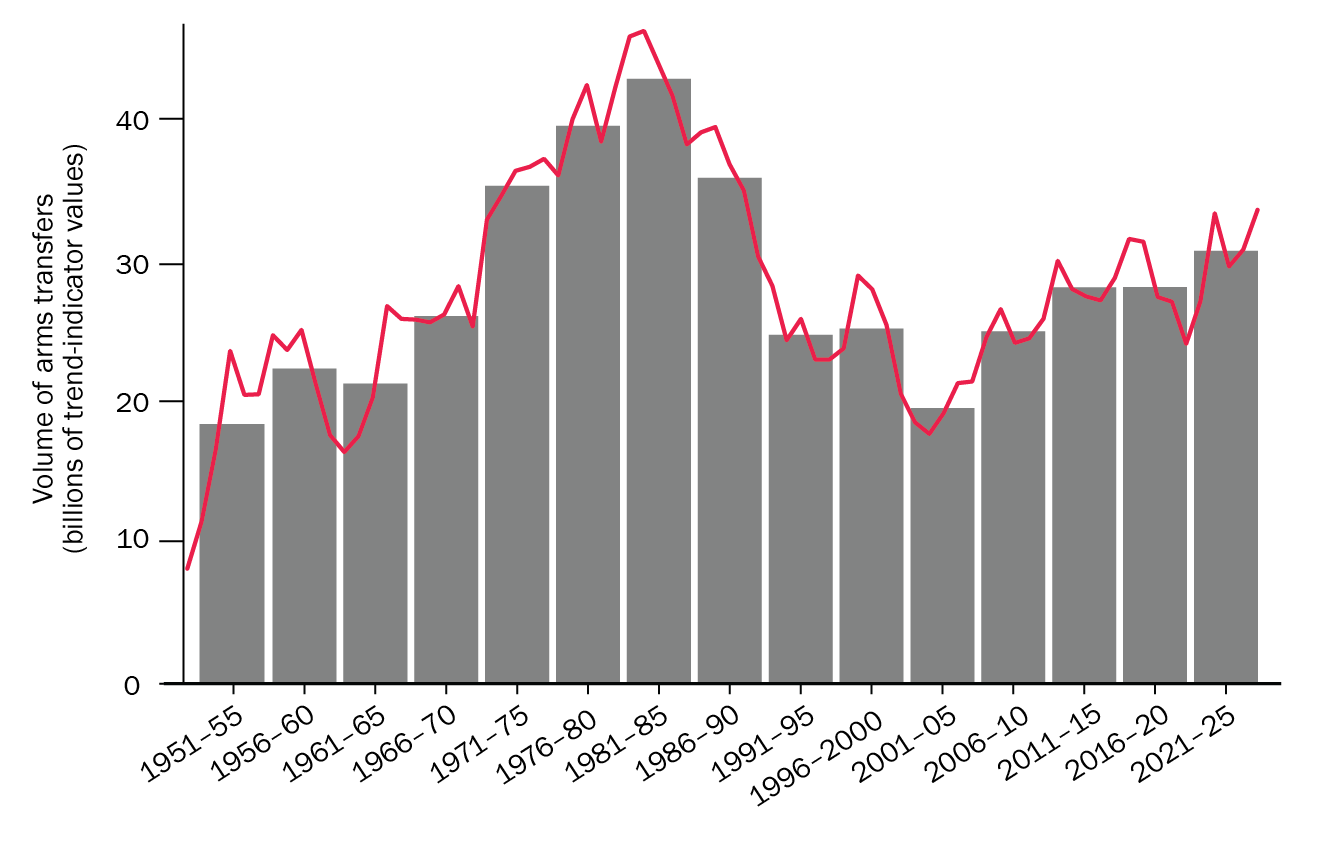
The volume of international transfers of major arms in the five-year period 2021–25 was the highest since the end of the cold war, having risen by 9.2 per cent compared with 2016–20. There are strong indications that demand for major arms is growing, which will probably lead to further increases in global arms flows in the coming years.
The trend in transfers of major arms, 1950–2025
Conflicts, tensions and arms transfers
Armed conflicts and geopolitical tensions are the main drivers of arms procurement for many states. Most of the world’s largest recipients of major arms in 2021–25 used imported arms in military combat operations in that period. Arms-exporting states are often directly or indirectly affected by the conflicts or tensions driving demand in importing states, which partly explains why they are willing to supply arms, even when this seems to contradict their stated arms export policies.
During 2021–25 Israel was involved in a multifront war stemming from its large-scale military offensive in Gaza that began in October 2023. Israel continued to receive major arms from supplier states throughout the period despite growing concerns in some states about the high civilian death toll in Gaza and Israeli violations of international law. The United States was the largest supplier to Israel in 2021–25 (accounting for 68 per cent of Israeli arms imports), followed by Germany (31 per cent).
Suppliers of major arms
SIPRI has identified 66 states as suppliers of major arms in 2021–25, but most were minor exporters. The 25 largest suppliers accounted for 98 per cent of the total volume of exports, and the top 5—the USA, France, Russia, Germany and China—accounted for 70 per cent.
The USA’s arms exports grew by 27 per cent between 2016–20 and 2021–25, increasing its share of global arms exports from 36 per cent to 42 per cent. Known plans for future deliveries strongly indicate that the USA will remain by far the world’s largest arms exporter—a position leading to anxieties of dependence for some of its main clients and allies. In contrast, Russia’s arms exports more than halved between 2016–20 and 2021–25 (–64 per cent), giving it a global share of 6.8 per cent—a level far below any previous five-year period in its history or in any previous five-year period since 1950 for its predecessor, the Soviet Union.
Taken together, the arms exports of the 27 current European Union member states went up by 36 per cent between 2016–20 and 2021–25. They accounted for 28 per cent of total global arms exports in 2021–25, which was two thirds the volume of US arms exports in the same period, but four times higher than Russia’s export volume and five times higher than China’s. Arms exports by France rose by 21 per cent between 2016–20 and 2021–25 and accounted for 9.8 per cent of the global total, while arms exports by Germany increased by 15 per cent, giving it a 5.7 per cent share.
Recipients of major arms
SIPRI has identified 162 states as recipients of major arms in 2021–25. The five largest recipients were Ukraine, India, Saudi Arabia, Qatar and Pakistan, which together accounted for 35 per cent of total arms imports in the period. Ukraine’s arms imports were around 100 times higher in 2021–25 than in 2016–20 and it became the world’s largest arms recipient with at least 36 states delivering major arms, mostly as aid. Arms imports by China fell by 72 per cent between 2016–20 and 2021–25 as it continued to expand its domestic design and production capabilities for major arms.
Arms imports by states in Europe more than trebled between 2016–20 and 2021–25 (+210 per cent), reaching a level far higher than at any time since the end of the cold war and making Europe the largest importing region for the first time since the 1960s. Arms imports by states in the Americas also increased (+12 per cent), while imports by states in Africa (–41 per cent), Asia and Oceania (–20 per cent) and the Middle East (–13 per cent) decreased.
English