News
|
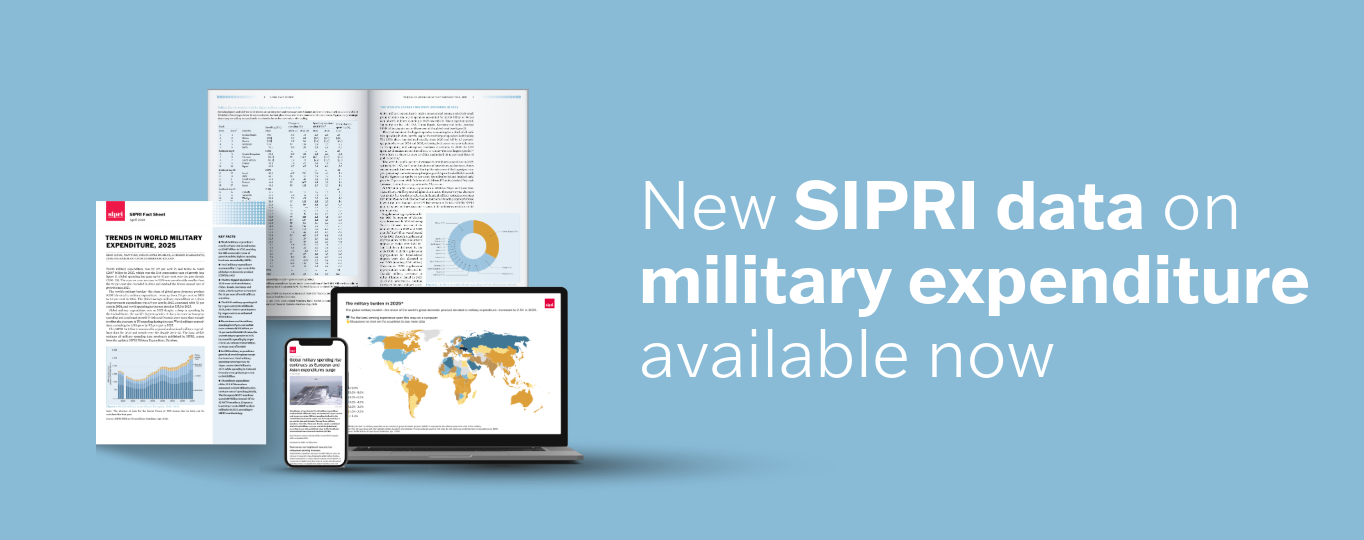 |
Global military spending rise continues as European and Asian expenditures surge
On 27 April, SIPRI released new data on world military expenditure and published a fact sheet that examines the data for 2025 and trends over the decade 2016–25. Global military expenditure increased to $2887 billion in 2025, the 11th year of consecutive rises, bringing the global military burden—military expenditure as a share of gross domestic product (GDP)—to 2.5%, its highest level since 2009.
Read more | Read the SIPRI Fact Sheet | Explore the map of military expenditure | Access the SIPRI Military Expenditure Database
|
|
 |
SIPRI webinar on pathways for dialogue and regional stability on the Korean Peninsula
SIPRI hosted a webinar in April that examined the prospects for renewed diplomatic engagement on the Korean Peninsula. In a discussion moderated by SIPRI Senior Researcher Fei Su, panellists revisited the idea of a North East Asia regional security dialogue as an alternative platform for risk reduction and broader regional stability. A recording of the webinar is available to watch.
Read more | Watch the recording | Read the related backgrounder
|
|
 |
New SIPRI Conversations videos
During the month, SIPRI released two interviews as part of its Conversations video series. In the first video, Dr Jiayi Zhou, SIPRI Senior Researcher, discusses the nature of maritime hybrid threats and why they are becoming more frequent, complex and difficult to respond to. In the second video, Dr Miranda Smith, SIPRI Researcher, discusses how technologies such as artificial intelligence (AI) and distributed ledger technology could be used to strengthen oversight and help prevent the development and proliferation of biological weapons.
Watch the video on maritime hybrid threats | Watch the video on biological weapons proliferation | Read more about biological weapons proliferation
|
|
|
Upcoming events
|
SIPRI to host panel at 2026 German Forum on Security Policy
7 May 2026
On 7 May, SIPRI will host a panel discussion at the 2026 German Forum on Security Policy, held in Berlin at the Federal Academy for Security Policy. Under the title ‘Military Assistance as an Instrument of Security Policy: Europe in Strategic Comparison to its Competition and the USA’, the panel will explore the growing importance of security partnerships for European security.
Read more | Register
|
|
SIPRI to co-host intensive course on WMD non-proliferation and disarmament in June
23–25 June 2026
SIPRI and the EU Non-Proliferation and Disarmament Consortium are pleased to announce that they will host a course on weapons of mass destruction (WMD) non-proliferation and disarmament in an era of technological convergence. This intensive, in-person course will take place in Stockholm on 23–25 June 2026.
Read more
|
|
|
Recent events
|
SIPRI at the Paris Defence and Strategy Forum
25 March 2026
SIPRI convened a roundtable discussion at the Paris Defence and Strategy Forum to examine the role of development cooperation in national security strategies. The discussion focused on the security implications of recent aid cuts and their impact on long-term stabilization efforts, with reflections drawn from developments in Chad, Mauritania and Somalia.
Read more
|
|
SIPRI co-organizes Sahel Symposium
24–25 March 2026
SIPRI and Uppsala University’s Forum for Africa Studies co-organized the fourth Sahel Symposium on ‘Academic Collaborations and Civic Liberties in the Sahel’. The 2026 edition focused on rethinking and reinvigorating academic collaboration and spaces in the Sahel. The event also hosted the launch of the AEGIS Collaborative Research Group ‘Le monde du Sahel: Promoting Academic Collaborations and Spaces’.
Read more
|
|
SIPRI expert informs Arms Trade Treaty working group
19 March 2026
SIPRI Researcher Lauriane Héau delivered a presentation at the Arms Trade Treaty working group meetings held in Geneva, in preparation for the 12th Conference of States Parties. With a focus on transparency and reporting, Héau highlighted key challenges that states parties encounter when identifying the most appropriate sources and methods for data collection for reporting purposes.
Read more
|
|
SIPRI concludes dialogue series on human security in Oslo
16–17 March 2026
SIPRI, the United Nations Trust Fund for Human Security and the Norwegian Institute of International Affairs hosted the third of three in-person dialogues in the Nordic Dialogues on Human Security series, this time in Oslo. With earlier events in Stockholm and Helsinki, the Nordic Dialogue series has sought to bring attention to how human-centred approaches can complement and strengthen traditional security frameworks.
Read more
|
|
SIPRI co-organizes workshop on conflict management in South East Asia and the Pacific
5–6 March 2026
SIPRI co-organized a workshop on the future of conflict management and peace operations in South East Asia and the Pacific. The workshop was held in Bangkok, Thailand, and formed part of the New Geopolitics of Conflict Management initiative, a long-standing collaboration between SIPRI and the Friedrich-Ebert-Stiftung. Participants examined how conflict management in South East Asia and the Pacific may evolve by 2035.
Read more
|
|
|
|
|
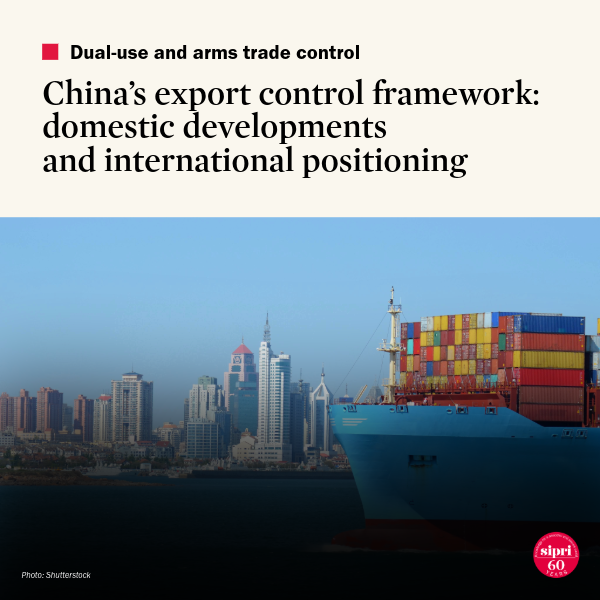 |
China’s export control framework: domestic developments and international positioning
In the UN General Assembly and other forums, China has frequently argued that export control measures infringe on the right of states to benefit from international cooperation in science and technology. In particular, it has called out the ‘abuse’ of export controls by some governments to achieve strategic or economic ends that have little to do with non-proliferation. At the same time, China has strengthened its own export control regime and used it in ways that are retaliatory and coercive, to pursue unambiguously geopolitical objectives. This backgrounder examines China’s recent rhetoric and action and explores the rationale behind them.
Read the SIPRI Topical Backgrounder
|
|
 |
Mapping the military AI industry
The involvement of industry is a key aspiration of arms control initiatives on the responsible application of AI in the military domain. But little attention is given to who should represent ‘industry’ in these processes—which companies or segments of the private-sector AI supply chain are relevant for the policy context. This backgrounder aims to provide an overview of the military AI industry to help policymakers, as well as civil society and academic researchers, to understand the wide variety of products, actors and relationships involved.
Read the SIPRI Topical Backgrounder
|
|
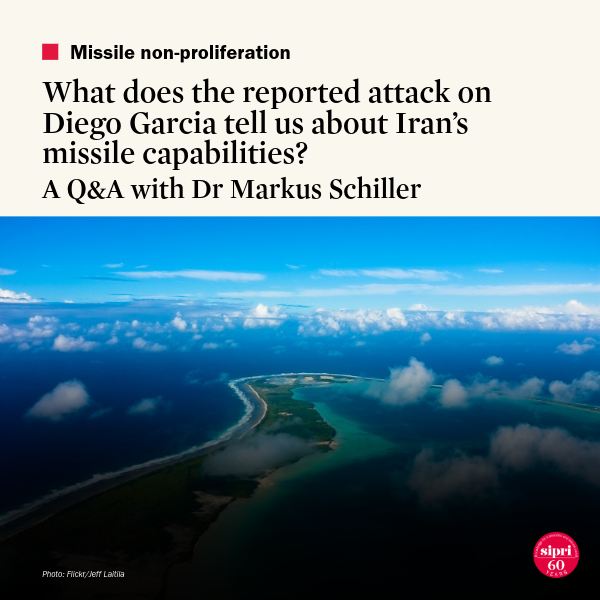 |
What does the reported attack on Diego Garcia tell us about Iran’s missile capabilities? A Q&A with Dr Markus Schiller
On 20 March the Wall Street Journal reported that Iran had launched two ballistic missiles towards the shared United Kingdom–United States military airbase on the Indian Ocean island of Diego Garcia. If the reports are accurate, this would mean that Iran has demonstrated the capability to launch missiles with a range of nearly 4000 kilometres from its borders. In this Q&A, SIPRI Associate Senior Researcher Dr Markus Schiller explains what we can glean from the limited information available about the missile technologies that might have been involved and about Iran’s long-range strike capabilities.
Read the SIPRI Q&A
|
|
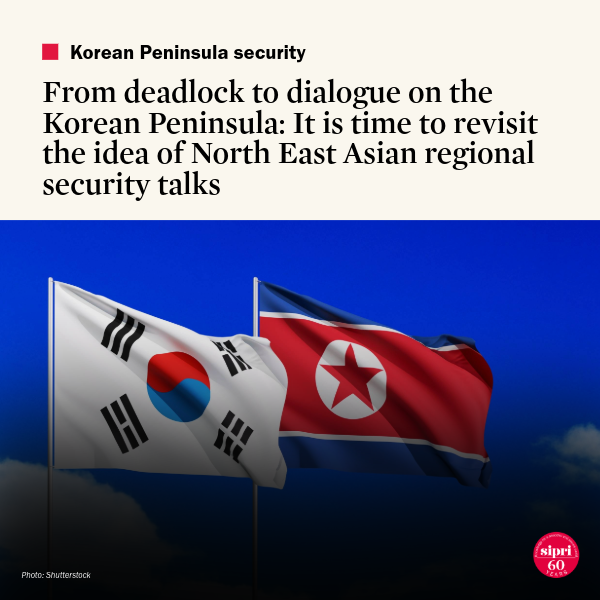 |
From deadlock to dialogue on the Korean Peninsula: It is time to revisit the idea of North East Asian regional security talks
Persistent tensions on the Korean Peninsula, the presence of large-scale military forces and nuclear weapons, and doubts about US commitments to its allies have created a volatile situation that risks spiralling out of control. There is an urgent need for preventive measures. This topical backgrounder argues that broader multilateral dialogue on regional stability in North East Asia could offer an alternative—and potentially more sustainable—framework for advancing inter-Korean reconciliation and risk reduction, notably by helping to decouple these much-needed efforts from the divisive issue of denuclearization.
Read the SIPRI Topical Backgrounder
|
|
 |
SIPRI experts were recently featured in these external outlets:
- ‘How to prevent weapons of mass destruction in a changing geopolitical and military landscape’, with Dr Wilfred Wan, on the Global Dispatches podcast, published on 30 March 2026.
- ‘The misguided quest for nuclear weapons in Nordic countries’, by Dr Tytti Erästö, Vladislav Chernavskikh and Dr Vitaly Fedchenko, published by the Bulletin of the Atomic Scientists on 27 March 2026.
- ‘Australia’s new military AI policy comes at a crucial time. The challenge is turning it into practice’, by Zena Assaad and Netta Goussac, published by The Conversation on 25 March 2026.
- ‘Smart green money must move to conflict zones’, by Dr Florian Krampe and Katongo Seyuba, published by fDi Intelligence on 30 March 2026.
|
|
|
Publications
|
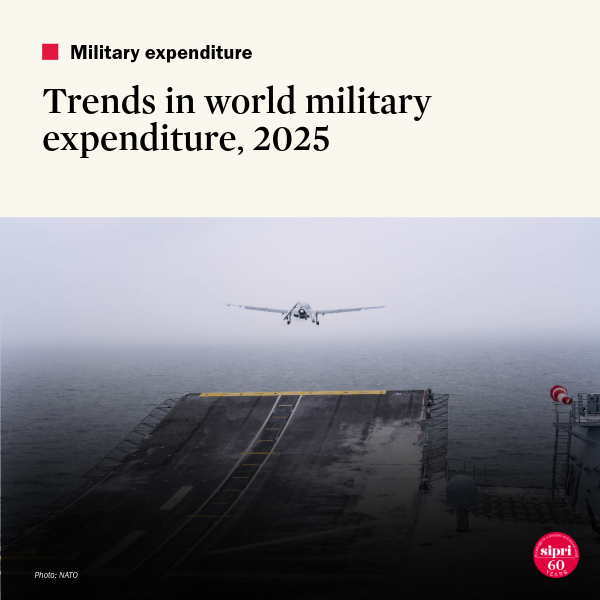 |
Trends in World Military Expenditure, 2025
Global military expenditure rose in 2025 despite a drop in spending by the USA, the world’s biggest spender. A sharp increase in European spending and continued growth in Asia and Oceania were more than enough to offset the decrease in US spending during the year. World military expenditure rose by 2.9 per cent in real terms to reach $2887 billion in 2025, which was the 11th consecutive year of growth. This SIPRI Fact Sheet examines the regional and national military expenditure data for 2025 and trends over the decade 2016–25. The data, which replaces all military spending data previously published by SIPRI, comes from the updated SIPRI Military Expenditure Database.
Read the SIPRI Fact Sheet
|
|
 |
Good Practice Guide on Applying Export Controls to Transfers of Commercial Cyber Intrusion Capabilities
States supporting the Pall Mall Process (PMP) Code of Practice for States have committed to using export controls to help ensure accountability across the market for commercial cyber intrusion capabilities (CCICs) and to mitigate risks of potential irresponsible use of CCICs. However, the potential application of export controls to the transfer of CCICs is limited by complexities and a lack of guidance. This SIPRI Good Practice Guide aims to strengthen efforts by PMP Code of Practice supporters by clarifying how export controls can be applied to CCICs and informing multilateral discussions on using export controls to tackle their proliferation and misuse.
Read the SIPRI Good Practice Guide
|
|
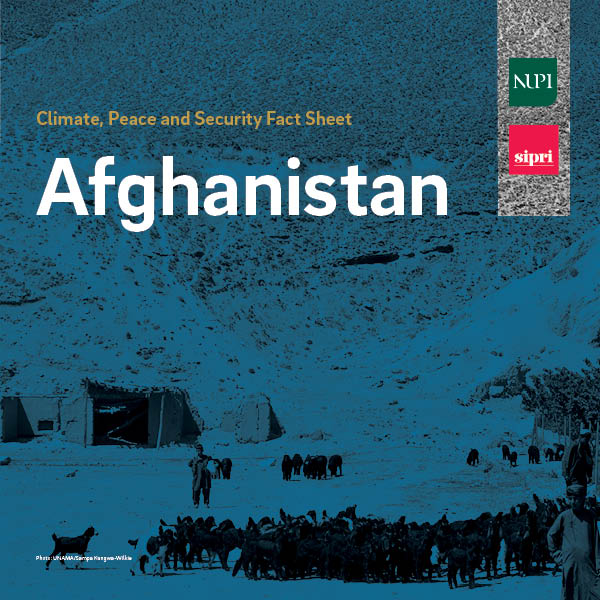 |
Climate, Peace and Security Fact Sheet: Afghanistan (2026)
This fact sheet focuses on Afghanistan, which faces severe climate vulnerability while being more exposed to extreme weather events and natural hazards (including droughts and floods) than the global average. This has been compounded by environmental degradation caused by prolonged conflict, poor natural resource management and limited resilient infrastructure. Together with complex humanitarian and economic crises and mass returns of Afghans from Iran and Pakistan, all these factors deepen the population’s vulnerability to overlapping crises. The fact sheet offers a range of recommended actions for the international community to address these issues effectively.
Read the fact sheet
|
|
|
Vacancies
|
- Research Assistant, Weapons of Mass Destruction Programme (22 May 2026)
Read more
- Expression of interest: Virtual Community of Practice on Human-centred Approaches to Security
Read more
|
|
|