The independent resource on global security

Women in Multilateral Peace Operations in 2025: What is the State of Play?

October 2025
Stockholm
SIPRI
summary
This year marks 25 years since UN Security Council Resolution 1325 on women, peace and security stressed the link between gender equality and international peace and security. The resolution underscored the importance of women’s full, equal and meaningful participation in all efforts to maintain and promote peace and security, including UN peace operations. In the years since, multilateral organizations and member states involved in multilateral peace operations affirmed their commitment to increase women’s participation in these activities. The UN Secretariat has made this a standing priority, while the Organization for Security and Co-operation in Europe (OSCE) Secretariat and, more recently, the European External Action Service of the European Union (EU) have developed strategies that set specific targets and timelines for women’s participation in their respective personnel. In 2025, 25 years after the adoption of the resolution, some progress has been achieved in enhancing women’s representation in multilateral peace operations, but much remains to be done.
This overview of women’s representation in multilateral peace operations presents data on aggregate personnel trends, annual snapshots of data on women’s representation in leadership, and annual averages of women in the personnel of peace operations and in member state contributions. It looks at UN peace operations, EU Common Security and Defence Policy missions and operations, and OSCE field operations. The objective is to support the efforts of multilateral organizations and their member states to increase the representation of women in multilateral peace operations.
The statistics presented here aim to inform and foster the debate on the future of the women, peace and security agenda within the context of multilateral peace operations. They illustrate to what extent the organizations deploying multilateral peace operations and their member states are making progress towards increasing women’s representation in multilateral peace operations. Having a clearer picture of the status of women’s participation in multilateral peace operations and keeping track of progress also help in recognizing and targeting potential shortcomings. Moreover, this overview enhances the transparency of multilateral peace operations and provides insights into their recent trends and developments.
Introduction
This year marks 25 years since the United Nations Security Council Resolution 1325 on women, peace and security (WPS) stressed the link between gender equality and international peace and security. The resolution underscored the importance of the full and equal participation of women in all efforts towards the maintenance and promotion of peace and security, including UN peace operations. Following the resolution, organizations and member states involved in multilateral peace operations affirmed their commitment to increase women’s participation in these activities. Increasing the number of uniformed and civilian women at all levels has since become a priority of the UN Secretariat. The Organization for Security and Co-operation in Europe (OSCE) Secretariat and, more recently, the European External Action Service (EEAS) of the European Union (EU) have followed suit and developed strategies establishing specific targets and deadlines to enhance women’s participation in their respective personnel. In 2025, 25 years after the adoption of the resolution, some progress has been achieved in enhancing women’s representation in multilateral peace operations, but much remains to be done.
This overview of women’s representation in multilateral peace operations presents data on aggregate personnel trends, annual snapshots of data on women’s representation in leadership, and annual averages of women in the personnel of peace operations and in member state contributions. It looks at UN peace operations (i.e. both UN peacekeeping operations and UN special political missions), EU Common Security and Defence Policy (CSDP) missions and operations, and OSCE field operations. The objective is to support the efforts of multilateral organizations and their member states to increase the representation of women in multilateral peace operations.
The statistics presented here aim to inform and foster the debate on the future of the women and peace and security agenda within the context of multilateral peace operations. They illustrate to what extent the organizations deploying multilateral peace operations and their member states are making progress towards increasing women’s representation in multilateral peace operations. Having a clearer picture of the status of women’s participation in multilateral peace operations and keeping track of progress also help in recognizing and targeting potential shortcomings. Moreover, this overview enhances the transparency of multilateral peace operations and provides insights into their recent trends and developments.
Women in the UN military
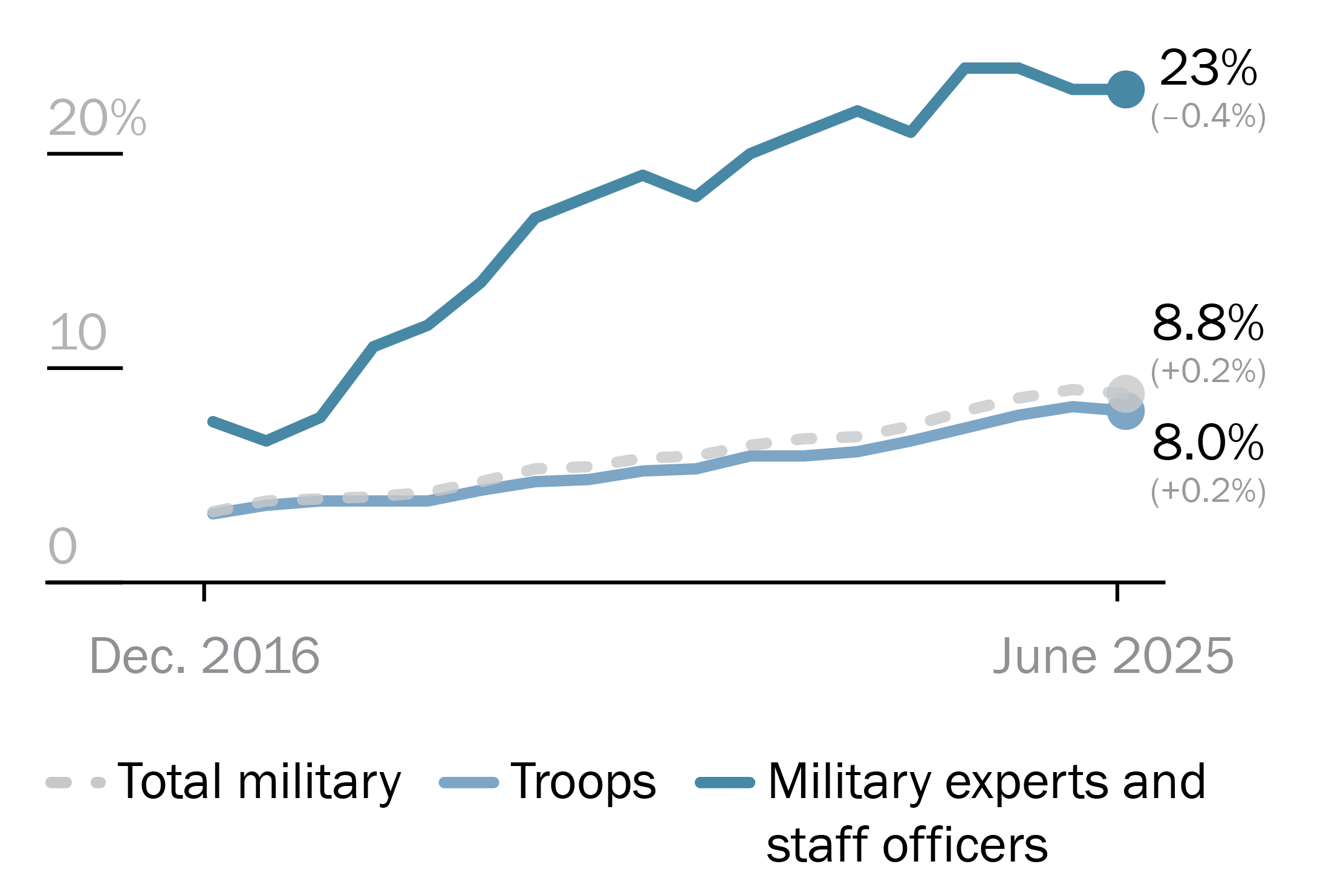
The UN’s 2018 Uniformed Gender Parity Strategy established the goal of reaching 25 per cent women among military experts and staff officers and 15 per cent among troops in UN peace operations by 2028. Under the Action for Peacekeeping (A4P) Declaration of Shared Commitments, the UN advocated for increasing the number of women in peacekeeping across all levels and key positions. Subsequently, Action for Peacekeeping Plus (A4P+) emphasized the need to enhance the meaningful participation of women in these roles. The proportion of women among military experts and staff officers is nearing the strategy’s target and has surpassed the intermediary 2025 target of 22 per cent. At 8 per cent, however, the proportion of women among troops remains significantly below both the 2025 intermediary target (12 per cent) and the 2028 goal.
Leadership
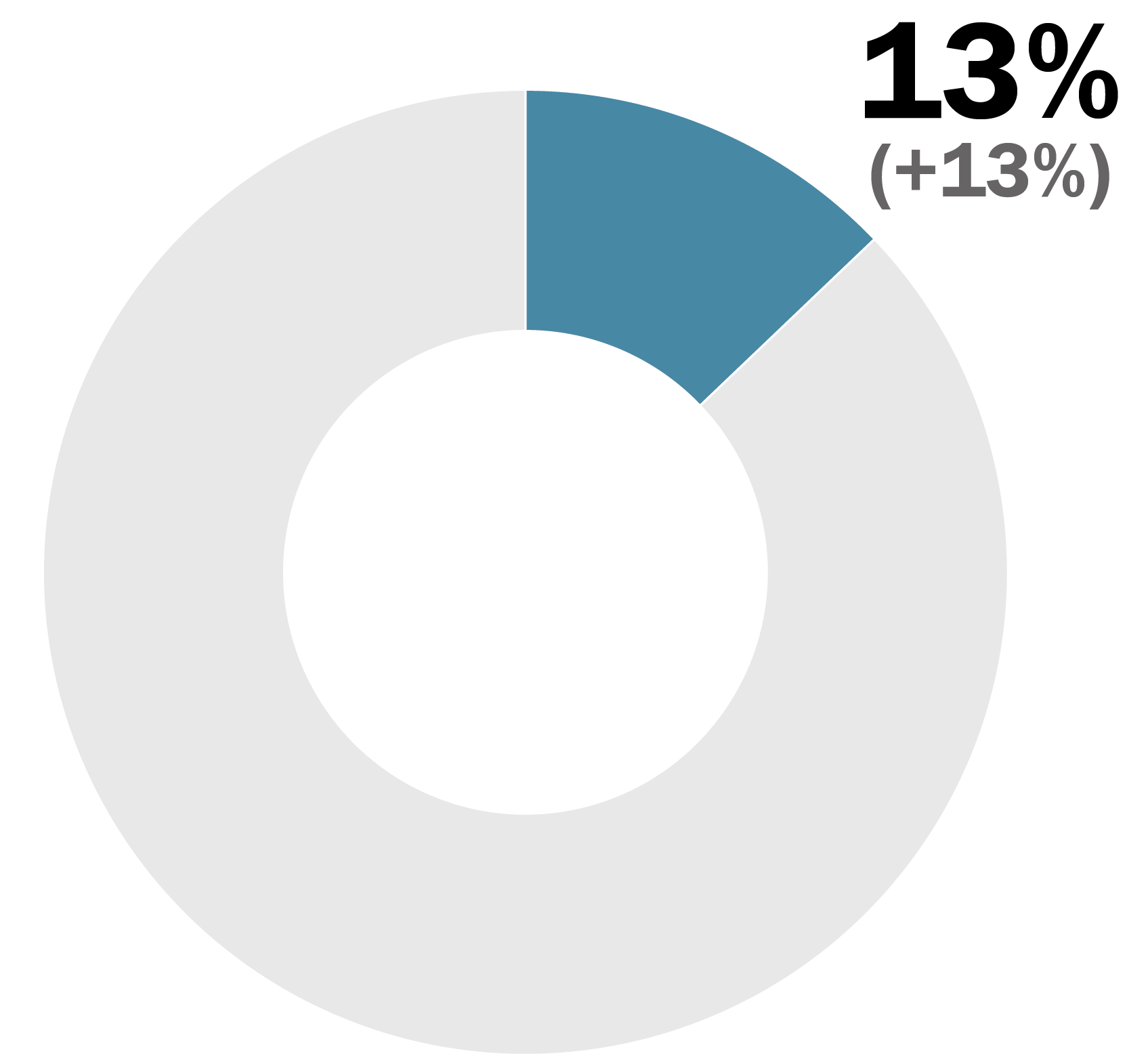
On 1 October 2025, 13 per cent of (1 out of 8) force commanders in UN peacekeeping operations were women. This was an increase of 13 percentage points compared to the previous year. The increase can be attributed to the naming of a woman force commander for UNDOF, a position held in the previous year by a man.
Totals
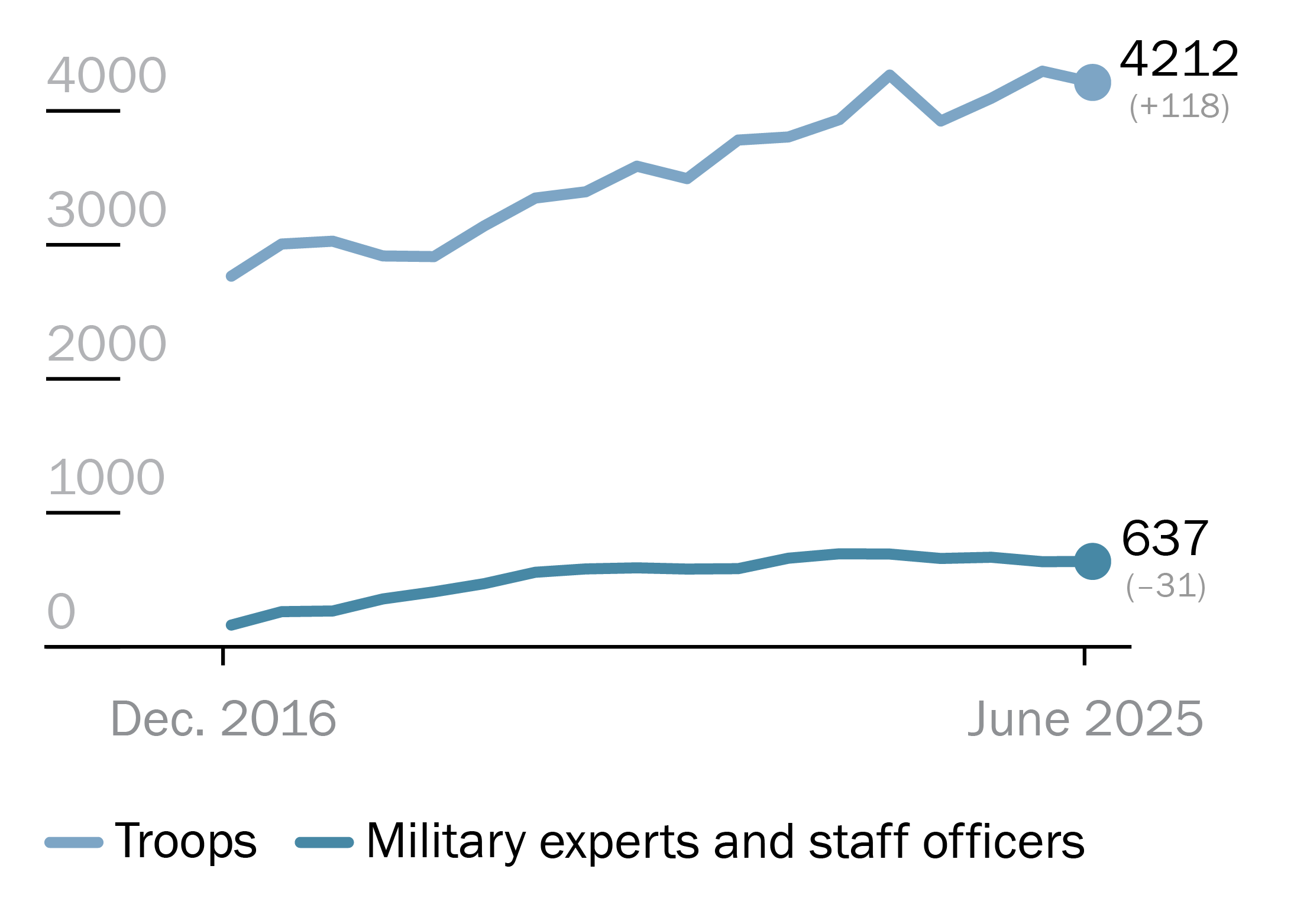
While the number and proportion of women serving as troops in UN peace operations increased in 2025, both the number and proportion of women military experts and staff officers decreased. Despite this year’s growth in the proportion of women troops, the pace of increase over the past decade has remained slow. In 2025, the increase was 0.2 percentage points. As of June 2025, women made up 8.8 per cent of the total military personnel deployed in UN peace operations (55 170), an increase of 0.2 percentage points from the previous year. Among military experts and staff officers, women’s representation was substantially higher than for troop positions, at 23 per cent, despite a decrease of 0.4 percentage points in comparison with the previous year.
Number of women in the military personnel of UN peace operations
Proportion of women in the military personnel of UN peace operations
Note: Values in parentheses indicate the variation in the number or proportion (in percentage points) of women personnel compared to the same month in the previous year.
Operations
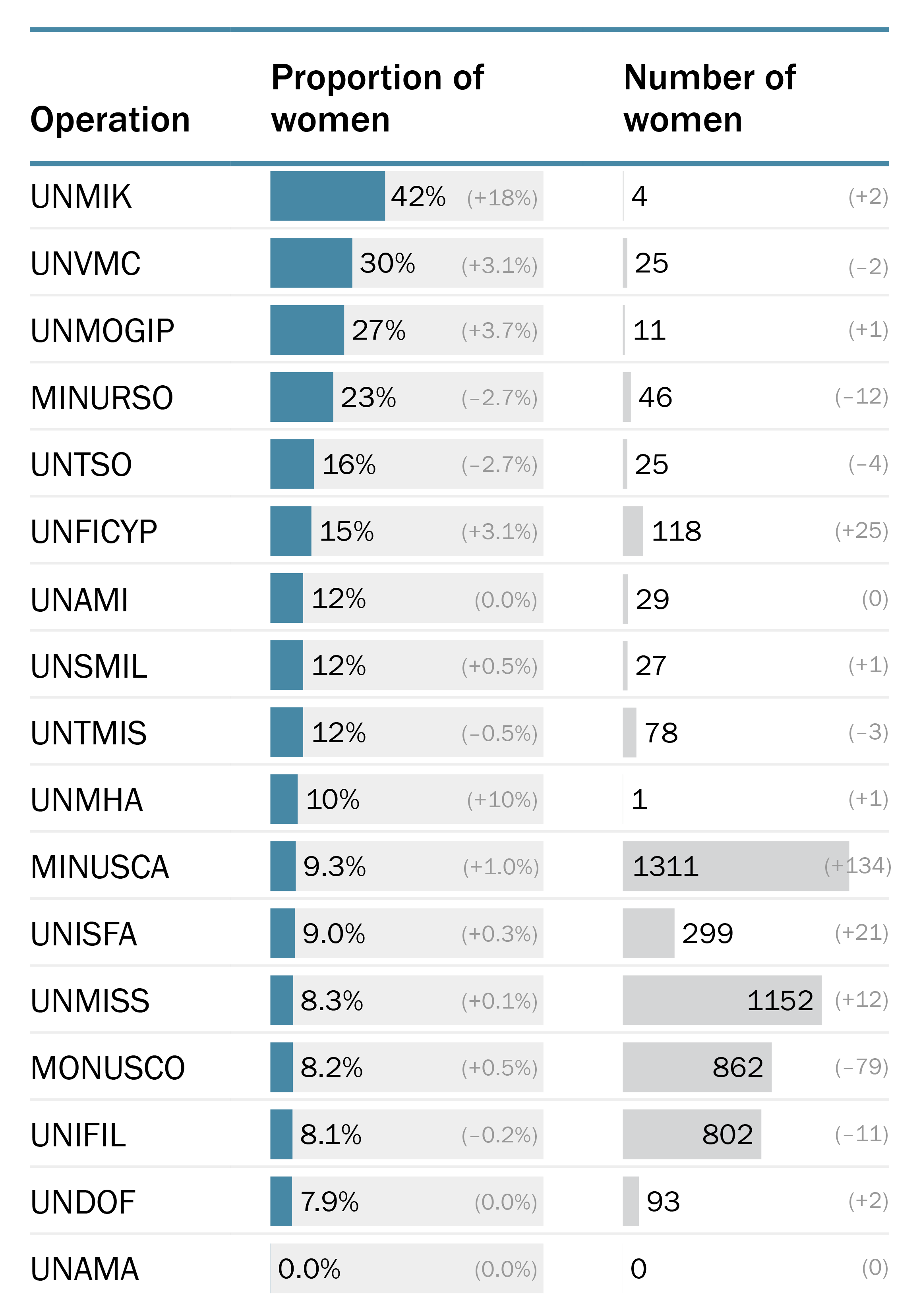
UN peace operations with relatively high proportions of women in the military personnel tend to be relatively small in terms of total deployment. In most UN peace operations, the proportion of women in the military personnel has increased over the past year.
Proportion and number of women in the military personnel of UN peace operations, 2025 monthly averages
Note: The 2025 monthly averages are based on the months from Jan. to June. Values in parentheses indicate the variation in the number or proportion (in percentage points) of women personnel compared to the previous year. The average numbers of women personnel are rounded to the nearest integer.
Contributors
Six of the top 10 contributors by total number of military personnel to UN peace operations also featured among the top 10 contributors by number of women to the military personnel of UN peace operations in 2025: Bangladesh, Ghana, Indonesia, Nepal, Pakistan and Rwanda. As in the previous year, Nepal was the top contributor of women to the military personnel of UN peace operations. Except for Cambodia, which dropped out of the top 10, and Indonesia, which joined the list in 2025, the main contributors by number of women remained the same as in the previous year. Six of the top 10 contributors by number of women were sub-Saharan African countries and 4 were Asian. Only 2 of the top 10 contributors by number of women were also among the top 10 contributors in terms of proportion of women: South Africa and Zambia. No country appeared in both the top 10 contributors by total number of military personnel and the top 10 contributors by proportion of women.
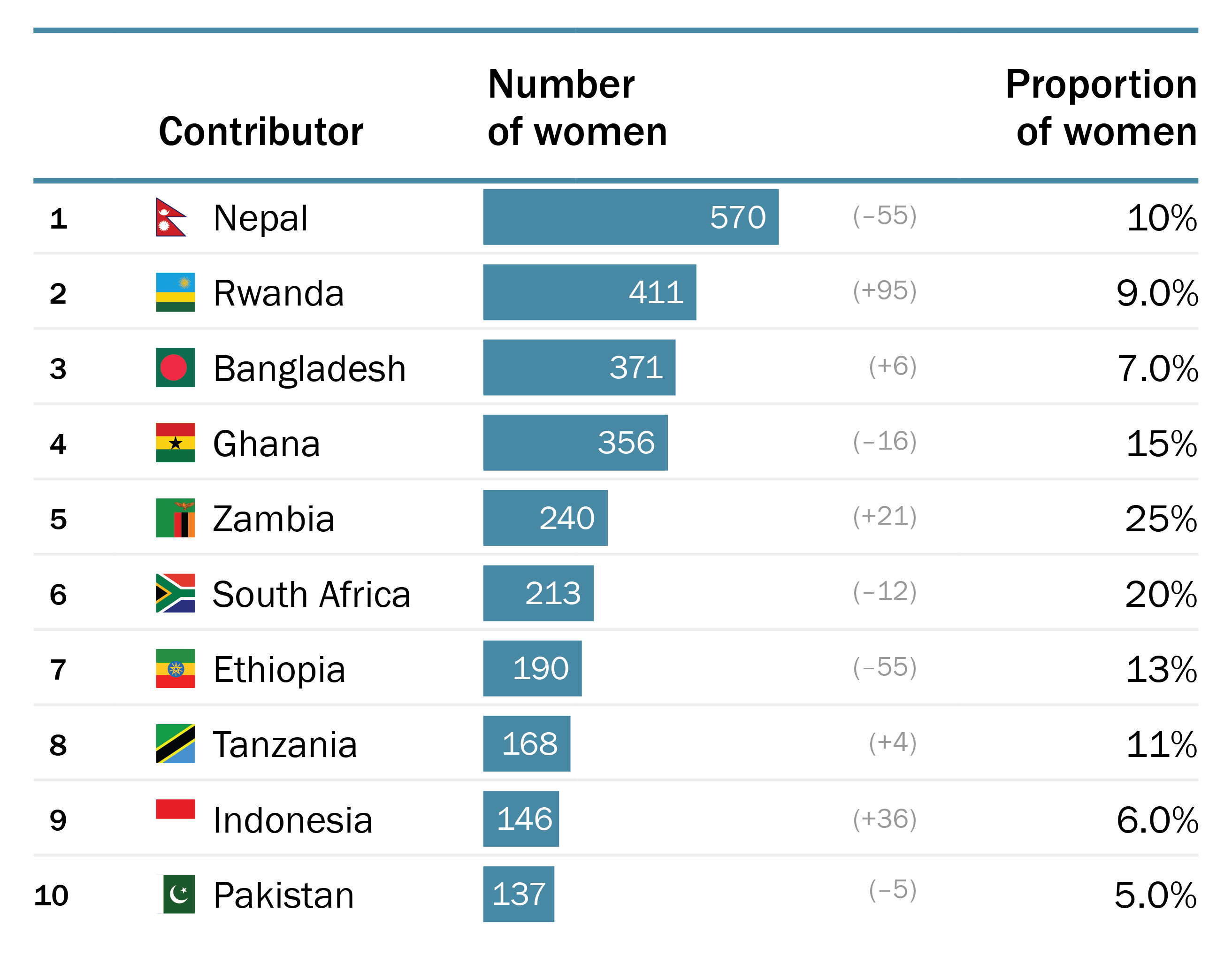
Top 10 contributors by number of women to the military personnel of UN peace operations, 2025 monthly averages
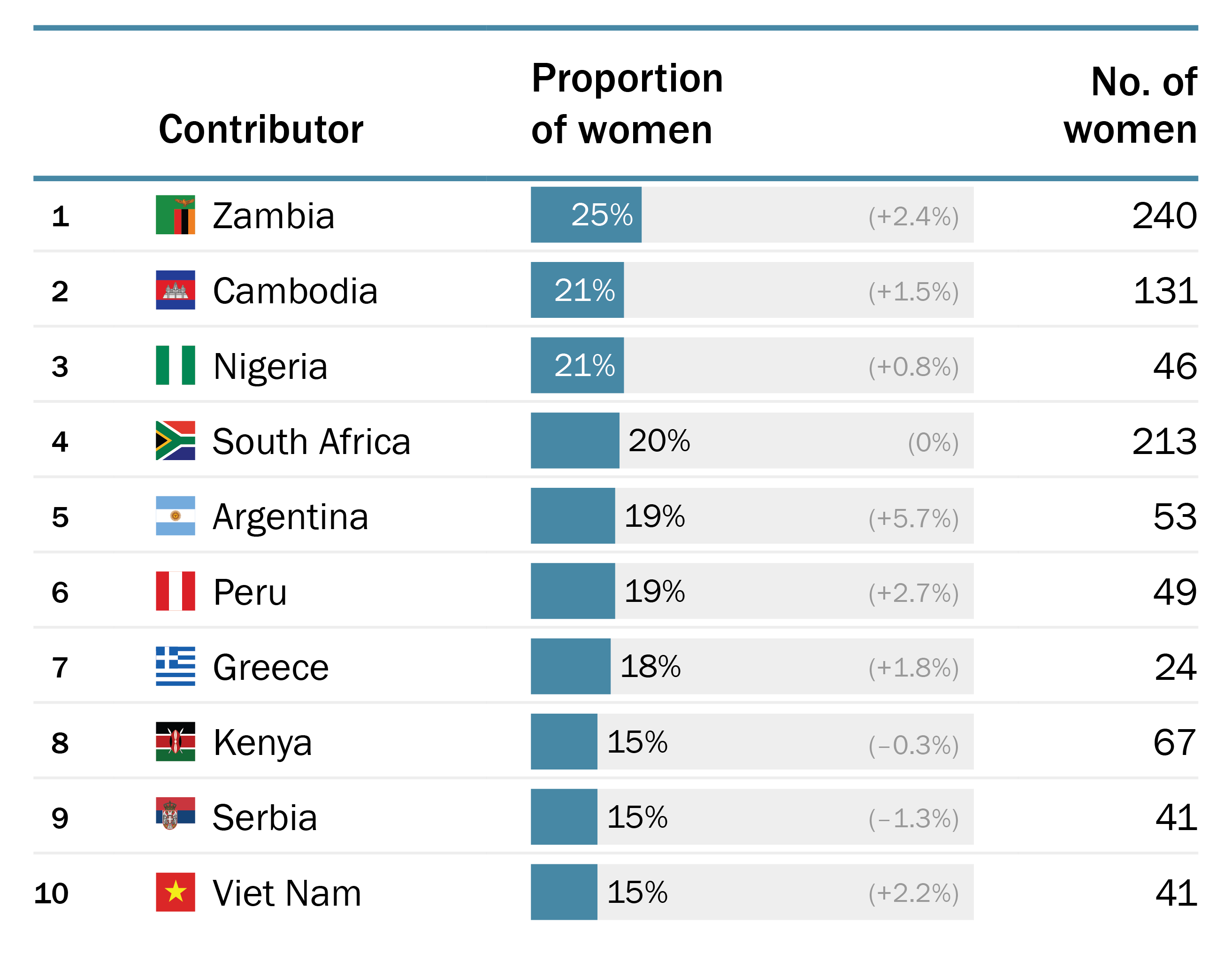
Top 10 contributors by proportion of women to the military personnel of UN peace operations, 2025 monthly averages
Note: The 2025 monthly averages are based on the months from Jan. to June. Countries deploying fewer than 100 military personnel per month on average are not included. Values in parentheses indicate the variation in the number or proportion (in percentage points) of women personnel compared to the previous year. The average numbers of women personnel are rounded to the nearest integer.
Women in the UN police
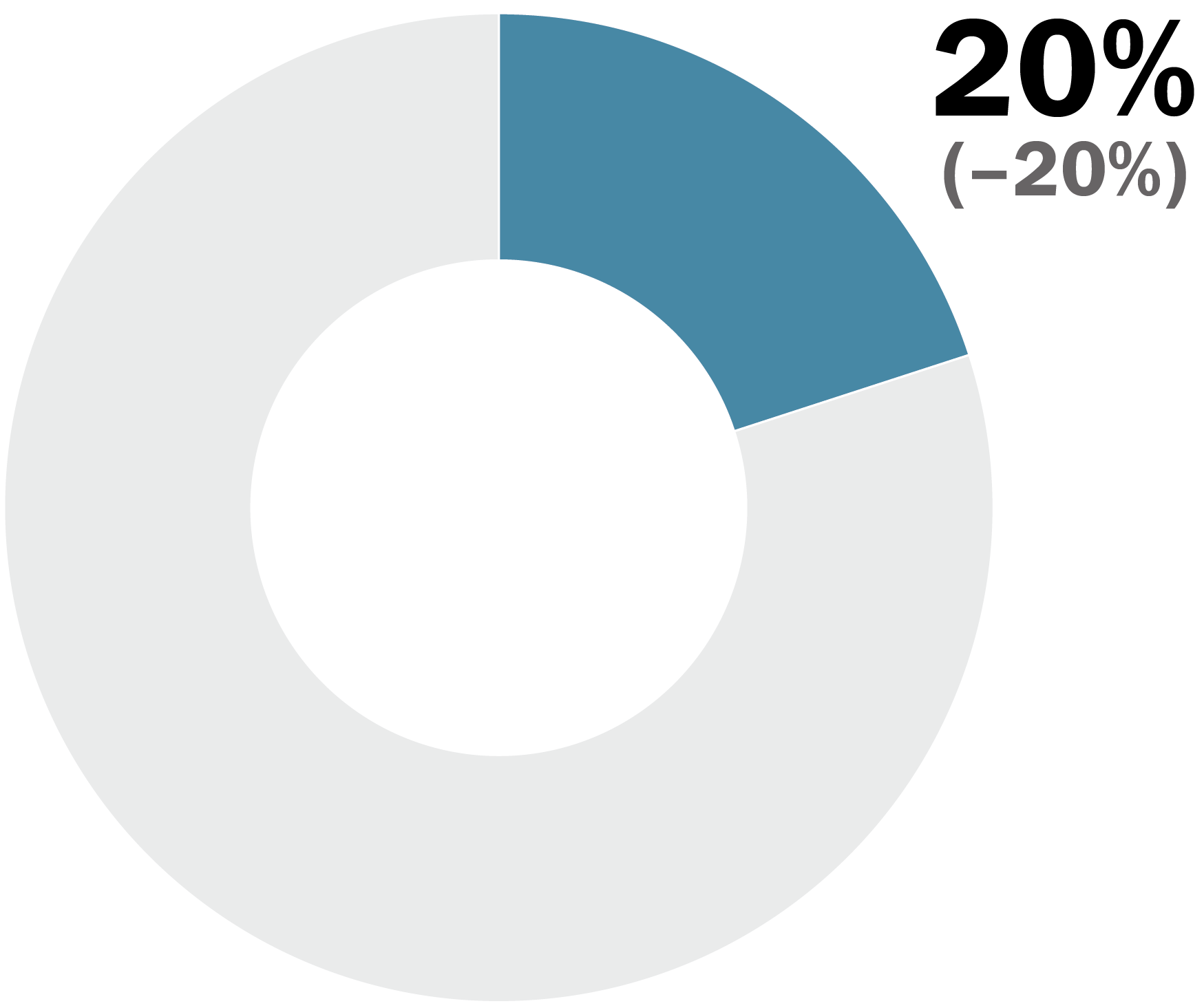
The UN’s 2018 Uniformed Gender Parity Strategy established the target of 20 per cent women in formed police units and 30 per cent women among individual police officers by 2028. The A4P initiative reaffirmed the commitments of the UN and its member states. In 2021, the UN reached the 30 per cent goal for the proportion of women among individual police officers. In 2025, this proportion was 31 per cent, the same as in the previous two years. The proportion of women in formed police units increased in 2025, surpassing this year’s target of 15 per cent and reaching 18 per cent.
Leadership
On 1 October 2025, 20 per cent of (1 out of 5) all chief police officers (4 police commissioners and 1 deputy senior police adviser) in UN peace operations were women. The sole woman in police leadership was a police commissioner at UNISFA. For the second consecutive year, this was a decrease of 20 percentage points compared to the previous year. In 2025, the decrease was due to the departure of the woman leading the UN police at UNMISS and the assumption of her role by a man.
Totals
The total number of women in the police personnel of UN peace operations increased in 2025 compared to the previous year. This was primarily driven by an increase in the number of women in formed police units, as the number of women among individual police officers decreased slightly. Likewise, the proportion of women increased only within formed police units. Among individual police officers, the proportion of women has remained relatively stable (30–32 per cent) since 2021, when it reached the Uniformed Gender Parity Strategy’s 2028 target.
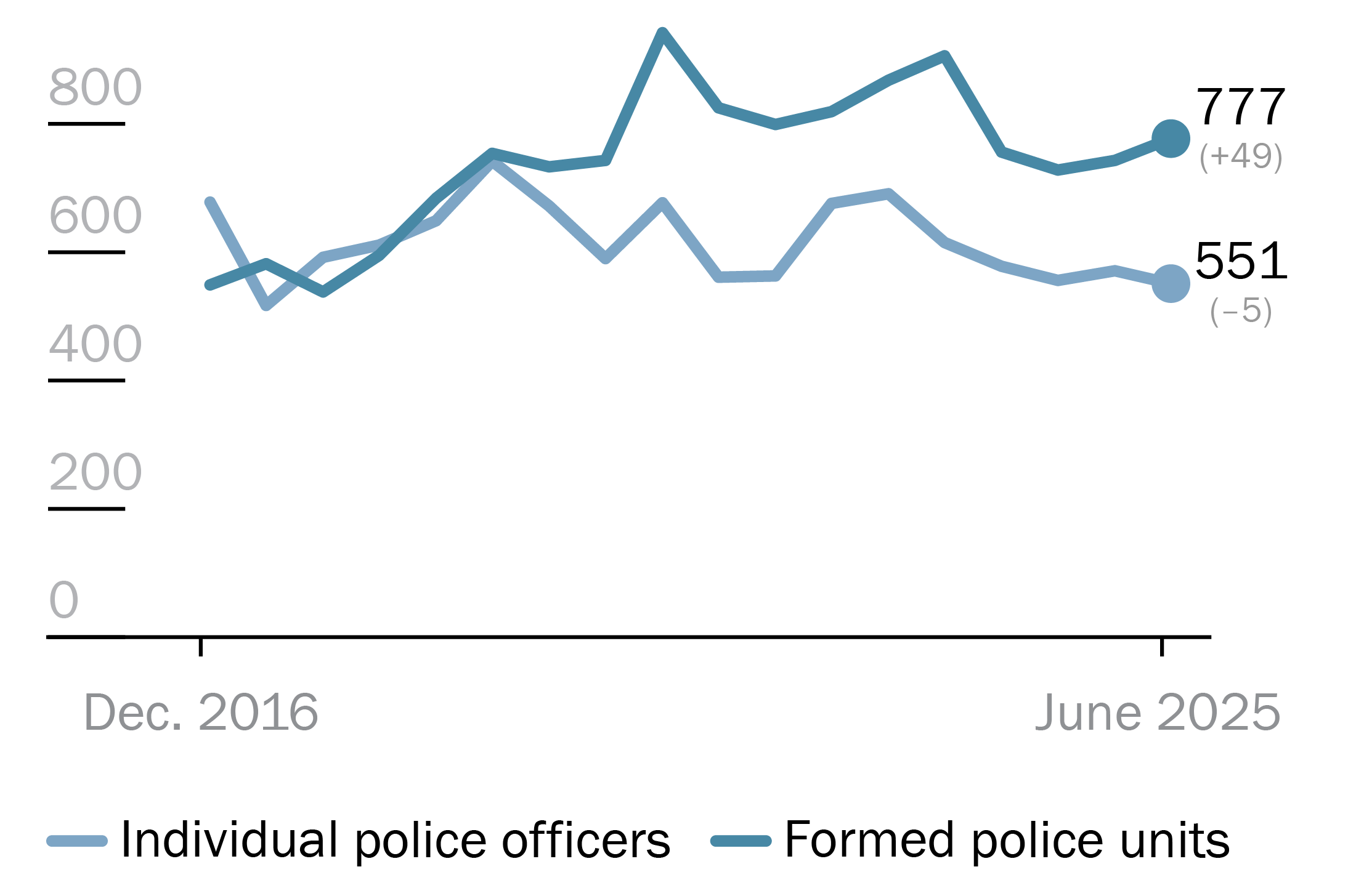
Number of women in the police personnel of UN peace operations
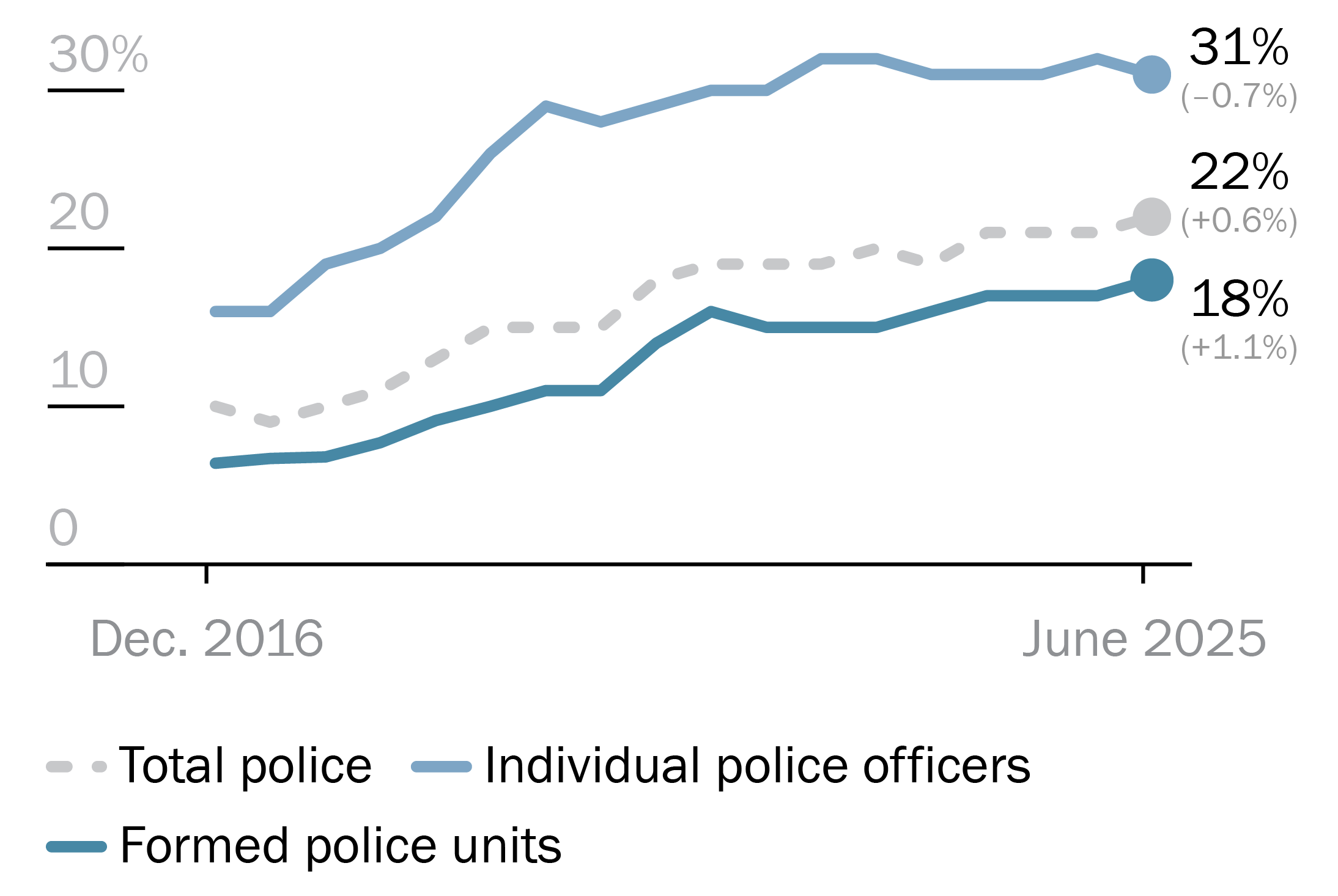
Proportion of women in the police personnel of UN peace operations
Note: Values in parentheses indicate the variation in the number or proportion (in percentage points) of women personnel compared to the same month in the previous year.
Operations
UN peace operations deploying smaller numbers of police personnel tend to record higher proportions of women in their police personnel. MINURSO, which had the highest proportion of women in its police personnel, had an average of only 2 police officers in total deployed in 2025. Among the three missions with the largest police deployments (MINUSCA, UNMISS and MONUSCO, respectively), the proportion of women varied only marginally, by –1.8 to +2.3 percentage points.
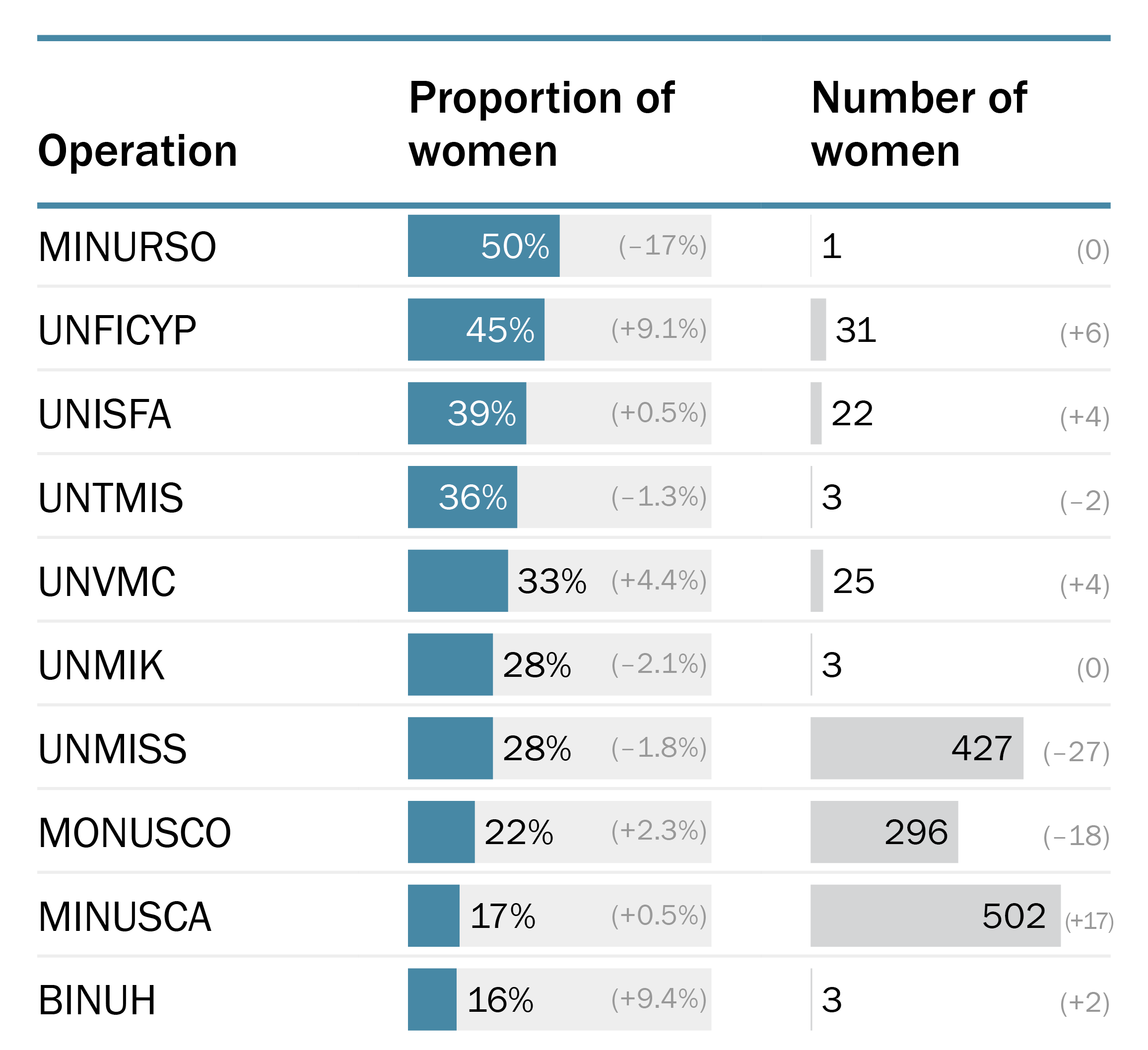
Proportion and number of women in the police personnel of UN peace operations, 2025 monthly averages
Note: The 2025 monthly averages are based on the months from Jan. to June. Values in parentheses indicate the variation in the number or proportion (in percentage points) of women personnel compared to the previous year. The average numbers of women personnel are rounded to the nearest integer.
Contributors
With the exception of the Republic of the Congo, 9 of the top 10 contributors by total number of police personnel to UN peace operations were also among the top 10 contributors by number of women to the police personnel of UN peace operations in 2025. Six of the top 10 contributors by number of women were sub-Saharan African countries: Cameroon, the Republic of the Congo, Djibouti, Ghana, Rwanda and Senegal. The countries that ranked in the top 10 by proportion of women contributed with a much smaller total number of police personnel compared to those that ranked in the top 10 by number of women.
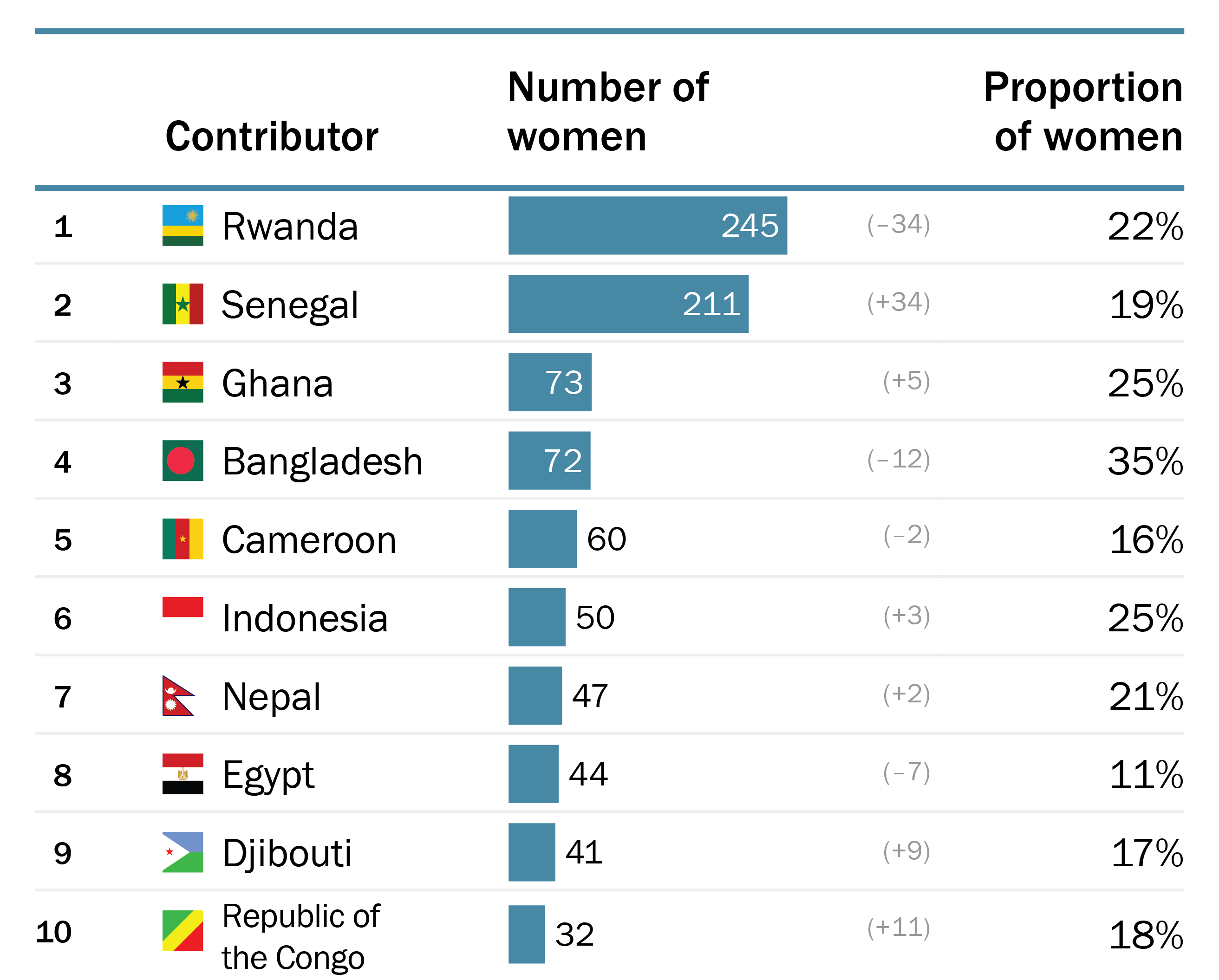
Top 10 contributors by number of women to the police personnel of UN peace operations, 2025 monthly averages
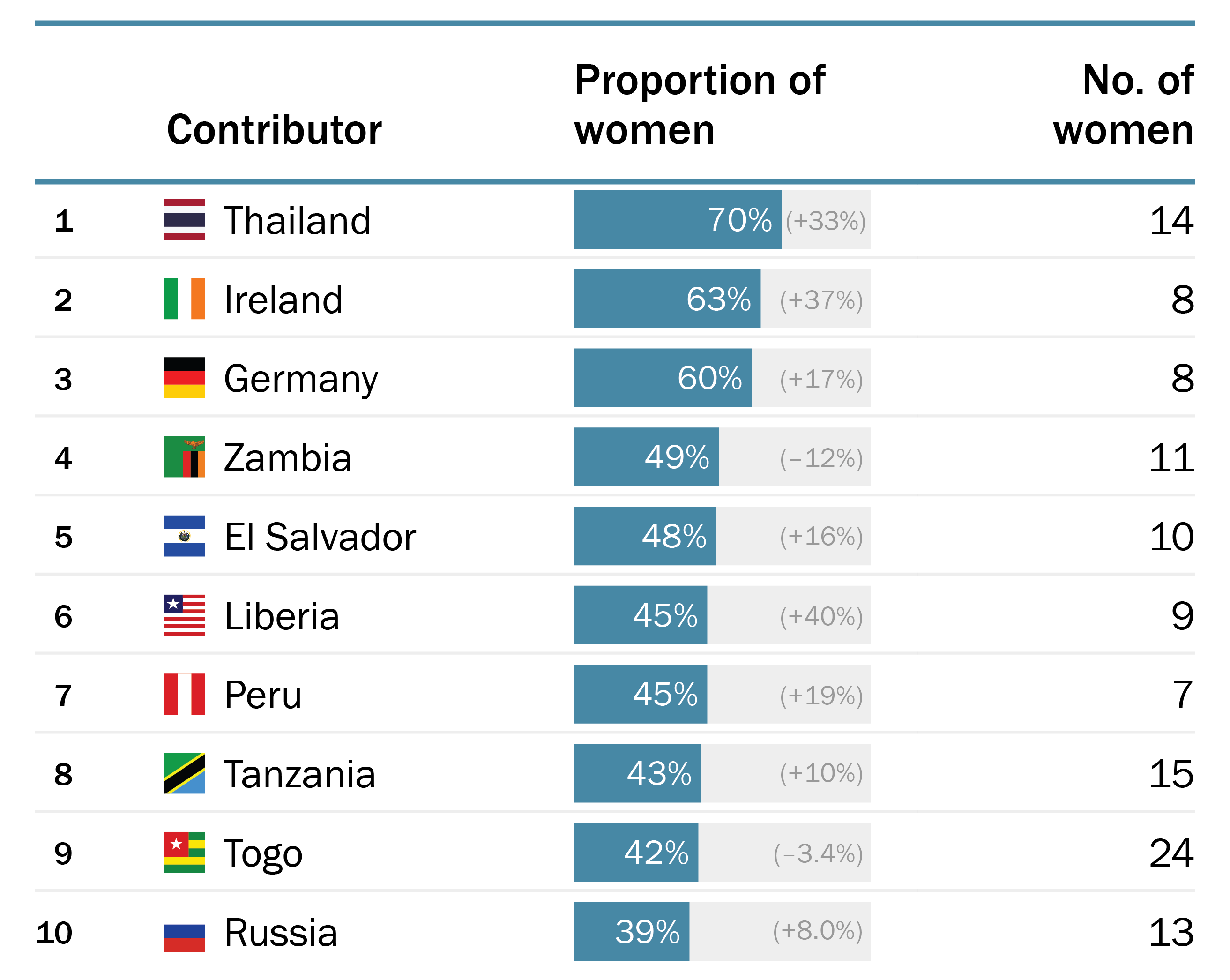
Top 10 contributors by proportion of women to the police personnel of UN peace operations, 2025 monthly averages
Note: The 2025 monthly averages are based on the months from Jan. to June. Countries deploying fewer than 10 police officers per month on average are not included. Values in parentheses indicate the variation in the number or proportion (in percentage points) of women personnel compared to the previous year. The average numbers of women personnel are rounded to the nearest integer.
Women in UN civilian personnel
The UN’s 2017 System-wide Strategy on Gender Parity set targets for the equal representation of women and men in several areas, including among civilian personnel in UN peace operations. The strategy allows for variation within a 47–53 per cent range as an indication of such parity. In May 2024, the Department of Peace Operations issued a new Gender-responsive UN Peacekeeping Operations Policy. It builds on previous strategies and efforts by reaffirming the need to promote both civilian and uniformed gender parity across all levels and roles, including by creating an enabling environment for the full, equal and meaningful participation of women deployed in peacekeeping operations. However, the goal of achieving gender parity in civilian personnel remains distant for most UN peace operations. In 2025, only UNSCOL had at least 47 per cent women in its civilian personnel.
Leadership
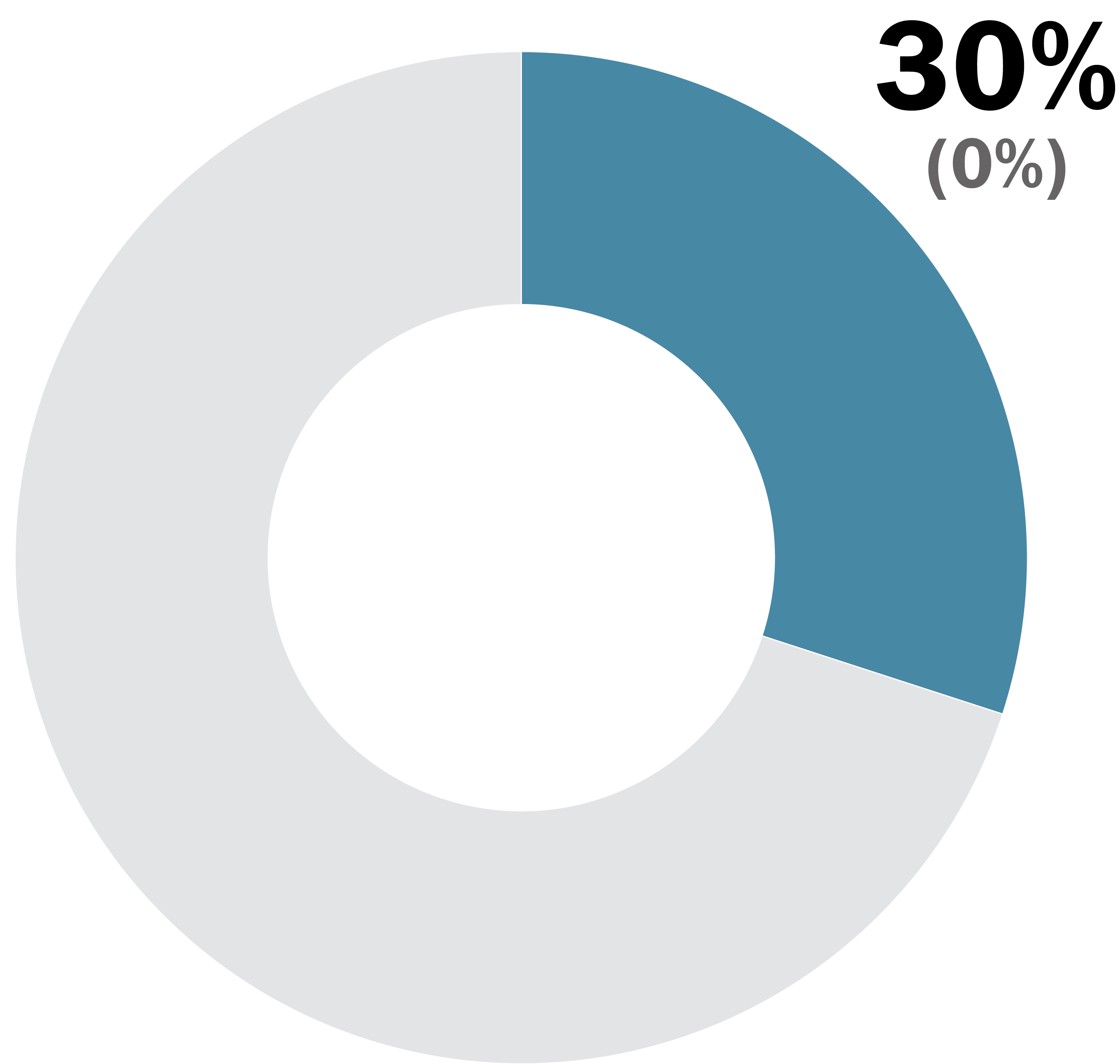
On 1 October 2025, 30 per cent of (7 out of 23)1 heads of UN peacekeeping operations and special political missions were women. This was the same number and proportion as the previous year.
Totals
The number of women in the civilian personnel of UN peace operations increased slightly in 2025. In terms of proportion, the variation was less than 1 percentage point compared to the previous year for both peacekeeping operations and special political missions.
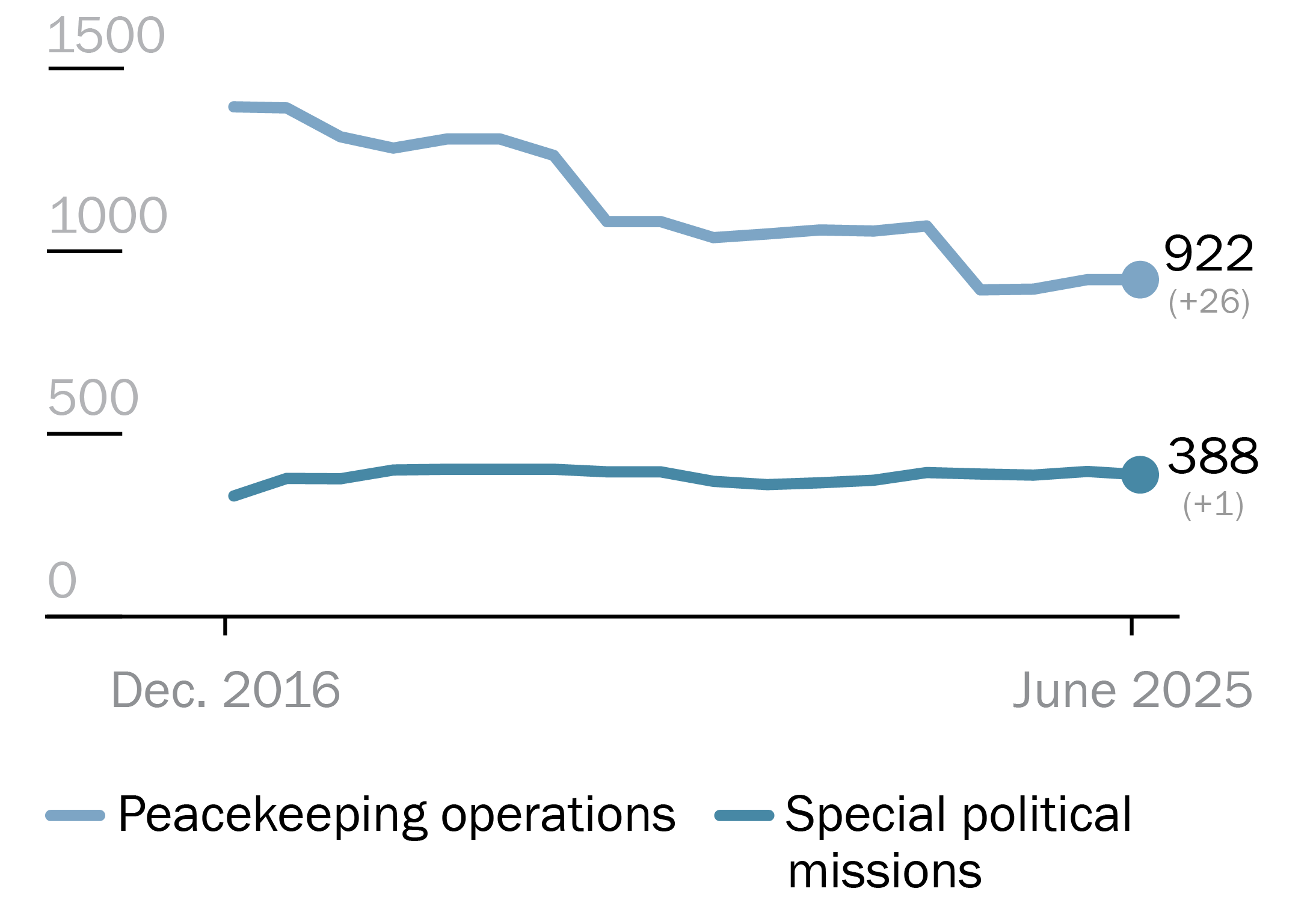
Number of women in the civilian personnel of UN peace operations
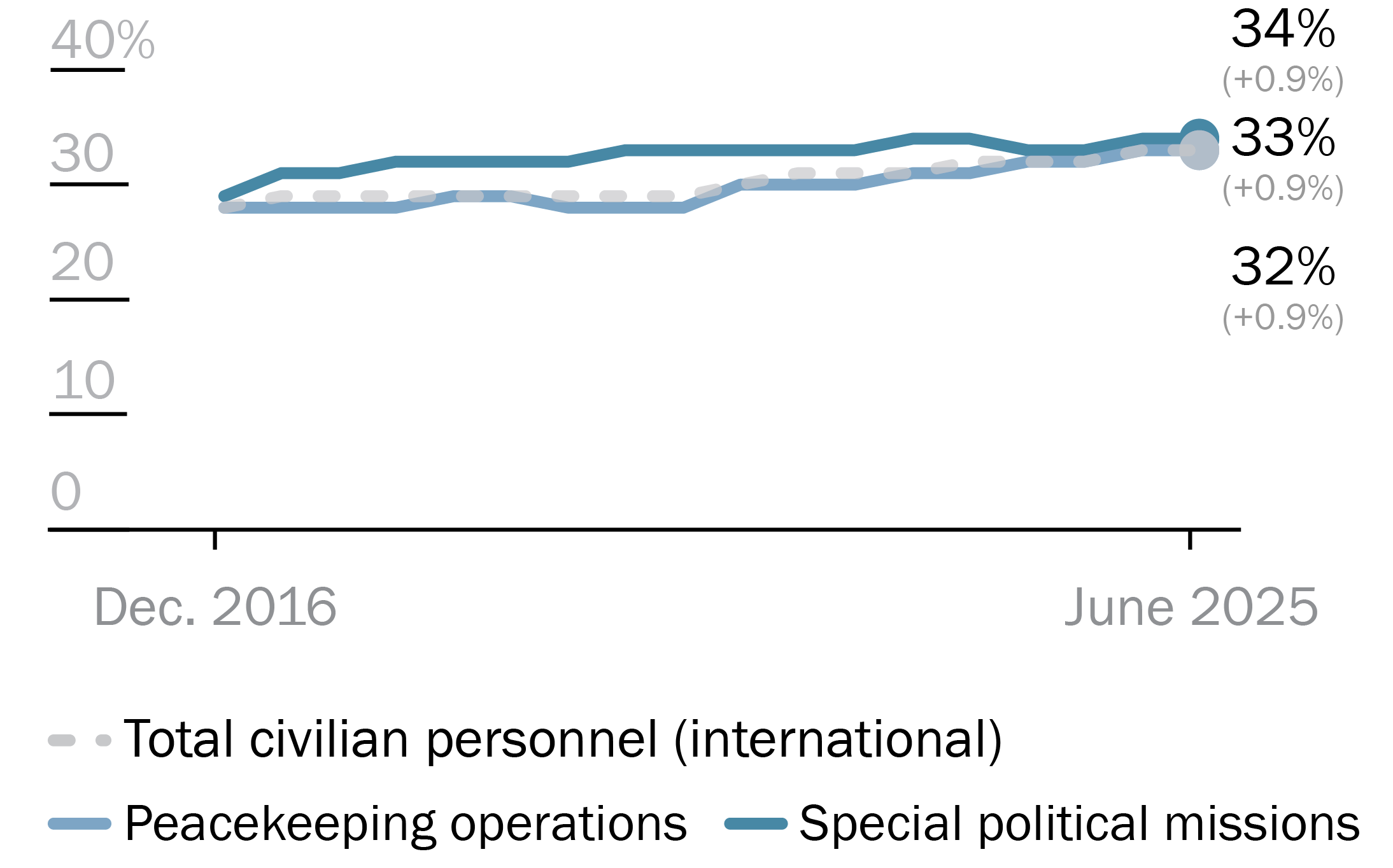
Proportion of women in the civilian personnel of UN peace operations
Note: Values in parentheses indicate the variation in the number or proportion (in percentage points) of women personnel compared to the same month in the previous year.
Operations
UN peacekeeping operations generally have a higher number of women civilian personnel compared to UN special political missions, primarily because they tend to deploy more civilian personnel on average. However, the proportion of women civilian personnel tends to be slightly higher among UN special political missions. In 2025, UNFICYP had the highest proportion of women in its civilian staff among UN peacekeeping operations, with 46 per cent. For special political missions and field offices, UNSCOL had the highest proportion of women in its civilian personnel, with 56 per cent. UNSCOL has therefore overshot the System-wide Strategy on Gender Parity goal of having between 47 and 53 per cent women in its civilian personnel.
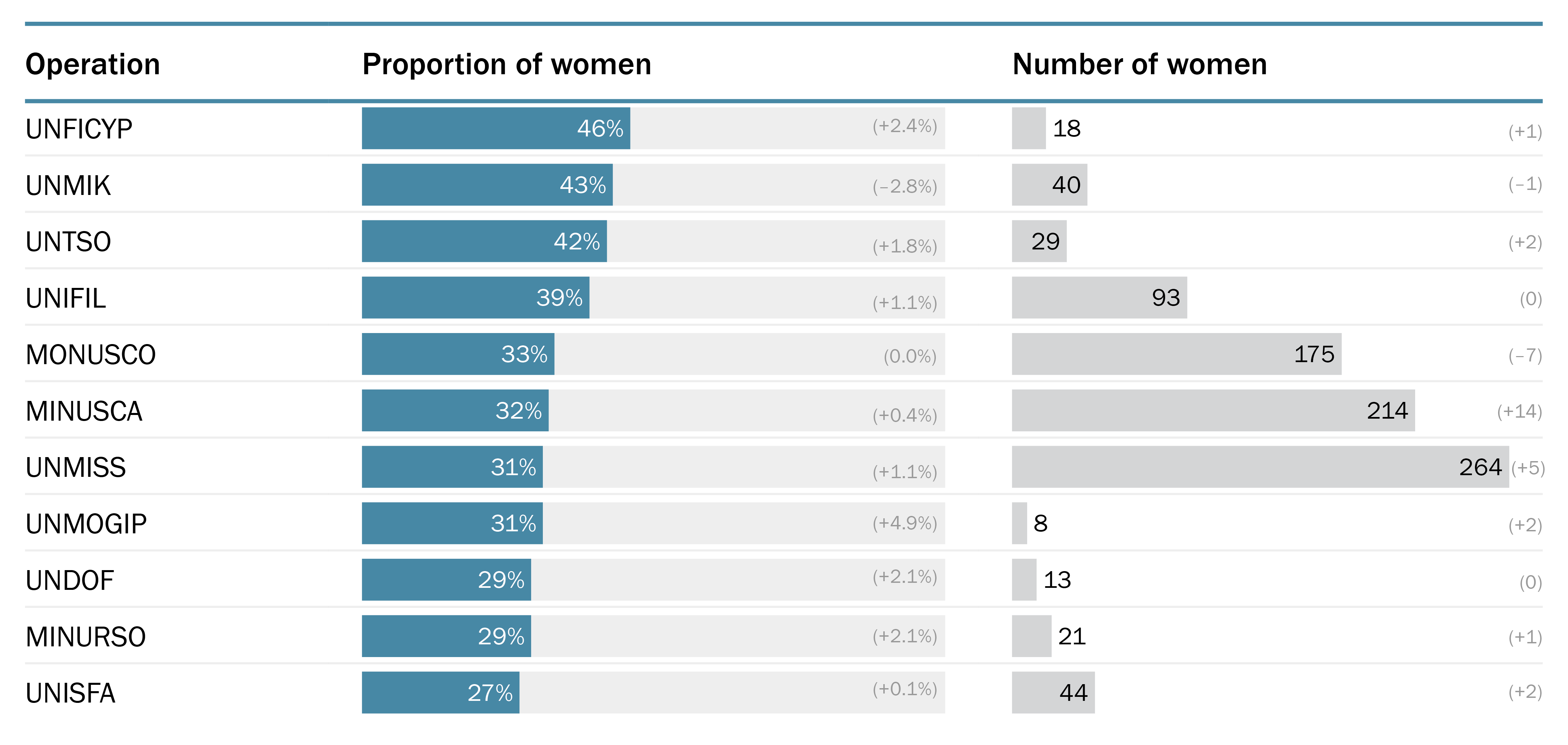
Proportion and number of women in the civilian personnel of UN peacekeeping operations, 2025 monthly averages
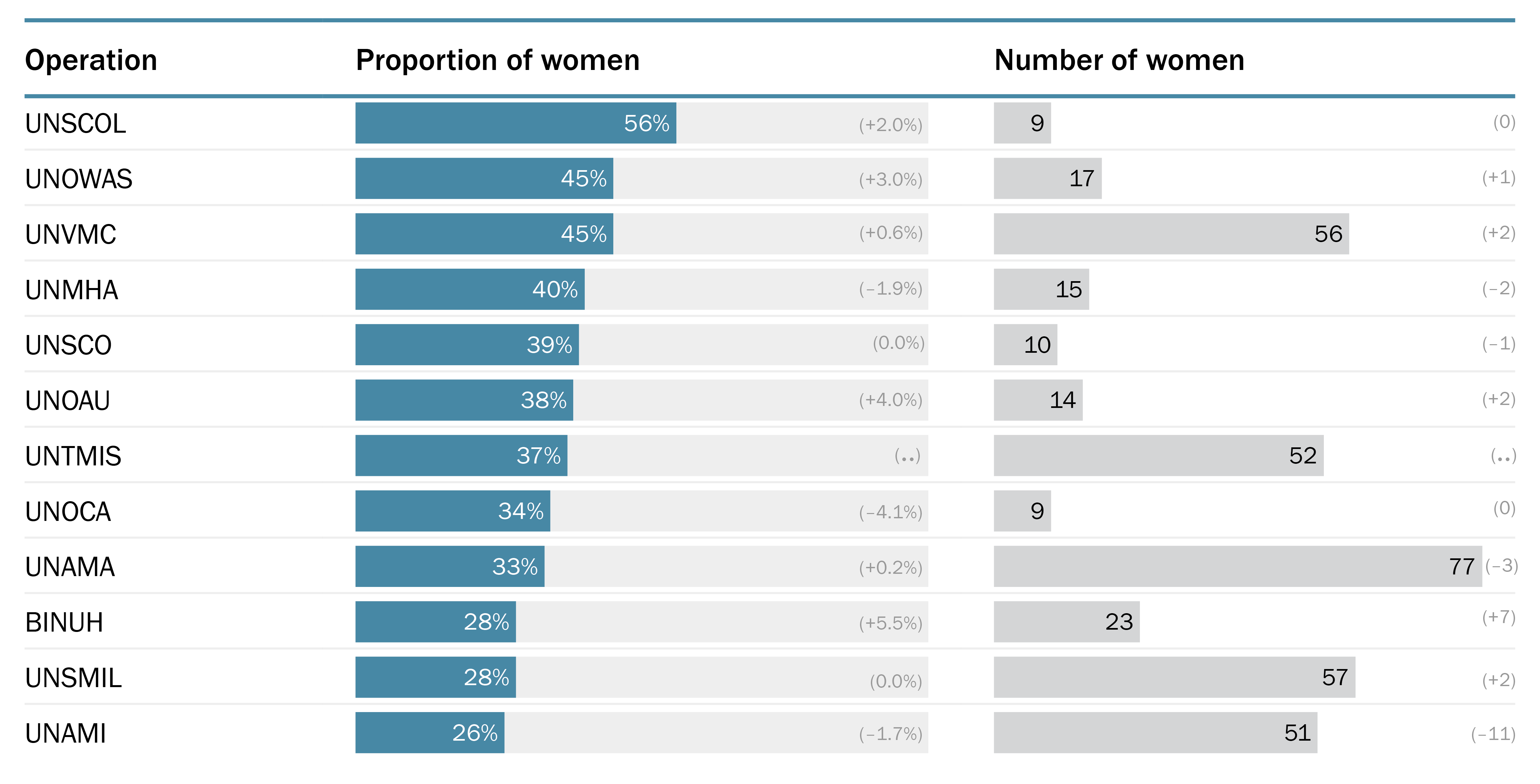
Proportion and number of women in the civilian personnel of UN special political missions, 2025 monthly averages
Note: The 2025 monthly averages are based on the months from Jan. to June. Values in parentheses indicate the variation in the number or proportion (in percentage points) of women personnel compared to the previous year. The average numbers of women personnel are rounded to the nearest integer.
Women in OSCE field operations
The OSCE Secretariat’s Gender Parity Strategy for 2019–26 set the goal of gender parity across all staff categories by 2026, including in OSCE field operations, allowing for variation within a 45–55 per cent range. The OSCE 2025 Annual Progress Report on Gender Equality reconfirmed the strategy and its target and pointed to gains in women’s representation, particularly at senior levels in contracted positions. Nevertheless, the OSCE continued to observe low nomination rates of women to senior positions among its member states. Five out of 12 operations had at least 45 per cent women in their personnel in 2025: the OSCE Centre in Ashgabat, OMIK, OM Moldova, OM Serbia and the OSCE Project Co-ordinator in Uzbekistan.
Leadership
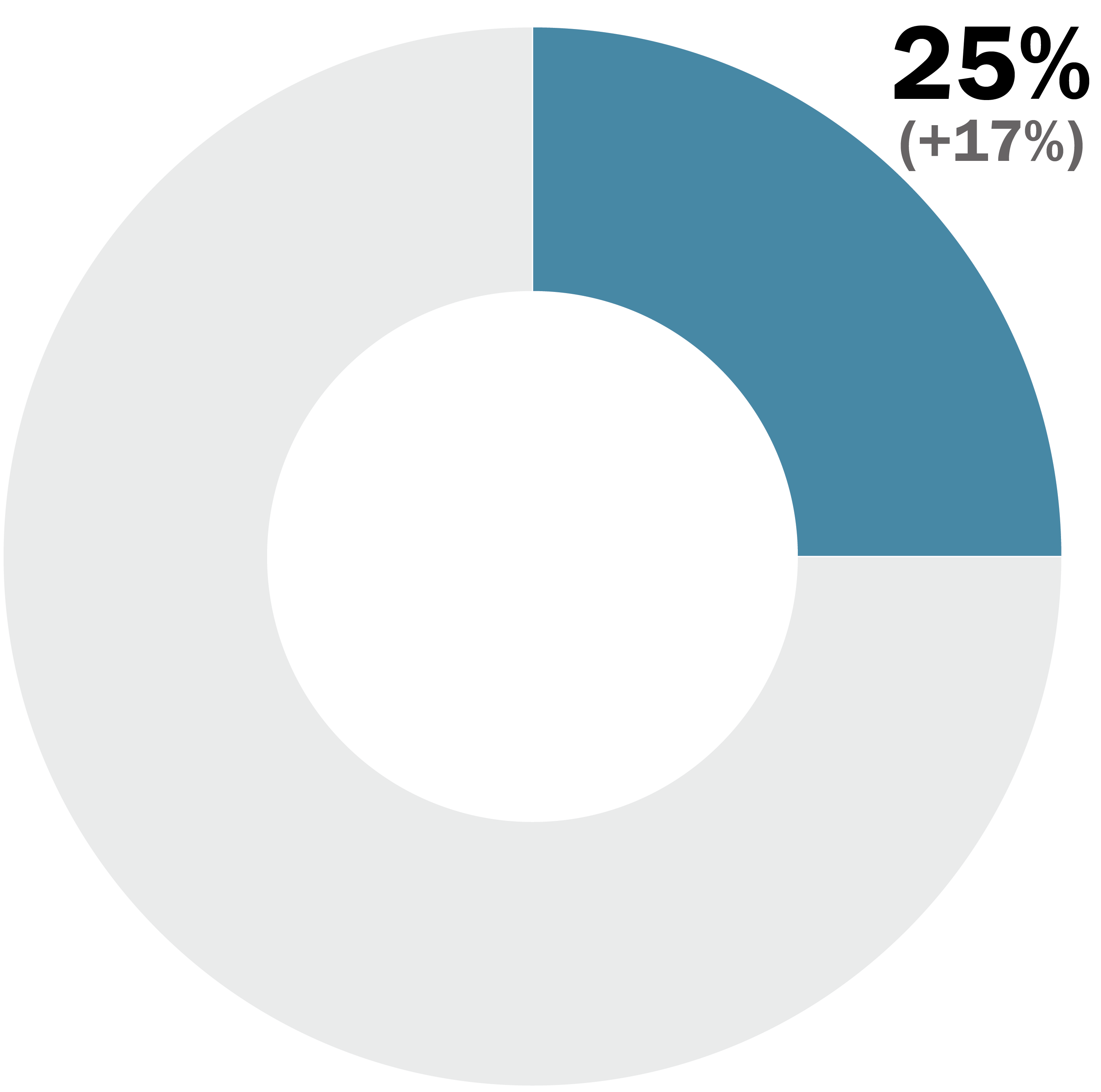
On 1 October 2025, 25 per cent of (3 out of 12)2 heads of mission of OSCE field operations were women. This was an increase of 17 percentage points compared to the previous year. The increase reflects women assuming leadership, as acting heads, of PO Dushanbe and OM Serbia and the closure of the PRCIO, which had been led by a man.
Totals
Up until its termination in March 2022, the SMM had been both the largest OSCE field operation and the one with the most women in its deployed personnel. It had shaped both the number and the proportion of women in OSCE operations. Excluding the SMM, the number of women in OSCE field operations has remained relatively constant, with 103 in June 2025. The proportion of women in OSCE field operations other than the SMM had been steady until 2025, when it rose by 7.8 percentage points compared to the previous year and reached 45 per cent, reflecting increases across most operations. This was the largest year-on-year rise in the proportion of women in OSCE field operations over the past decade.
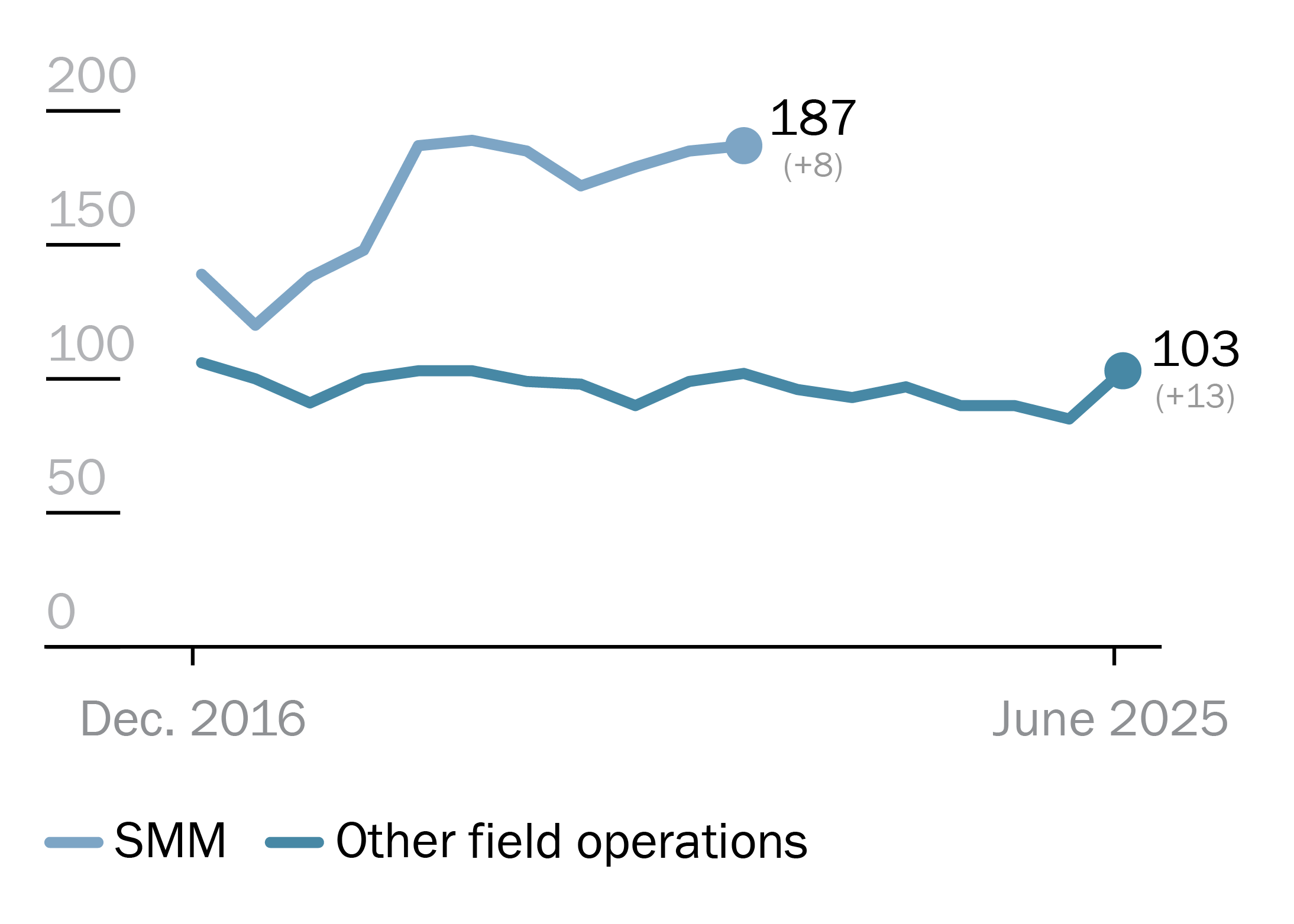
Number of women in the personnel of OSCE field operations
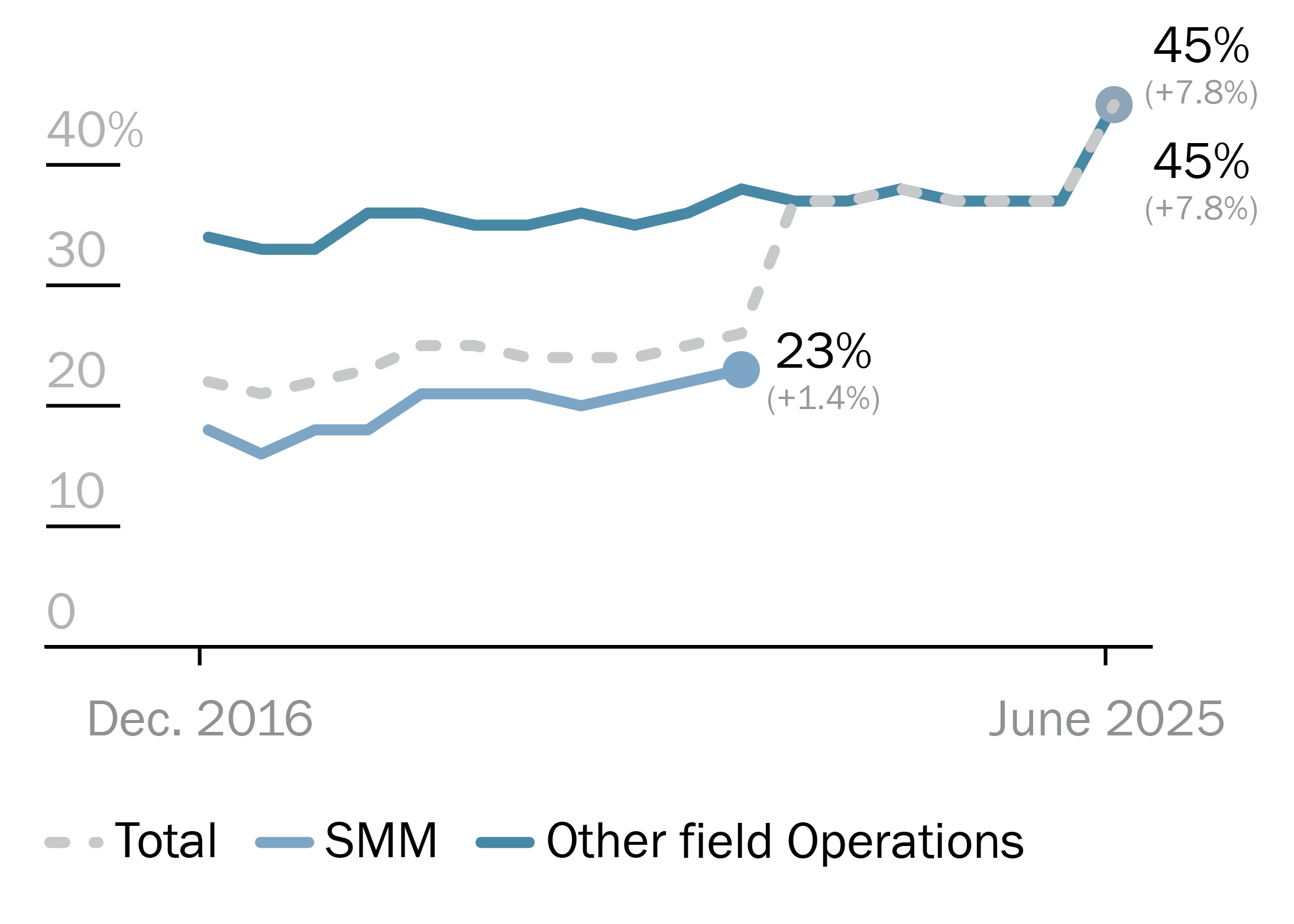
Proportion of women in the personnel of OSCE field operations
Note: The SMM was discontinued on 31 Mar. 2022. Values in parentheses indicate the variation in the number or proportion (in percentage points) of women personnel compared to the same month in the previous year.
Operations
Most OSCE field operations have a relatively low number of personnel. Therefore, small variations in the number of women can have a large impact on the proportion of women in the personnel of a field operation. In 2025, meeting the target of the Secretariat’s Gender Parity Strategy, 5 field operations had at least 45 per cent women (up from 1 field operation in the previous year). OMIK, the largest OSCE operation by number of personnel, had both a relatively high number and a relatively high proportion of women personnel deployed.
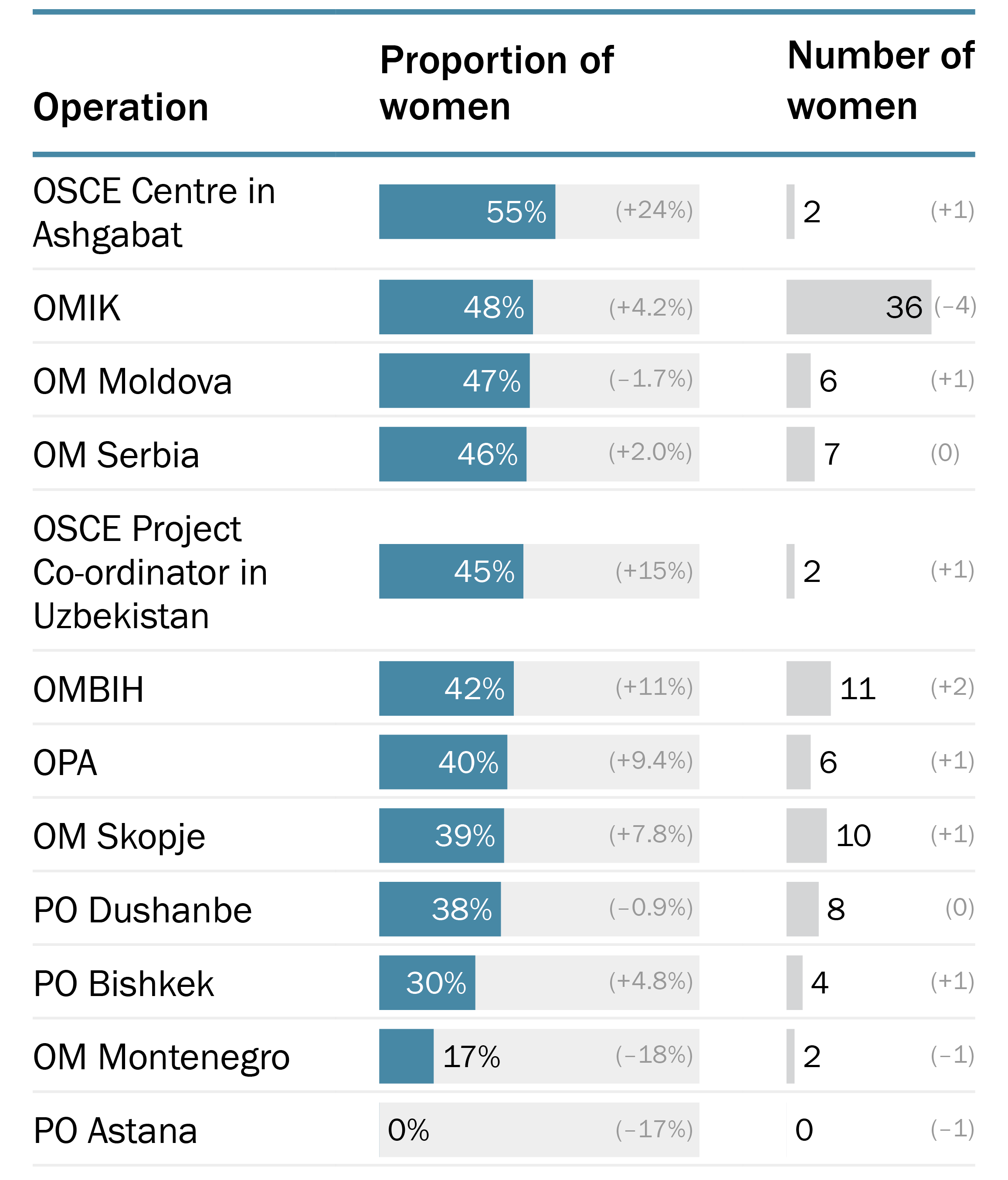
Proportion and number of women personnel of OSCE field operations, 2025 monthly averages
Note: Values in parentheses indicate the variation in the number or proportion (in percentage points) of women personnel compared to the previous year. The average numbers of women personnel are rounded to the nearest integer.
Contributors
The countries that contribute the highest number of personnel in total to OSCE field operations also tend to contribute the highest number of women personnel. In 2025, Albania, France, Georgia and Serbia were among both the top 10 contributors by number of women personnel and the top 10 contributors by proportion of women personnel to OSCE field operations. Among the top 10 contributors by number of women personnel, women made up 45 per cent or more of the contributions in 6 countries: Albania, France, Georgia, Italy, Moldova and Serbia. While some of the top contributors by proportion of women continued to be countries deploying only women, their overall personnel numbers remained very small, ranging from 1 to 3 individuals.
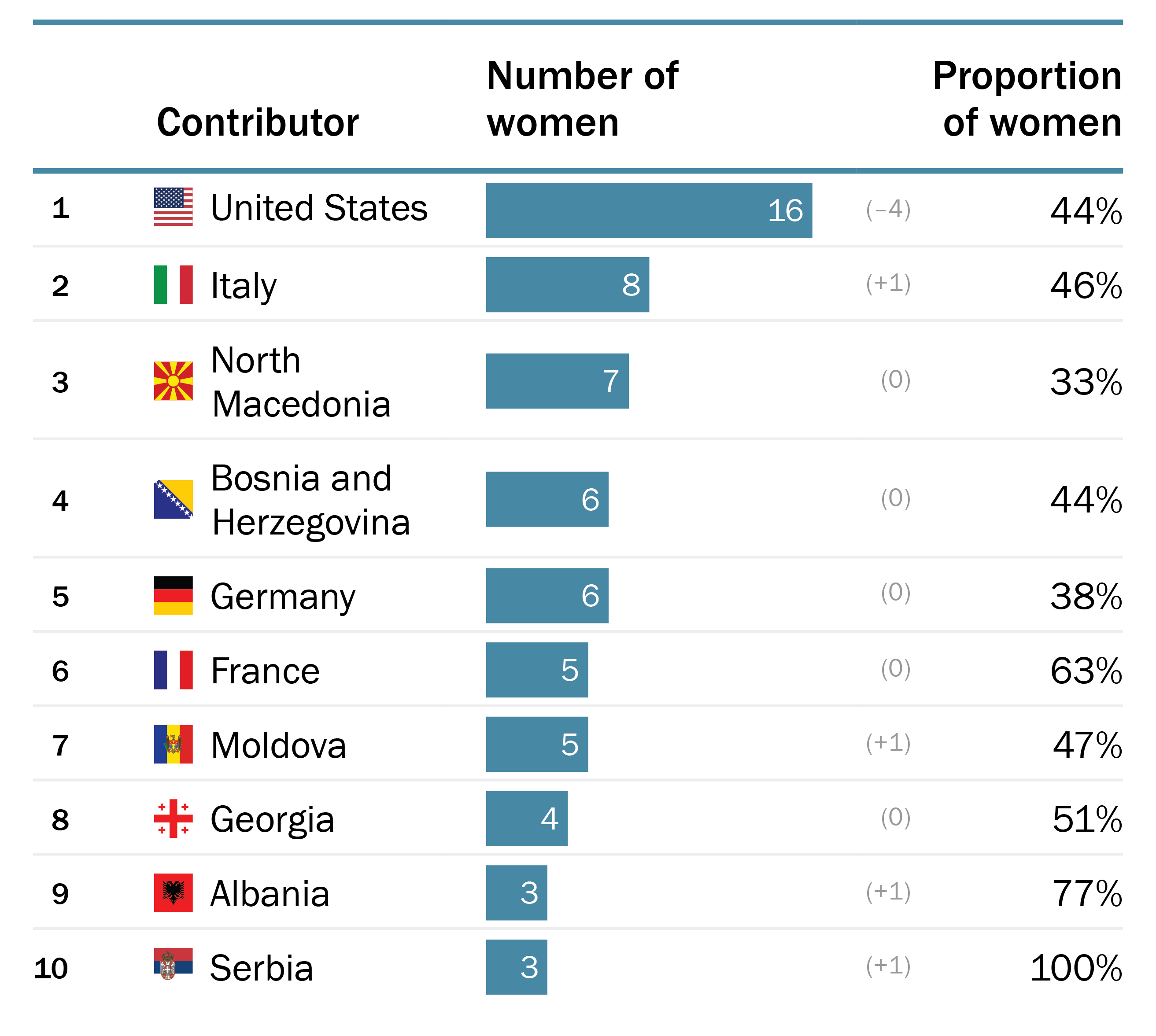
Top 10 contributors by number of women to the personnel of OSCE field operations, 2025 monthly averages
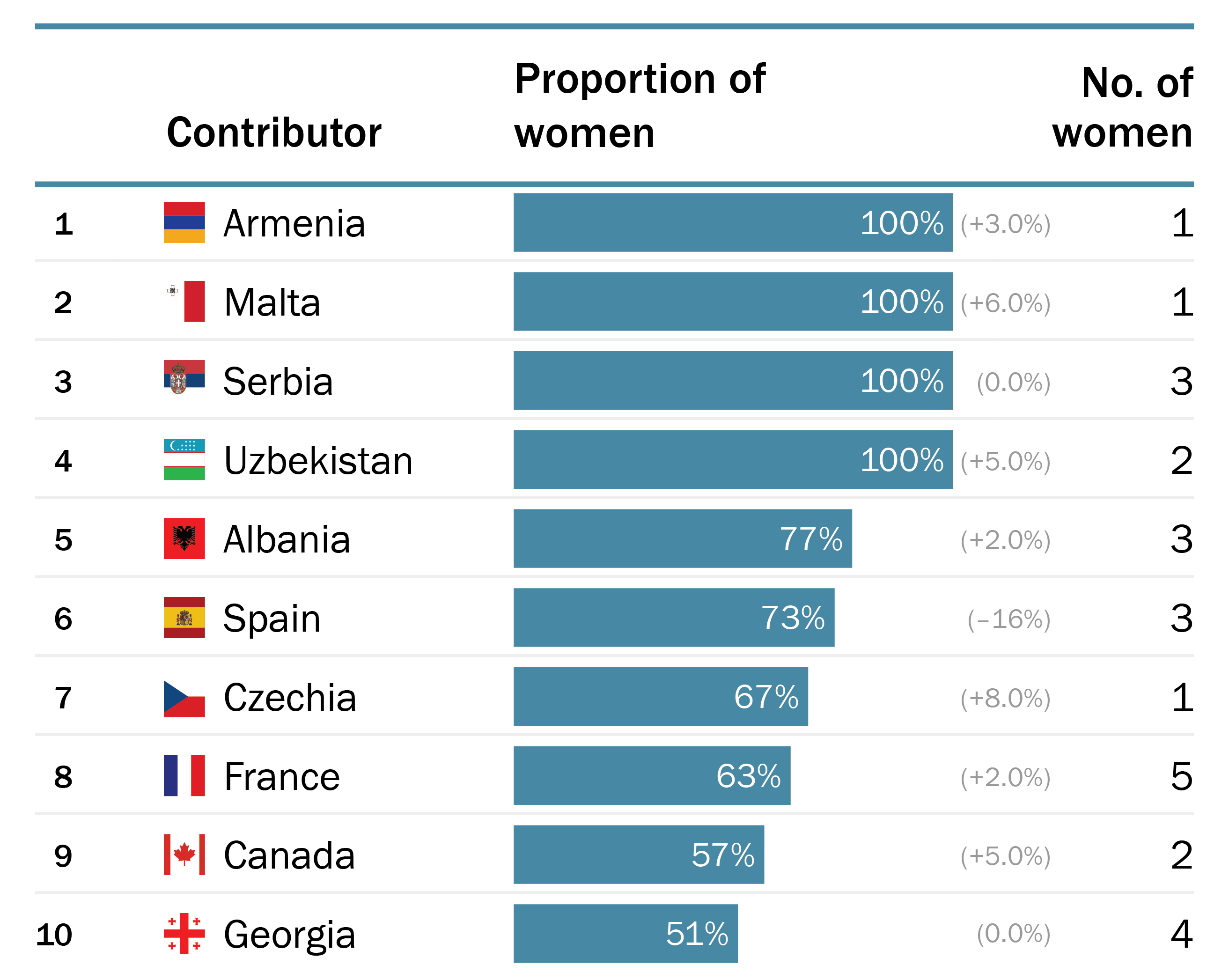
Top 10 contributors by proportion of women to the personnel of OSCE field operations, 2025 monthly averages
Note: The 2025 monthly averages are based on the months from Jan. to June. Values in parentheses indicate the variation in the number or proportion (in percentage points) of women personnel compared to the previous year. The average numbers of women personnel are rounded to the nearest integer.
Women in EU CSDP missions and operations
In 2023, EU member states renewed the Civilian CSDP Compact to strengthen the EU’s civilian crisis management missions, committing among other things to increasing women’s representation in line with UN Security Council Resolution 1325. The renewal set the concrete objective of reaching at least 40 per cent women in EU CSDP missions by 2025, with a longer-term goal of parity at all levels—something the previous compact lacked. To support implementation, the EEAS updated the 2021 Strategy and Action Plan, completing the process at the end of 2024. The Strategy and Action Plan to Enhance Women’s Participation in Civilian CSDP Missions 2024–27 is now in place. Nevertheless, progress has been slow and by mid 2025, only 1 of the EU’s 12 civilian missions had met the 40 per cent target: EUBAM Rafah.
Leadership
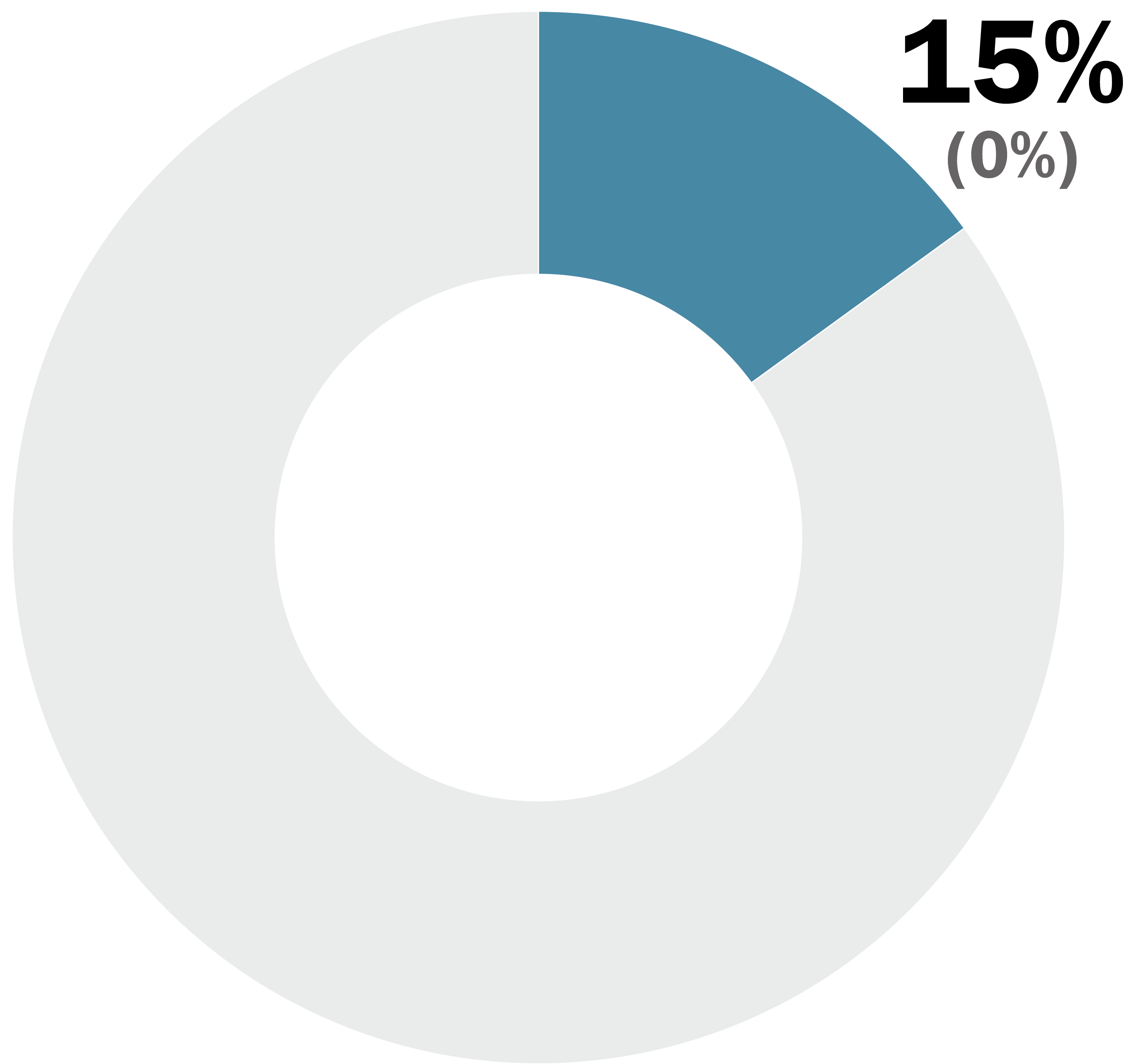
On 1 October 2025, 15 per cent of (3 out of 20)3 heads of EU CSDP missions and operations were women. This remained unchanged from the previous year. The missions led by women in 2025 were the same as in 2024: EUBAM Rafah, EUPOL COPPS and EUMM Georgia. None of the military CSDP missions has ever had a woman head of mission.
Totals
Over the past year, the number of women in civilian EU CSDP missions has declined, partly due to the closure of EUCAP Sahel Niger, while the proportion of women in those missions remained stable at 24 per cent in June 2025. In military EU CSDP missions and operations, the number of women was lower in December 2024 (the latest year for which data is available) in comparison to the previous year, in part reflecting the closure of EUTM Mali. However, the proportion of women in these missions and operations reached 8.8 per cent in December 2024—a year-on-year increase of 1.5 percentage points.
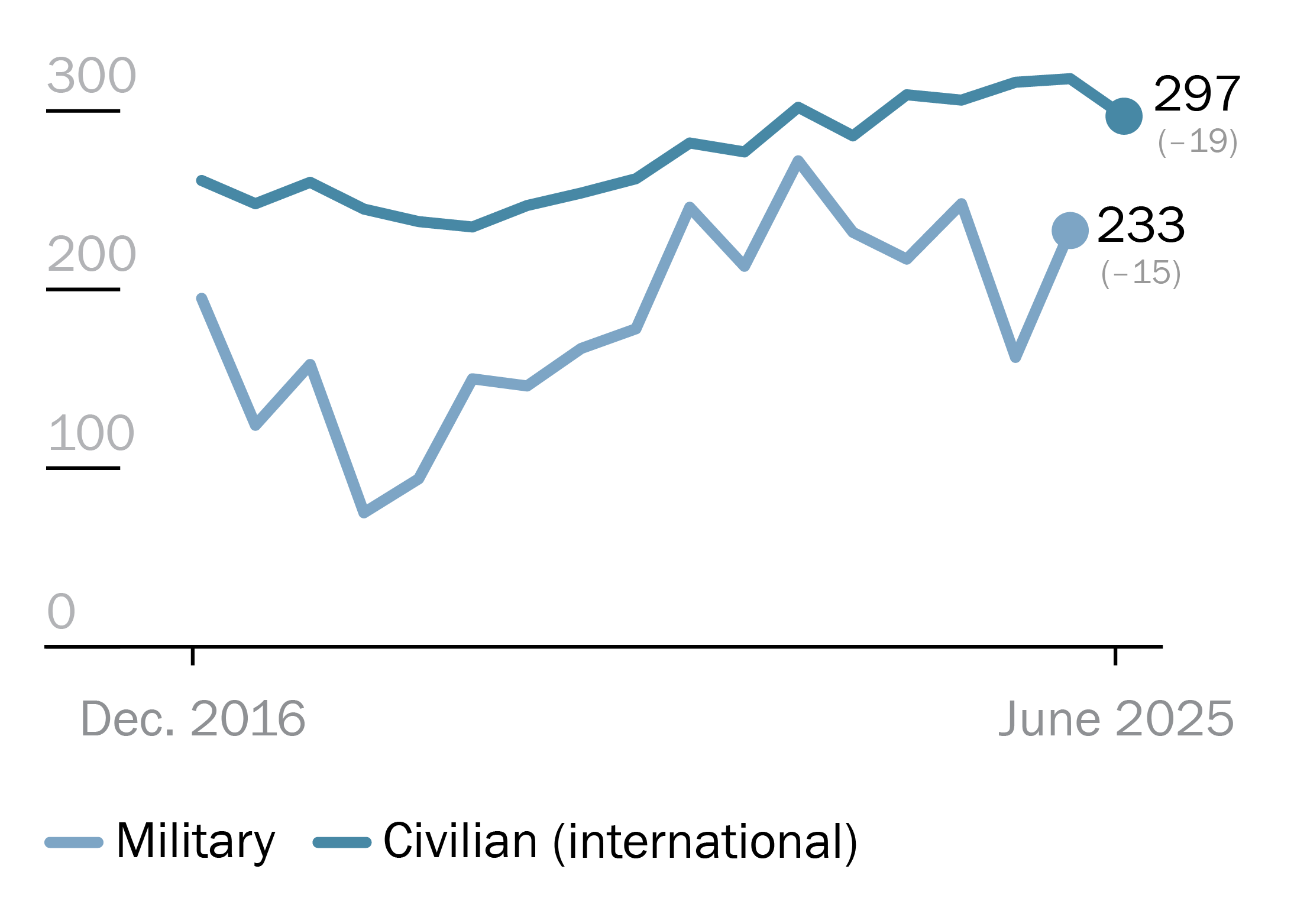
Number of women in the personnel of EU CSDP missions and operations
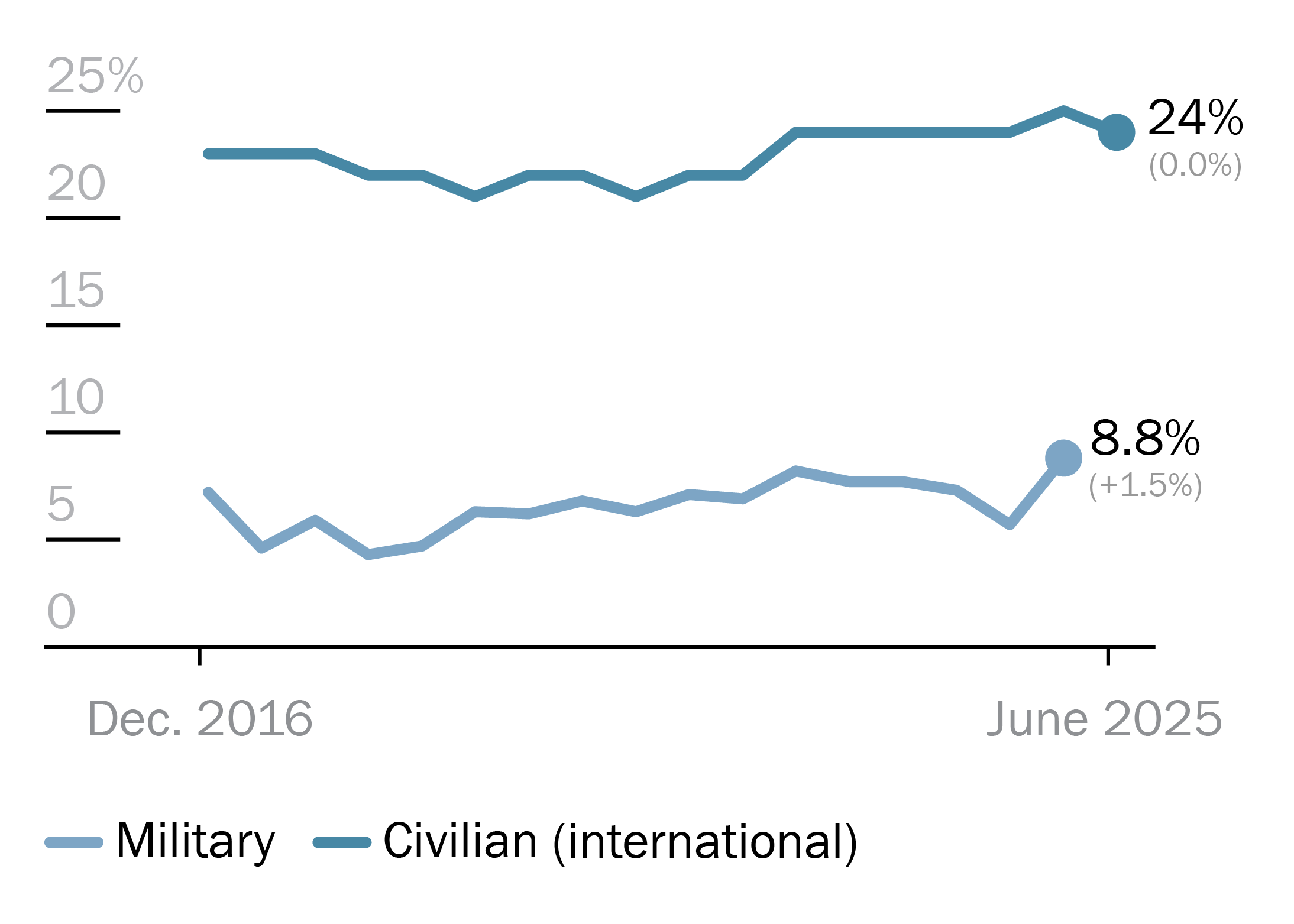
Proportion of women in the personnel of EU CSDP missions and operations
Note: The data for military personnel is not yet available for 2025. Values in parentheses indicate the variation in the number or proportion (in percentage points) of women personnel compared to the same month in the previous year.
Operations
The proportion of women in EU CSDP missions and operations has been consistently higher for civilian missions than for military missions and operations. However, some military missions and operations still have the largest absolute numbers of women because they deploy the largest overall personnel numbers. Over the past year, only EUBAM Rafah had at least 40 per cent women in its international personnel.
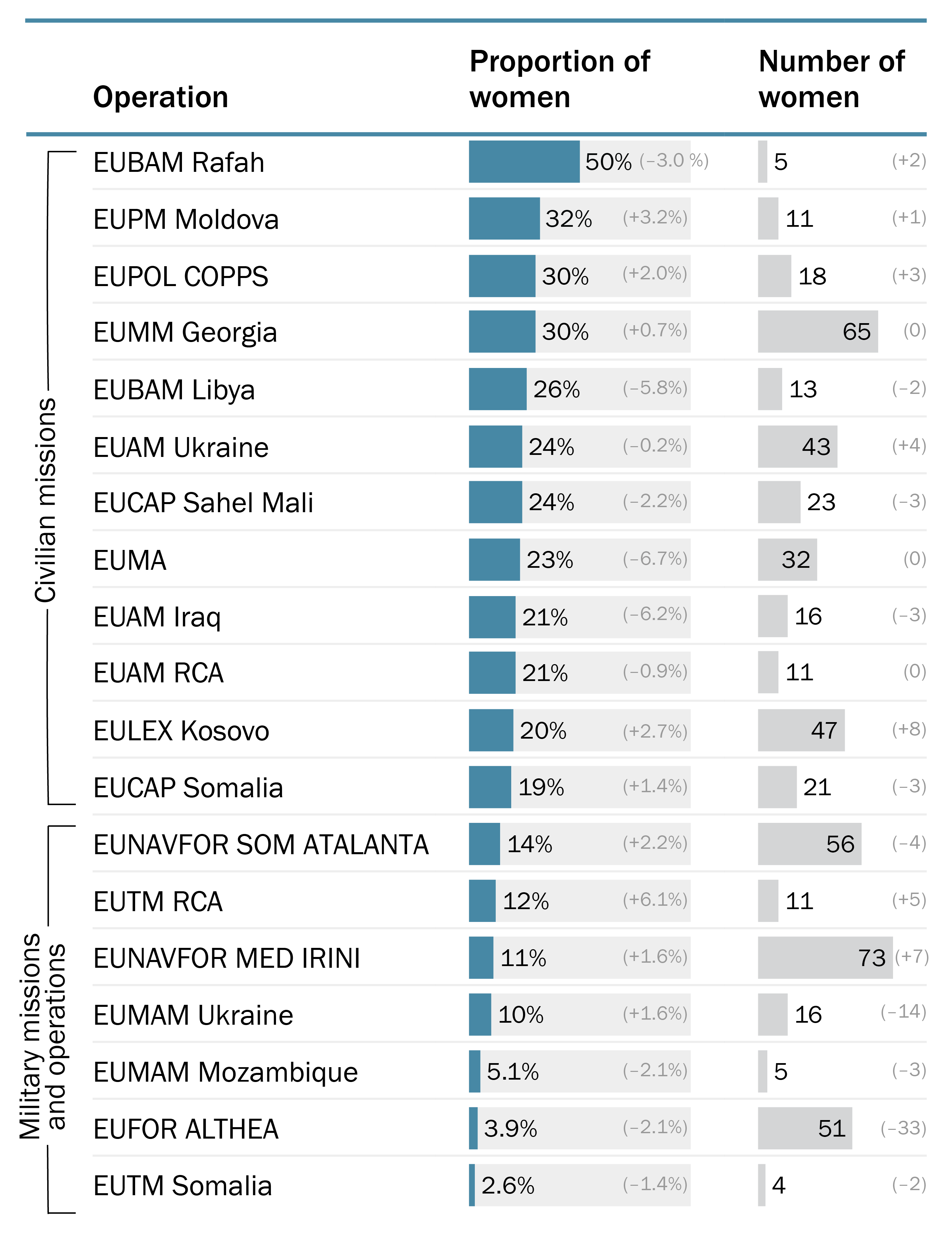
Proportion and number of women in the personnel of EU CSDP missions and operations, monthly averages
Note: For civilian EU CSDP missions, the 2025 monthly averages are based on the months from Jan. to June. For military EU CSDP missions and operations, the averages are based on the year 2024 since the last available data is from Dec. 2024. Values in parentheses indicate the variation in the number or proportion (in percentage points) of women personnel compared to the previous year. The average numbers of women personnel are rounded to the nearest integer.
Contributors
In 2025, 9 of the top 10 contributors by total number of personnel to EU CSDP civilian missions were also among the top 10 contributors by number of women personnel, with Bulgaria as the only exception. Four countries featured in both the top 10 contributors by number of women personnel and the top 10 contributors by proportion of women personnel: Belgium, Finland, Italy and Sweden. Out of 30 contributing countries, 9 had at least 40 per cent women among their seconded personnel.
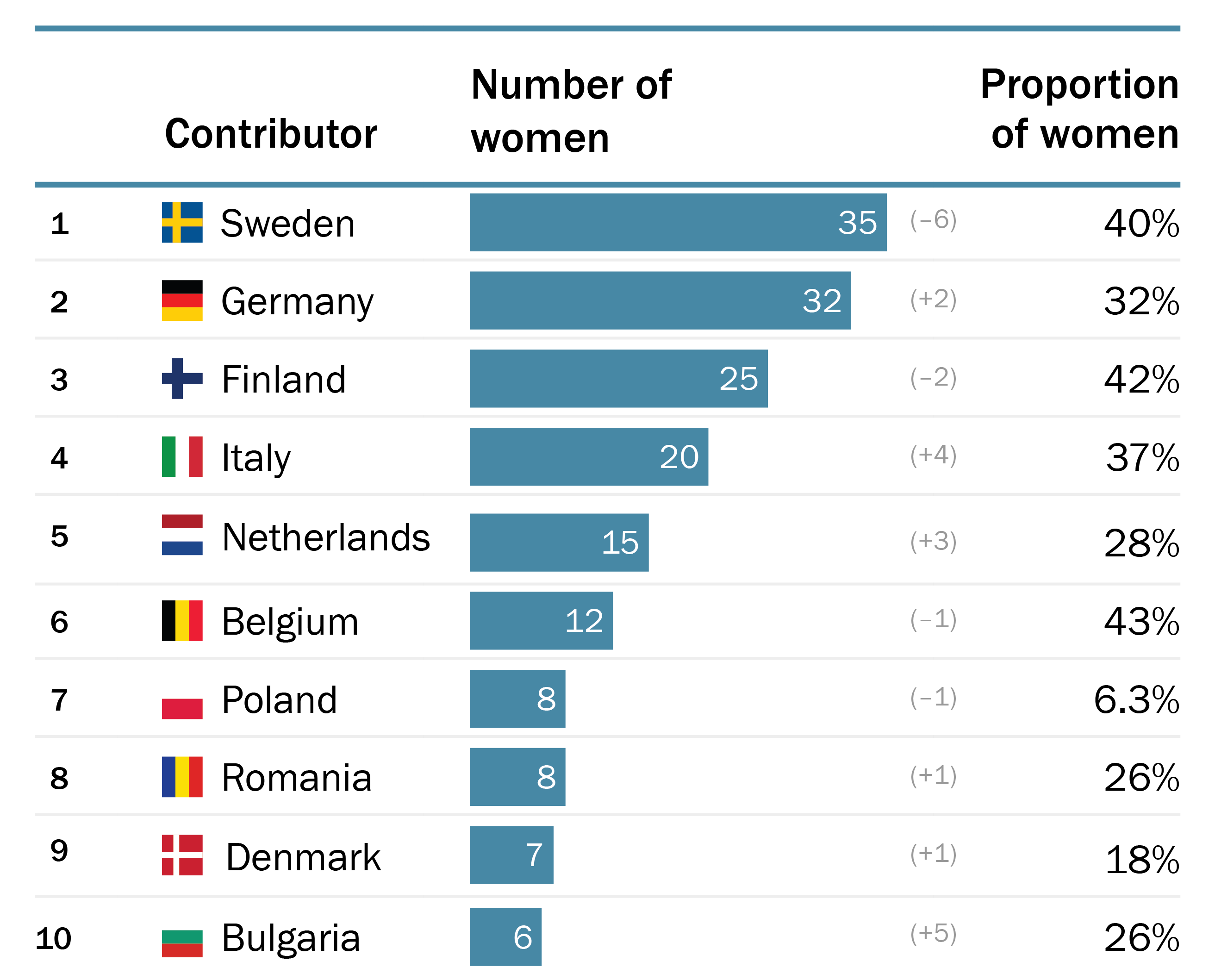
Top 10 contributors by number of women to the personnel of EU CSDP missions, 2025 monthly averages
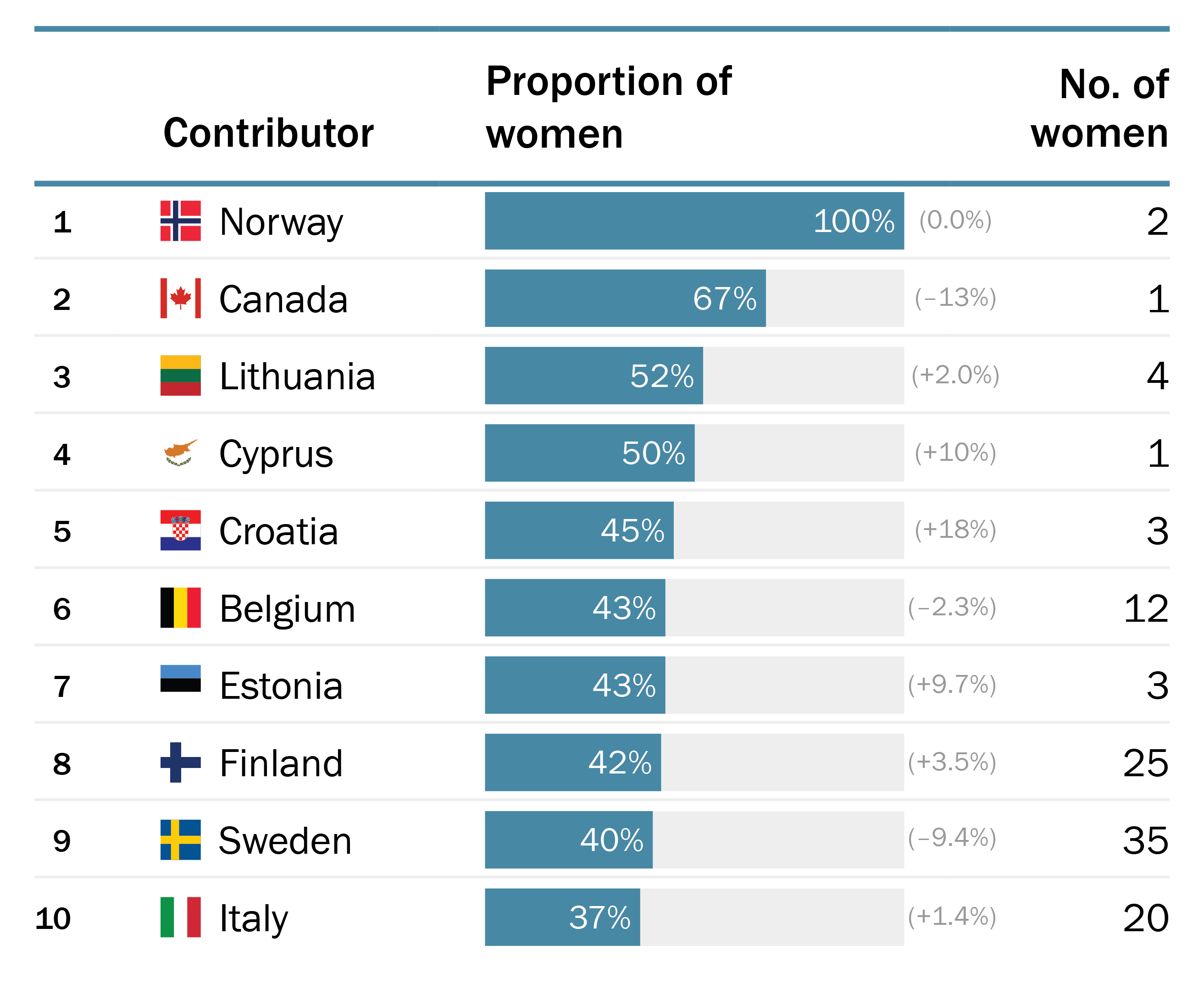
Top 10 contributors by proportion of women to the personnel of EU CSDP missions, 2025 monthly averages
Note: The data includes only civilian EU CSDP missions since data on the country contributions to military EU CSDP missions and operations is not available. The 2025 monthly averages are based on the months from Jan. to June. Values in parentheses indicate the variation in the number or proportion (in percentage points) of women personnel compared to the previous year. The average numbers of women personnel are rounded to the nearest integer.
Concluding remarks
Since the UN Security Council passed its landmark resolution on women, peace and security 25 years ago, organizations and member states have pledged and set targets to improve the representation of women in peace operations. There has been some progress in this regard, but it remains modest and gender parity is still a distant goal. Overall, women continue to be under-represented in the field.
For UN military personnel, both the overall number and the proportion of women have increased. Despite steady gains over the past decade, women’s representation among military experts and staff officers decreased slightly in 2025, although it remained above the year’s intermediate target and on the path towards the 2028 goal of 25 per cent. By contrast, while higher than last year, women’s representation in troop contingents was still low, making the target of 15 per cent by 2028 a challenge at the current pace.
In comparison, women’s participation in the UN police is better aligned with the Uniformed Gender Parity Strategy’s 2028 goals. In 2021, the category of individual police officers met the 2028 target of at least 30 per cent women, and the proportion has continued to hover at around 30–32 per cent. In formed police units, women’s participation surpassed the 2025 target of 15 per cent and has increased steadily since 2021.
Although the proportion of women in UN civilian personnel is higher than in the military and police categories, women still remain a minority across all the UN peace operations and field offices analysed, except UNSCOL. UNSCOL was the only case to meet the UN System-wide Strategy on Gender Parity target of 47–53 per cent women in civilian staff. In 2025, the proportion of women in UN civilian personnel was relatively stable across peace operations and special political missions, with slight increases in both.
Five of the 12 OSCE field operations met the target of 45–55 per cent women in their personnel in 2025: the OSCE Centre in Ashgabat, OMIK, OM Moldova, OM Serbia and the OSCE Project Co-ordinator in Uzbekistan. This was 4 more operations than in the previous year. After a few years in which the proportion of women in OSCE field operations was relatively stable, in 2025 it increased by 7.8 percentage points and reached 45 per cent. The number of women in these operations also increased.
Over the latest reporting periods, there were decreases in the number of women in civilian EU CSDP missions (to June 2025) and in military EU CSDP missions and operations (to December 2024), partly due to the closures of EUCAP Sahel Niger and EUTM Mali respectively. However, the proportion of women increased in military missions and operations and remained unchanged in civilian missions. Of the 19 missions and operations, only EUBAM Rafah reached at least 40 per cent women in its personnel, consistent with the target set by the renewed Civilian CSDP Compact. Regarding women seconded to EU CSDP missions, 9 contributing countries met or exceeded the 40 per cent target for their seconded personnel: Belgium, Canada, Croatia, Cyprus, Estonia, Finland, Lithuania, Norway and Sweden.
The 2025 overview of women’s participation in leadership roles across peace operations shows a mixed picture. Participation increased markedly in the OSCE, up by 17 percentage points to 25 per cent, and in the UN military, which went from having no woman force commander in 2024 to 1 woman in 2025 (out of 8 force commanders). By contrast, the UN police saw a noticeable decline, from 40 per cent in 2024 to 20 per cent in 2025. For UN civilian and EU CSDP missions and operations, the proportions were unchanged from last year, at 30 per cent and 15 per cent respectively. The highest proportion of women in leadership roles was observed in UN civilian personnel.
This annual overview of women’s representation in peace operations is important for understanding the state of play, particularly related to the strategies and targets set by organizations deploying peace operations. However, while the numbers are important for fostering discussions on women’s participation, they have limitations and do not address the deeper challenges. A narrow focus on headcounts can also encourage compliance with targets without addressing underlying constraints in recruitment pipelines, retention, promotion, training and workplace safety. It can also create situations where women are present in numbers but lack equal opportunities or influence.
Alongside tracking representation, organizations need to consider indicators that capture the influence and quality of participation. In line with the WPS agenda, this focus on participation should advance together with the other WPS pillars of prevention, protection, and relief and recovery. They should work as mutually reinforcing elements in the integrated implementation of the agenda. Finally, as part of this integrated effort, it is crucial to simultaneously highlight the need for institutional measures that create enabling conditions for the meaningful and equitable participation of women in peace operations.
Source: SIPRI Multilateral Peace Operations Database, accessed Oct. 2025.
The SIPRI Multilateral Peace Operations Database is the only database on multilateral peace operations in the world that combines sex-disaggregated data on UN and non-UN peace operations.
Endnotes
- 1 This number includes field offices that are not considered multilateral peace operations according to SIPRI’s definition, namely UNOAU, UNOCA, UNOWAS, UNSCO and UNSCOL.
- 2 This number includes field operations that are not considered multilateral peace operations according to SIPRI’s definition, namely OM Montenegro, the OSCE Centre in Ashgabat, the OSCE Project Co-ordinator in Uzbekistan, PO Astana, PO Bishkek and PO Dushanbe.
- 3 This number includes field operations that are not considered multilateral peace operations according to SIPRI’s definition, namely EUCAP Somalia, EUMAM Ukraine, EUNAVFOR ASPIDES, EUNAVFOR MED IRINI and EUNAVFOR SOM ATALANTA.
Abbreviations
| A4P | Action for Peacekeeping (of the UN) |
|---|---|
| A4P+ | Action for Peacekeeping+ (of the UN) |
| BINUH | UN Integrated Office in Haiti |
| CSDP | Common Security and Defence Policy (of the EU) |
| EEAS | European External Action Service |
| EU | European Union |
| EUAM Iraq | EU Advisory Mission in Iraq |
| EUAM RCA | EU Advisory Mission in the Central African Republic |
| EUAM Ukraine | EU Advisory Mission Ukraine |
| EUBAM Libya | EU Border Assistance Mission in Libya |
| EUBAM Rafah | EU Border Assistance Mission for the Rafah Crossing Point |
| EUCAP Sahel Mali | EU Capacity Building Mission in Mali |
| EUCAP Sahel Niger | EU Capacity Building Mission in Niger |
| EUCAP Somalia | EU Capacity Building Mission in Somalia |
| EUFOR ALTHEA | EU Force Bosnia and Herzegovina /Operation ALTHEA |
| EULEX Kosovo | EU Rule of Law Mission in Kosovo |
| EUMA | EU Mission in Armenia |
| EUMAM Mozambique | EU Military Assistance Mission Mozambique |
| EUMAM Ukraine | EU Military Assistance Mission in support of Ukraine |
| EUMM Georgia | EU Monitoring Mission in Georgia |
| EUNAVFOR ASPIDES | EU Naval Force Operation Aspides |
| EUNAVFOR MED IRINI | EU Naval Force Mediterranean /Operation Irini |
| EUNAVFOR SOM ATALANTA | EU Naval Force Somalia /Operation Atalanta |
| EUPM Moldova | EU Partnership Mission in the Republic of Moldova |
| EUPOL COPPS | EU Police Mission for the Palestinian Territories |
| EUTM Mali | EU Training Mission in Mali |
| EUTM RCA | EU Training Mission in the Central African Republic |
| EUTM Somalia | EU Training Mission in Somalia |
| MINURSO | UN Mission for the Referendum in Western Sahara |
| MINUSCA | UN Multidimensional Integrated Stabilization Mission in the Central African Republic |
| MONUSCO | UN Organization Stabilization Mission in the Democratic Republic of the Congo |
| OM Moldova | OSCE Mission to Moldova |
| OM Montenegro | OSCE Mission to Montenegro |
| OM Serbia | OSCE Mission to Serbia |
| OM Skopje | OSCE Mission to Skopje |
| OMBIH | OSCE Mission to Bosnia and Herzegovina |
| OMIK | OSCE Mission in Kosovo |
| OPA | OSCE Presence in Albania |
| OSCE | Organization for Security and Co-operation in Europe |
| OSCE PRCIO | OSCE Personal Representative of the Chairperson-in-Office on the Conflict Dealt withby the OSCE Minsk Conference |
| PO Astana | OSCE Programme Office in Astana |
| PO Bishkek | OSCE Programme Office in Bishkek |
| PO Dushanbe | OSCE Programme Office in Dushanbe |
| SMM | OSCE Special Monitoring Mission to Ukraine |
| UN | United Nations |
| UNAMA | UN Assistance Mission in Afghanistan |
| UNAMI | UN Assistance Mission for Iraq |
| UNDOF | UN Disengagement Observer Force |
| UNFICYP | UN Peacekeeping Force in Cyprus |
| UNIFIL | UN Interim Force in Lebanon |
| UNISFA | UN Interim Security Force for Abyei |
| UNITAMS | UN Integrated Transition Assistance Mission in Sudan |
| UNMHA | UN Mission to support the Hudaydah Agreement |
| UNMIK | UN Interim Administration Mission in Kosovo |
| UNMISS | UN Mission in South Sudan |
| UNMOGIP | UN Military Observer Group in India and Pakistan |
| UNOAU | UN Office to the African Union |
| UNOCA | UN Regional Office for Central Africa |
| UNOWAS | UN Office for West Africa and the Sahel |
| UNSCO | Office of the UN Special Coordinator for the Middle East Peace Process |
| UNSCOL | Office of the UN Special Coordinator for Lebanon |
| UNSMIL | UN Support Mission in Libya |
| UNTMIS | UN Transitional Assistance Mission in Somalia |
| UNTSO | UN Truce Supervision Organization |
| UNVMC | UN Verification Mission in Colombia |
| WPS | Women, peace and security |
ABOUT THE AUTHOR(S)/EDITORS

Dr Claudia Pfeifer Cruz is a Senior Researcher in the SIPRI Peace Operations and Conflict Management Programme.

Abeer S. Ahmad is a Researcher in the SIPRI Peace and Development Programme.