News
|
|

SIPRI Yearbook 2026 summary now available in 14 languages
The summary of SIPRI Yearbook 2026 is now available in English, Arabic, Catalan, Chinese, Dutch, French, Italian, Japanese, Korean, Portuguese, Russian, Spanish, Swedish and Ukrainian. The Yearbook provides an independent overview of developments in armaments, disarmament and international security. SIPRI is grateful for the work of its translation partners.
Read more | Explore SIPRI Yearbook 2026
|
|
|

2026 Stockholm Forum on Peace and Development
On 3–4 November 2026, SIPRI will host the 2026 Stockholm Forum on Peace and Development on the theme ‘From Rupture to Repair: New Visions for Peace and Development’. The 2026 Stockholm Forum will be held by invitation only at Münchenbryggeriet in Stockholm and is co-convened with the Folke Bernadotte Academy and the Swedish International Development Cooperation Agency. The plenary sessions will be livestreamed on SIPRI’s YouTube channel.
Read more | Watch the livestreams
|
|
|

SIPRI statement on the 2026 Nobel Peace Prize
SIPRI congratulated Navanethem ‘Navi’ Pillay on the award of the 2026 Nobel Peace Prize. In a statement, SIPRI Director Karim Haggag emphasized the importance of international law, justice and accountability for peace. He highlighted the award’s significance at a time when international legal institutions are under pressure and civilians face the consequences of states disregarding international law.
Read the SIPRI statement
|
|
|

SIPRI publications—now available in full-text HTML
All publications issued in SIPRI’s regular series in 2025 and 2026 are now available in full-text HTML, alongside the existing downloadable PDFs. Future publications in these series will also be available in this format. The HTML editions adjust to different screen sizes and offer interactive content menus and linked references. Many also include interactive charts, maps and tables. The format makes SIPRI research easier to find, navigate and use, including through search engines and AI-assisted research tools.
Read more | Access SIPRI publications
|
|
|
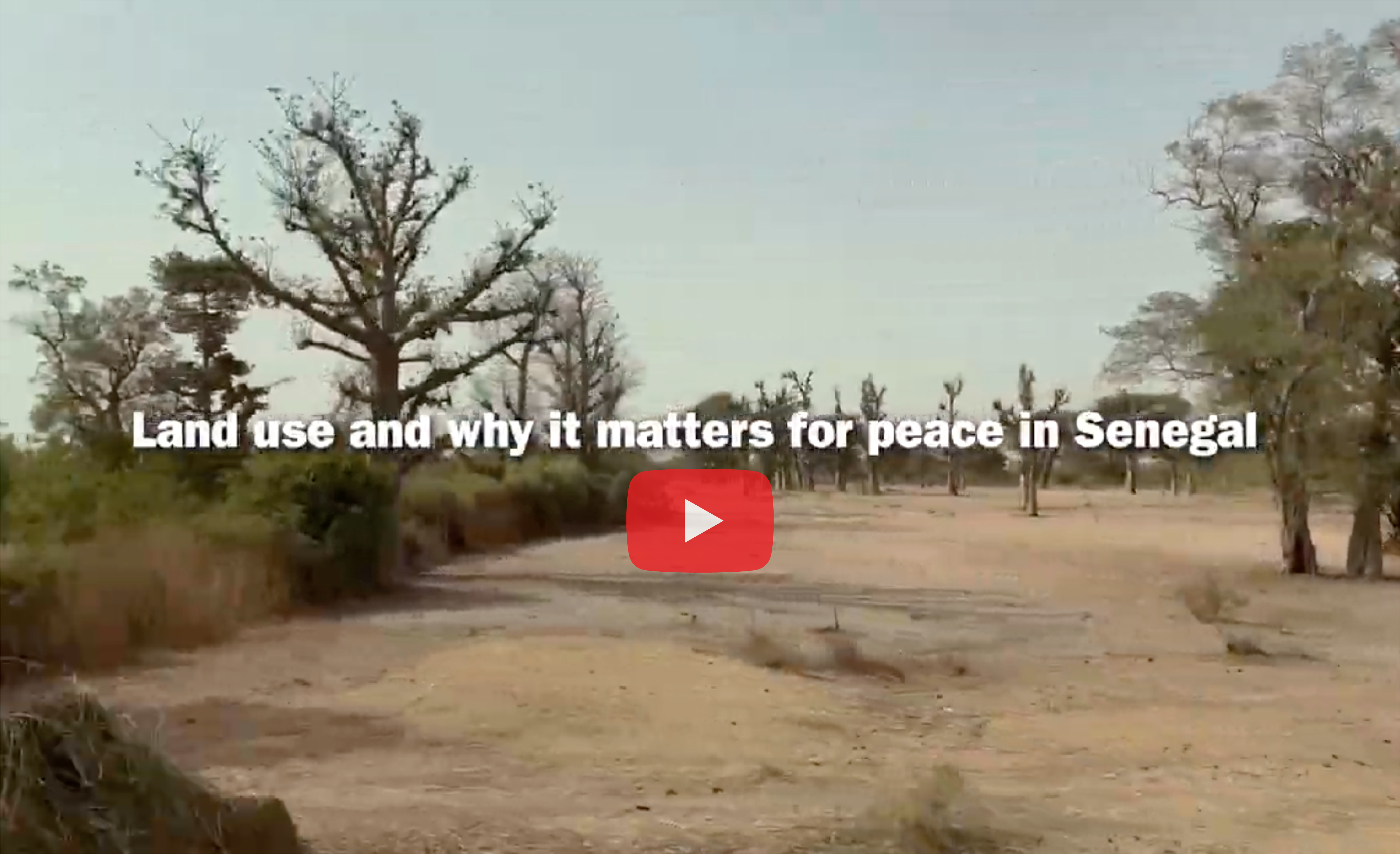
New SIPRI film: Why land-use governance matters for social cohesion and conflict prevention in Senegal
SIPRI is pleased to launch a new film exploring how land-use governance shapes social cohesion and conflict prevention in Senegal. Despite being regarded as one of West Africa’s most stable democracies, Senegal has experienced security challenges and its location in the increasingly volatile Sahel exposes it to broader regional pressures. Addressing the drivers of violence early is therefore crucial for maintaining social cohesion, public trust and peaceful stability. This film was made by SIPRI in cooperation with GIZ, with funding from the German Federal Ministry for Economic Cooperation and Development.
Watch the film
|
|
|
Recent events
|
SIPRI convenes Berlin Climate Security Conference events
October 2026
In October, SIPRI convened and co-hosted three events in Berlin on the relationship between development, climate change and security.
Read more
|
|
Managing quantum computer export controls in an era of geopolitical competition
8 October 2026
SIPRI hosted a webinar on export controls and other technology security policies for quantum computing.
Read more | Watch the recording
|
|
SIPRI co-hosts event during United Nations General Assembly High-level Week
24 September 2026
SIPRI and partners organized a side event in New York on rising military expenditure and alternatives for achieving durable security.
Read more
|
|
SIPRI hosts Canberra workshop on China’s export control framework
23 September 2026
SIPRI’s Dual-use and Arms Trade Control Programme delivered a workshop in Canberra on developments in China’s export control framework and their implications for Australia and multilateral cooperation.
Read more
|
|
SIPRI co-convenes human security dialogue in Rome
16–17 September 2026
SIPRI, the Istituto Affari Internazionali and the UN Trust Fund for Human Security convened a dialogue on human security in Europe and the Mediterranean.
Read more
|
|
SIPRI experts at the 15th EUNPDC Consultative Meeting
15 and 18 September 2026
SIPRI experts took part in the annual EU Non-Proliferation and Disarmament Consortium (EUNPDC) Consultative Meeting in Brussels.
Read more
|
|
|
|
|
|
The military AI industry’s involvement in armed conflict: Implications under international humanitarian law
Military artificial intelligence (AI) capabilities increasingly support targeting and other military operations, often relying on continued involvement by industry suppliers. This SIPRI Topical Backgrounder examines how international humanitarian law (IHL) applies to these industry actors. The backgrounder explores under what circumstances industry personnel and assets may lose civilian protection, the conditions for legal accountability for IHL violations and the industry’s role in supporting compliance. It also highlights states’ overarching responsibilities and the need for greater legal clarity.
Read the SIPRI Topical Backgrounder
|
|
|
Military spending in Russia’s draft federal budget for 2027 to 2029
On 30 September, the Russian Ministry of Finance submitted its draft federal budget for 2027–29 to the State Duma. This SIPRI Topical Backgrounder examines what the draft reveals about Russia’s military spending intentions, the economic assumptions behind it and spending that falls outside the ‘National defence’ budget chapter. The analysis also highlights uncertainties surrounding budget implementation and the provisional nature of projections for 2028 and 2029.
Read the SIPRI Topical Backgrounder
|
|
|
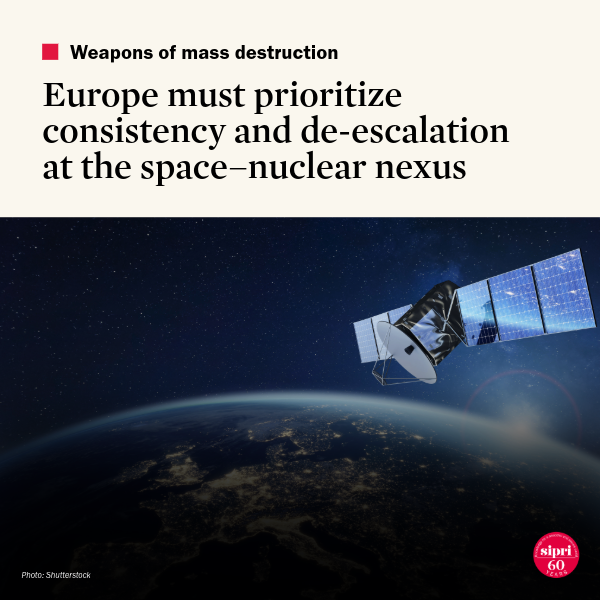
Europe must prioritize consistency and de-escalation at the space–nuclear nexus
Space systems support both conventional weapons and nuclear infrastructure, creating risks of escalation across domains when these systems are perceived to be under threat. This SIPRI Essay examines European responses to a changing strategic environment marked by heightened competition among nuclear-armed states and declining interest in arms control. The essay argues for a more consistent approach to space and nuclear security that prioritizes de-escalation.
Read the SIPRI Essay
|
|
|
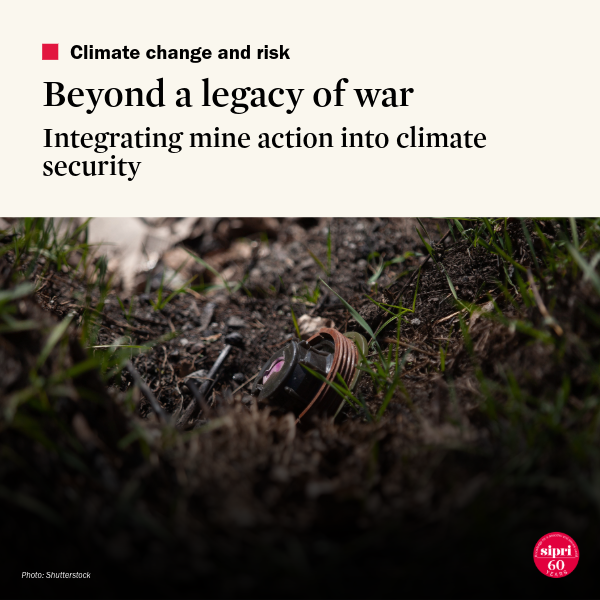
Beyond a legacy of war: Integrating mine action into climate security
Landmine contamination and climate change can interact to create new risks for communities. Flooding and erosion can move mines, while contamination can restrict access to land and hinder climate adaptation and disaster response. This blog explores these overlapping challenges and argues for closer coordination between mine action authorities and institutions responsible for environmental policy, disaster risk reduction and climate adaptation.
Read the SIPRI WritePeace Blog
|
|
|

SIPRI experts were recently featured in these external outlets:
|
|
Publications
|
|
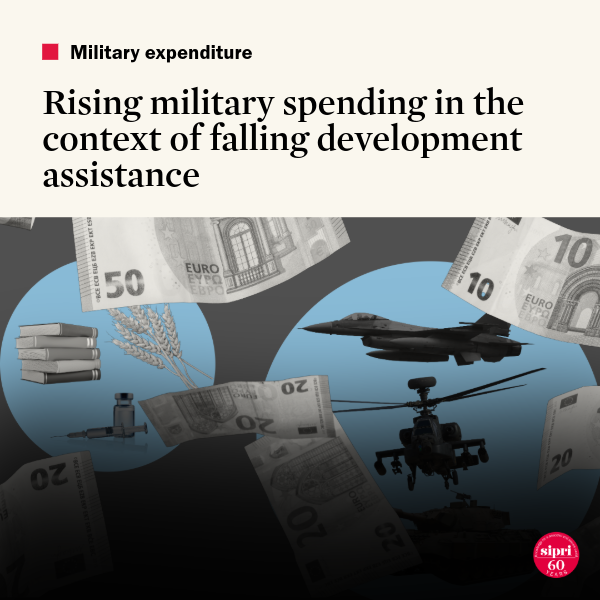
Rising Military Spending in the Context of Falling Development Assistance
Funding for sustainable development is facing sharp cuts as global development and humanitarian needs rise, while many donor countries are rapidly increasing military spending. This paper examines the divergence between military expenditure and official development assistance, including case studies of Germany and the United Kingdom. It finds that savings from aid reductions are small compared with planned increases in military spending, but that the cuts will have significant development and humanitarian consequences. An empirical model also shows that current and projected aid commitments fall well below the levels expected in relation to global needs.
Read the paper | Read the press release
|
|
|
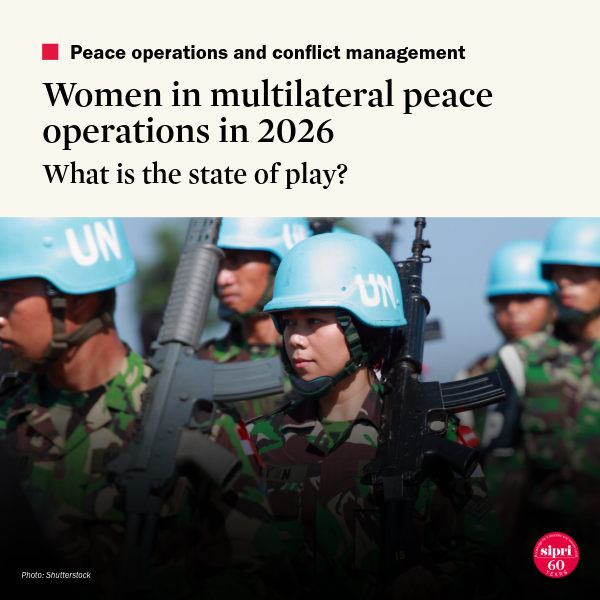
Women in Multilateral Peace Operations in 2026: What is the State of Play?
As the 26th anniversary of UN Security Council Resolution 1325 approaches on 31 October, progress towards increasing women’s representation in multilateral peace operations remains uneven. This report examines representation in UN peace operations, European Union missions and operations, and Organization for Security and Co-operation in Europe field operations. Through data visualizations, it presents personnel trends, women’s representation in leadership and annual averages of women’s representation among personnel and in member state contributions.
Read the SIPRI report | Explore the visualizations
|
|
|

Commitments into action: Women, Peace, and Security in defence budgeting
This policy brief examines how defence institutions can integrate women, peace and security (WPS) commitments into their budgeting cycles. It maps how gender analysis and WPS principles can inform five phases of the defence budgeting process, using existing accountability mechanisms such as audits, parliamentary oversight and civil society monitoring. The brief offers recommendations for a range of stakeholders while considering wider questions about defence spending amid declining development assistance and growing humanitarian needs.
Read the partner policy brief
|
|
|

Countering Drone Proliferation from Russia’s War Against Ukraine: Implications for Arms Control and Security Governance
Russia’s war against Ukraine has accelerated the spread of cheap, scalable drone technologies and their use beyond the battlefield. This paper examines the implications for European arms control and security governance. It explores rapid proliferation, uncertainty in airspace governance and sanctions evasion, arguing that technological responses alone are insufficient. The paper identifies gaps in arms trade regulations and dual-use export controls that European countries need to address.
Read the EUNPDC paper
|
|
|
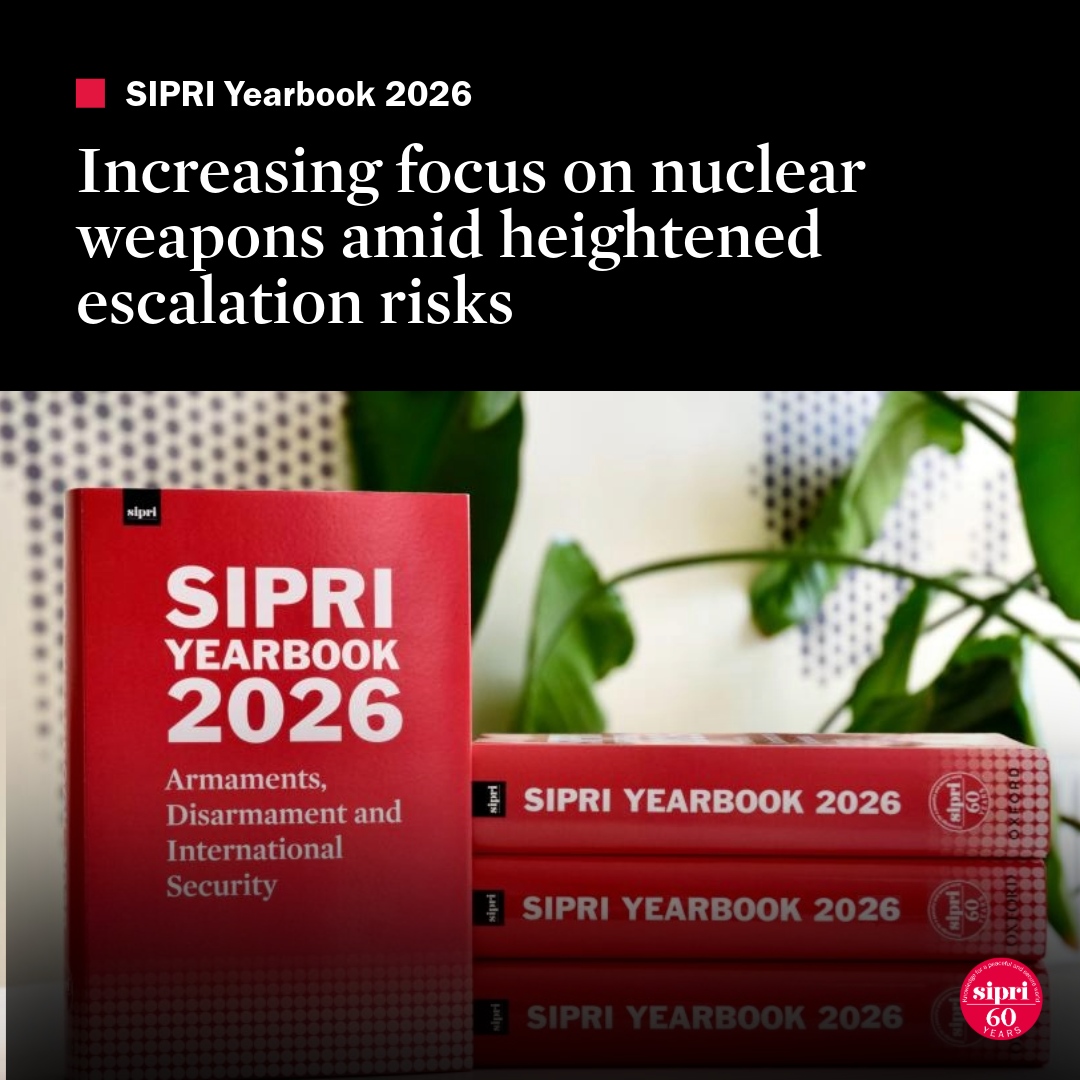
|
SIPRI Yearbook 2026
SIPRI Yearbook 2026 provides an overview of developments in international security, weapons and technology, military expenditure, arms production and the arms trade, and armed conflicts and conflict management, along with efforts to control conventional, nuclear, chemical and biological weapons. This 57th edition of the SIPRI Yearbook covers developments during 2025, including:
- armed conflict and conflict management, with an overview of global and regional developments in armed conflict, peace processes and peace operations;
- military expenditure, international arms transfers and developments in arms production, documenting, in particular, the consequences of a significant unravelling of global security;
- the proliferation of missiles and uncrewed aerial vehicles, with a focus on their widening use in armed conflict; and
- world nuclear forces, highlighting the nuclear modernization trends in the nine nuclear-armed states.
Browse the contents page | Download the summary | Download the sample chapter on world nuclear forces | Download the sample chapter on artificial intelligence and international peace and security | Download the sample chapter on space security governance | Download the introductory chapter | Order SIPRI Yearbook 2026
|
|