The independent resource on global security

4. Peace processes and multilateral peace operations
Contents
I. Introduction
II. From comprehensive to transactional and coercive peace processes
III. Key peace processes in 2025
IV. Multilateral peace operations in 2025
V. Table of multilateral peace operations, 2025
VI. Conclusions
Peace processes became more fragmented, transactional and coercive in 2025. There was less emphasis on comprehensive, inclusive settlements and more on rapid deals, ceasefires and leader-driven bargaining. This approach achieved some outline agreements, but these were often fragile, disputed or incomplete, and prioritized economic and strategic interests over durable reconciliation.
Increasing geopolitical rivalries have had a huge impact on multilateral peace operations in recent years. The United States is no longer willing to sustain the multilateral system and in 2025 took significant action to withdraw from, defund and challenge the efficacy of various United Nations bodies. China and the European Union are unwilling or unable to replace the USA in this role. In this context of multilateral inaction, middle powers—including Brazil, Qatar, Saudi Arabia, Türkiye and the United Arab Emirates—have gained increased manoeuvring space to substitute for, or complement, the multilateral security frameworks while actively advancing their own national interests.
Peace processes in 2025
There were partial breakthroughs and agreements in some major or long-running conflicts during 2025, including Armenia–Azerbaijan, the Democratic Republic of the Congo–Rwanda, Kyrgyzstan–Tajikistan and the war in Gaza. However, implementation gaps and renewed violence remain major risks.
In 2025the UN Security Council endorsed the establishment of US President Donald J. Trump’s proposed Board of Peace as a new international transitional body to supervise governance in Gaza. However, the board’s founding Charter contains far more ambitious aims that are potentially in competition with those of the UN.
Multilateral peace operations
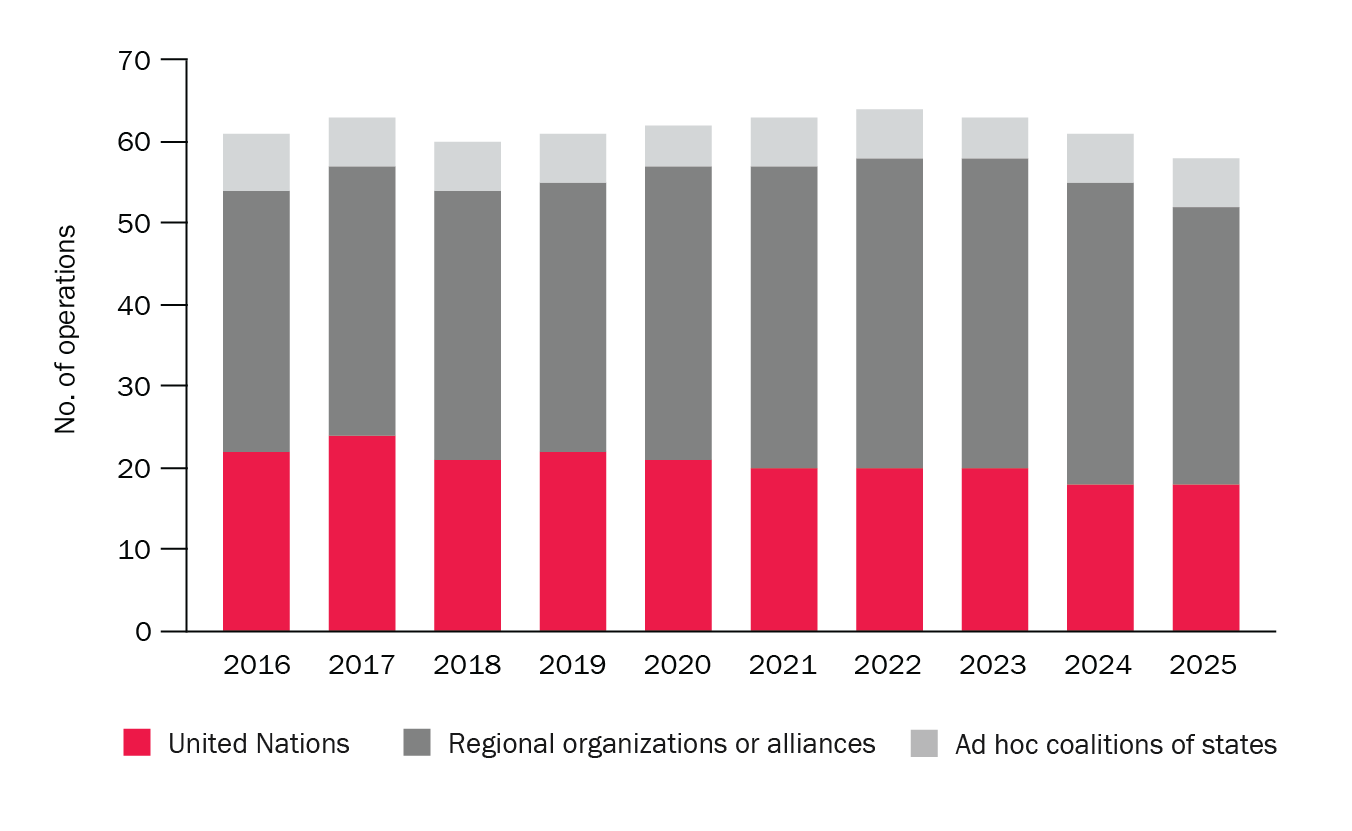
Multilateral peace operations faced political and financial strain in 2025, as well as declining consensus and mission withdrawal, signalling a challenging outlook for traditional peacebuilding. There were 58 active peace operations in 2025, which was 3 fewer than in the previous year, meaning that the number fell below 60 for the first time since 2016. Two started during 2025: the African Union (AU) Support and Stabilization Mission in Somalia (AUSSOM), which succeeded the AU Transition Mission in Somalia (ATMIS); and the Gang Suppression Force (GSF) in Haiti. Four had closed by the end of the year: the Multinational Security Support Mission in Haiti (MSS); the Personal Representative of the Organization for Security and Co-operation in Europe (OSCE) Chairperson-in-Office on the Conflict Dealt with by the OSCE Minsk Conference (PRCIO); the Southern African Development Community (SADC) Mission in the Democratic Republic of the Congo (SAMIDRC); and the UN Assistance Mission in Iraq (UNAMI).
Multilateral peace operations, by conducting organization, 2016–25
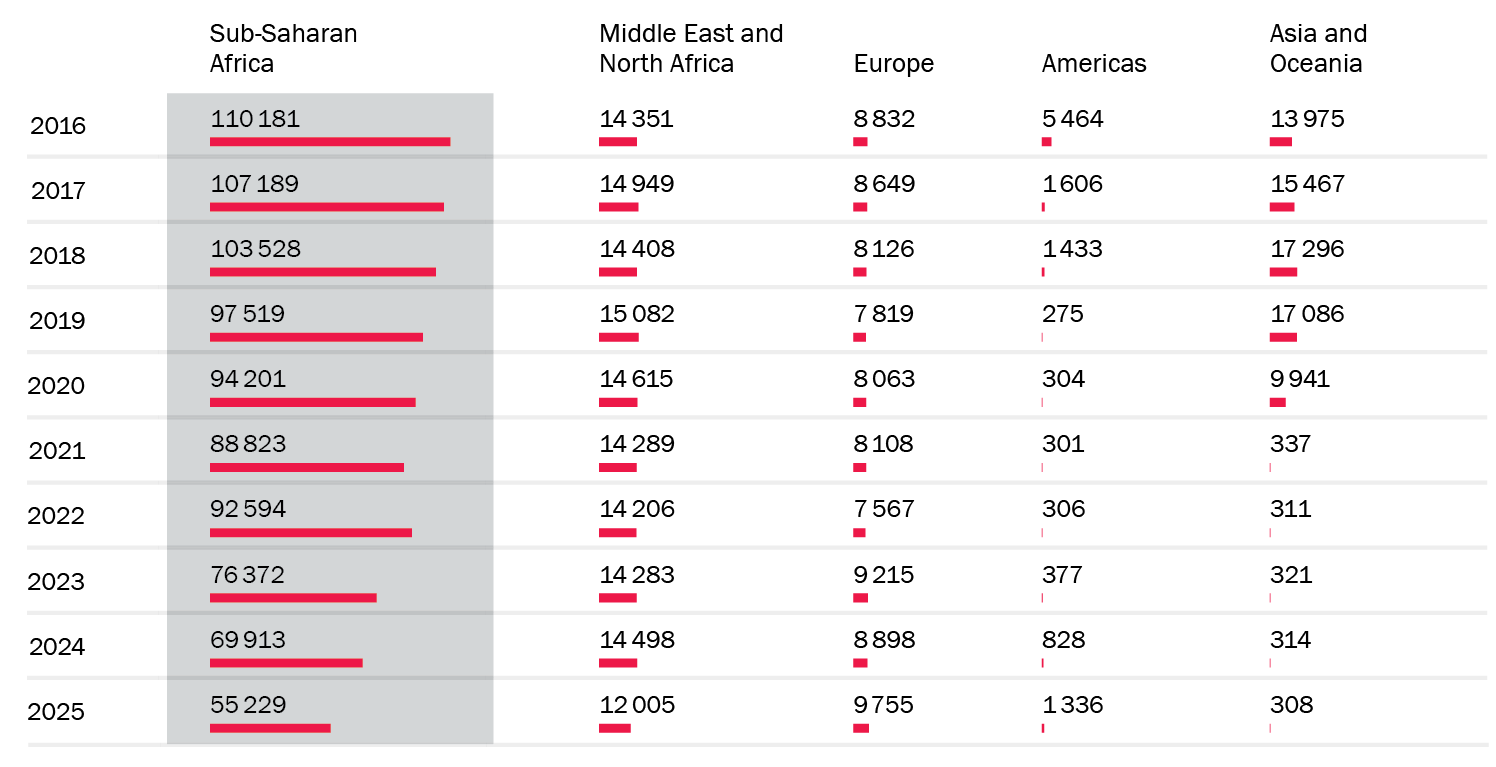
The number of personnel deployed to multilateral peace operations globally has fallen by nearly 49 per cent during the past decade, dropping from 152 803 in December 2016 to 78 633 in December 2025. The overall year-on-year decrease in personnel numbers of 15 818 in 2025 can primarily be attributed to reductions in sub-Saharan Africa, where most peace operation personnel were deployed.
Number of international personnel in multilateral peace operations, by region, 2016–25
In the past decade, the UN’s peacekeeping budget has declined (in nominal terms) from about US$7.9 billion to just under $5.4 billion, but it continued to be the main organization deploying multilateral peace operations in 2025. It accounted for 18 operations and 67 per cent of all personnel deployed as of December 2025. However, most peace operations were deployed by regional organizations or alliances, which led 34 multilateral peace operations in 2025 (3 fewer than in 2024). Ad hoc coalitions of states con-ducted 6 multilateral peace operations in 2025, which was the same number as in 2024.
English