|
| |
|
News | Events | Commentaries | Publications | Vacancies
|
News
|
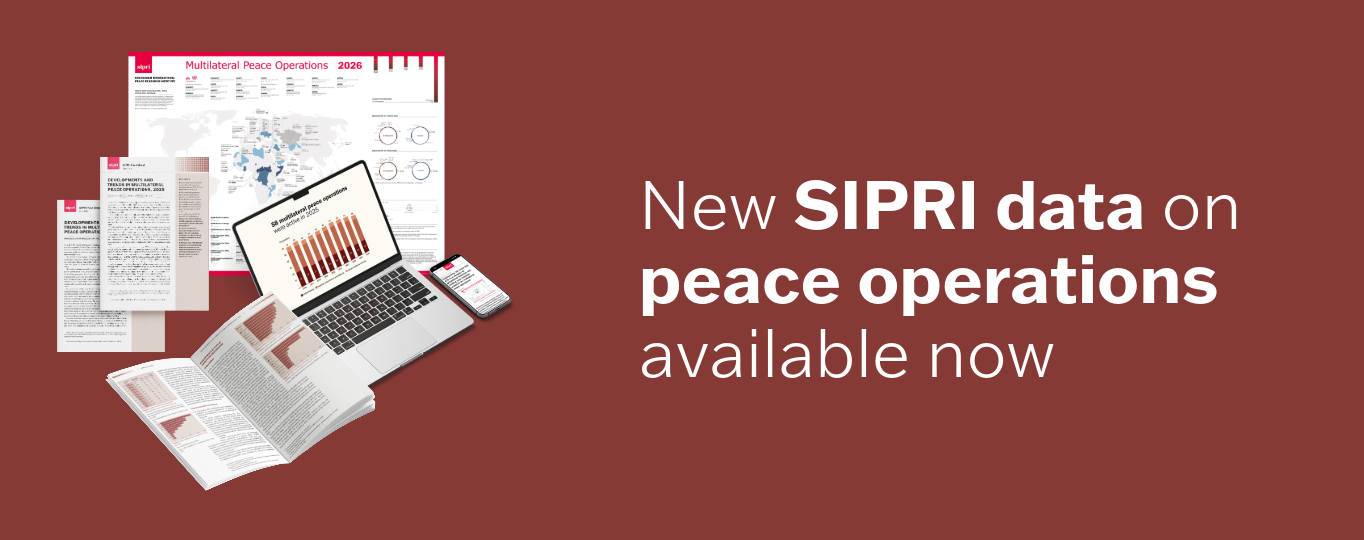 |
Peacekeeping in peril amid plummeting troop numbers and geopolitical deadlock: New SIPRI report
Ahead of the International Day of United Nations Peacekeepers, SIPRI released a new analysis of developments and trends in multilateral peace operations. The report found that geopolitical tensions, political pressures and funding crises are putting the viability of multilateral peacekeeping in jeopardy. The number of personnel in peace operations at the end of 2025 fell to its lowest point in at least 25 years.
Read more | Read the SIPRI Fact Sheet | Explore the visualizations | Explore the map
|
|
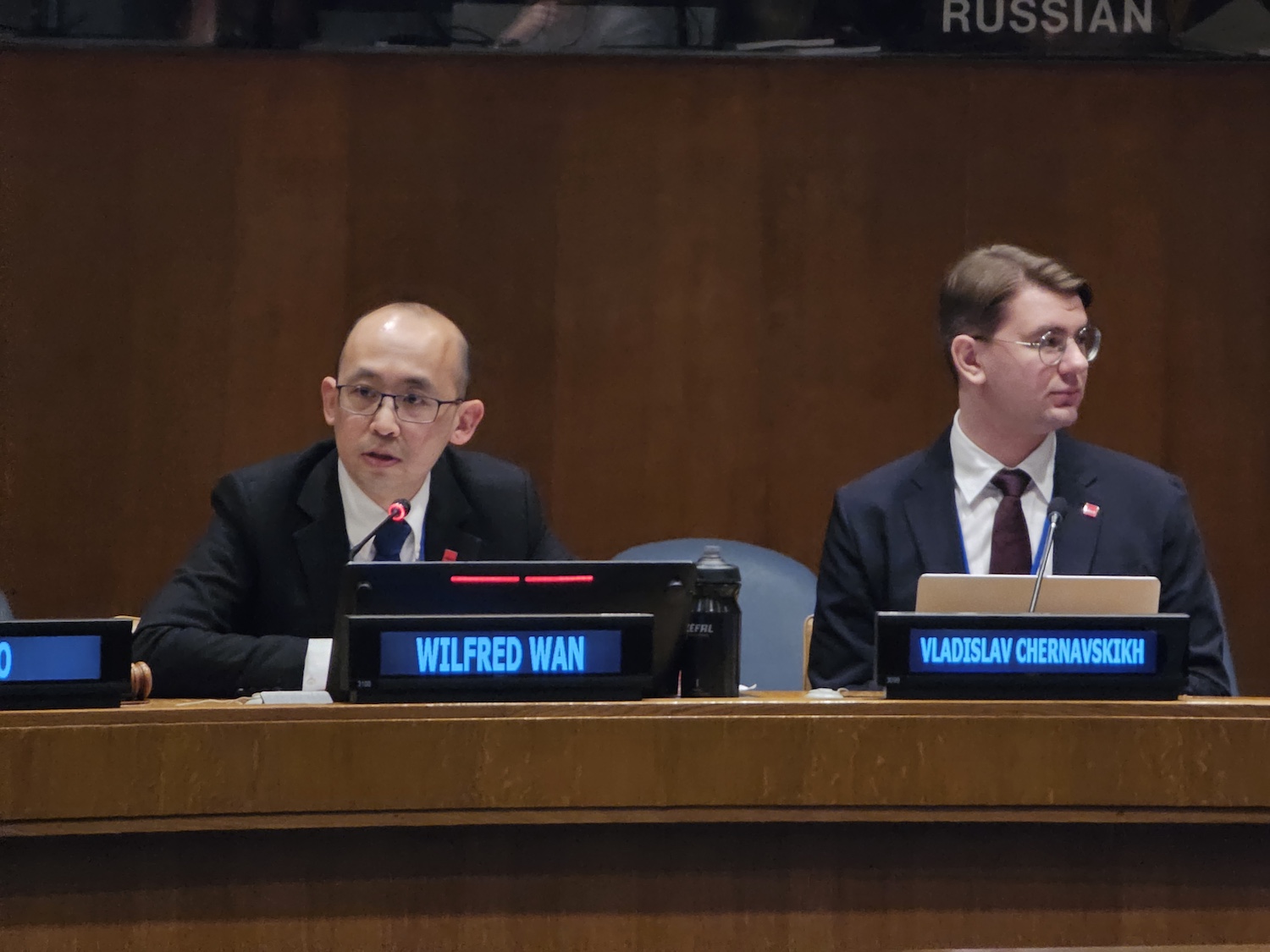 |
SIPRI experts at the 11th Nuclear Non-Proliferation Treaty review conference
Experts from the SIPRI Weapons of Mass Destruction (WMD) Programme took part in the 11th Review Conference of the Parties to the Treaty on the Non-Proliferation of Nuclear Weapons (NPT), which ran from 27 April to 22 May in New York. SIPRI experts contributed to a range of events on nuclear disarmament, risk reduction and the implications of emerging technologies.
Read more
|
|
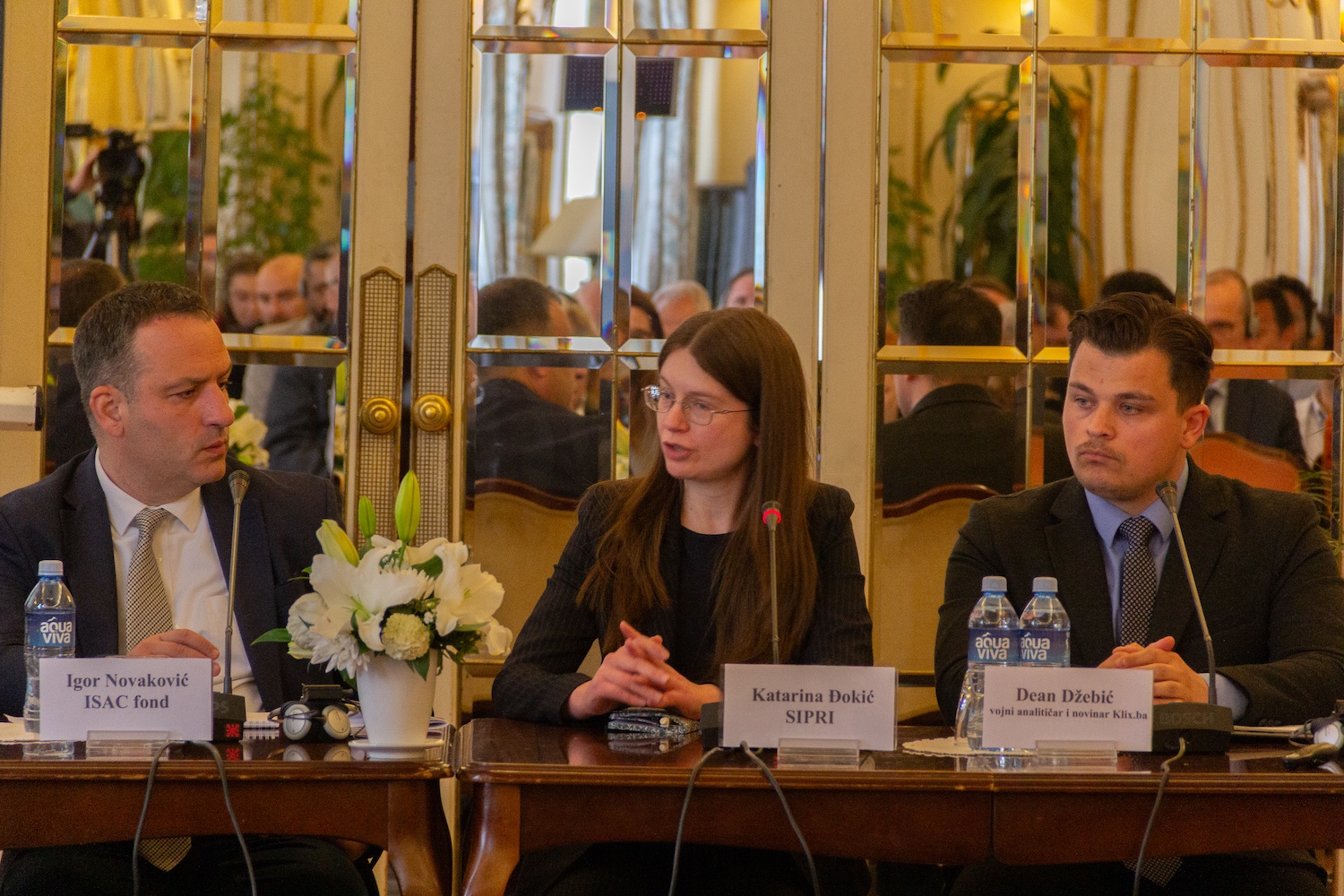 |
SIPRI co-organizes conference on increasing militarization in the Western Balkans
On 13 May, SIPRI, in partnership with the news outlet Nova Ekonomija, organized a conference in Belgrade, Serbia, on ‘The Price of Security—Between Threat and Trust’, as part of an ongoing SIPRI project funded by the Swedish Institute. During the event, experts discussed the economic consequences and the transparency of arms procurement processes in the Western Balkans. Panellists also examined how rising military spending is justified in Serbia, how it is portrayed and perceived in the media, and how countries in the region view increases in their neighbours’ military expenditure.
Read more
|
|
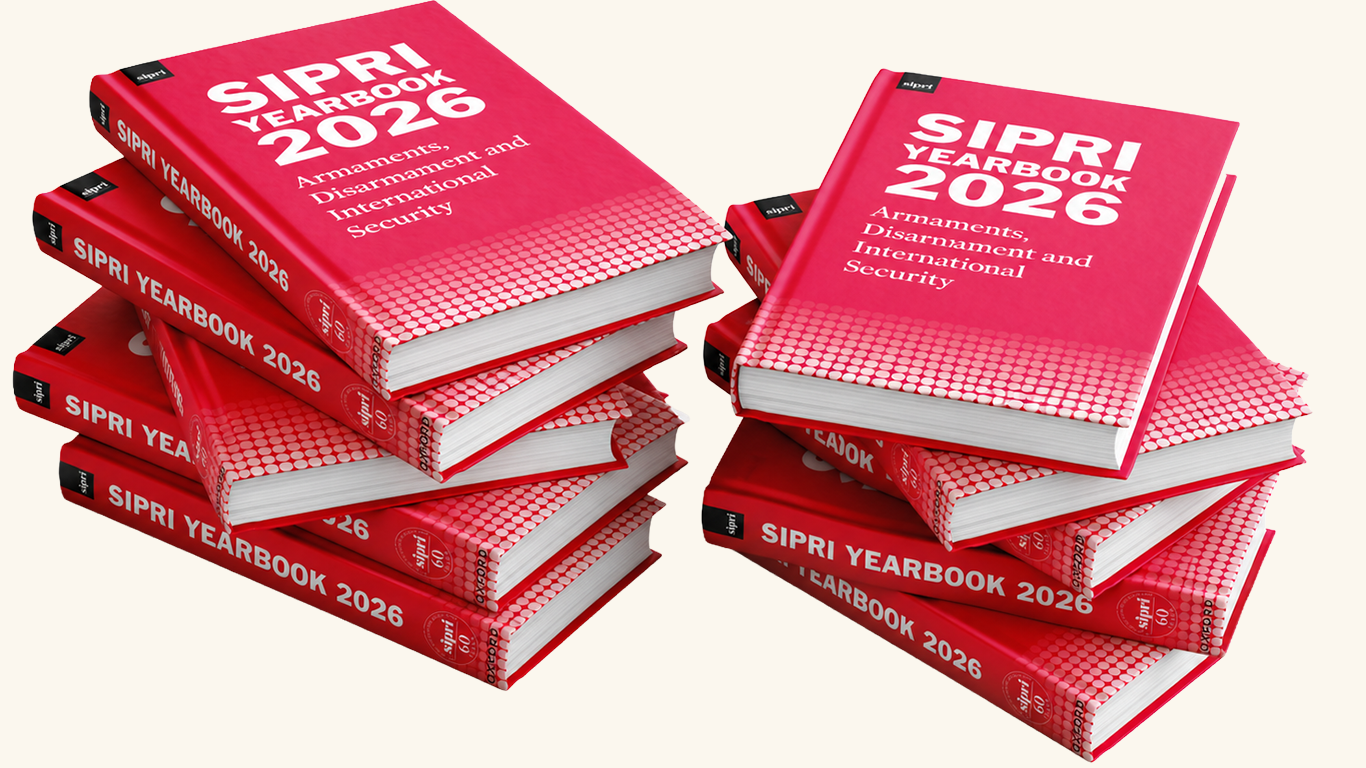 |
SIPRI to celebrate 60th anniversary with SIPRI Yearbook launch at the Swedish Parliament
SIPRI is honoured to be invited to launch SIPRI Yearbook 2026 at the Swedish Parliament on 9 June 2026 to celebrate SIPRI’s 60th anniversary. As part of the launch, the Parliament’s Committee on Foreign Affairs will hold an open meeting, which will be available to watch live online. During the event, SIPRI experts will join SIPRI Director Karim Haggag to discuss nuclear arms control, military uses of artificial intelligence and the centrality of the space domain to contemporary warfare.
Read more | Watch the livestream | Pre-order the Yearbook
|
|
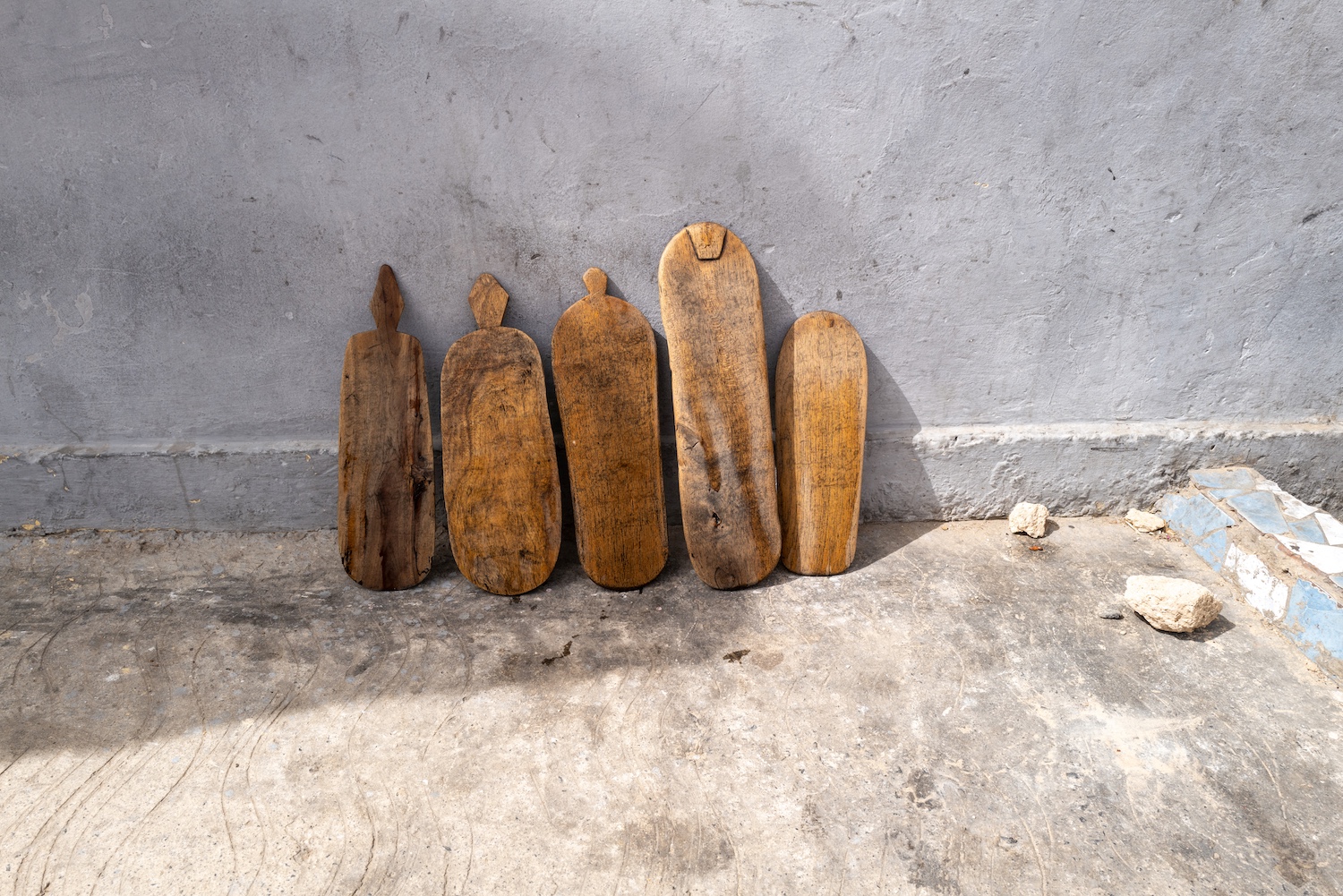 |
SIPRI and partners launch publications on peacebuilding and conflict prevention in West Africa and the Lake Chad Basin
SIPRI, together with its partners the West Africa Network for Peacebuilding and the Danish Refugee Council, has launched the book Madrasas, State Regulation and Governance in West Africa: A Comparative Perspective. The book was developed through the Research & Action for Peace (REcAP) Network, in collaboration with researchers from across West Africa, and focuses on the diversity of madrasa systems in West Africa and their role in promoting inclusive, quality education for long-term conflict prevention. The REcAP Network has also produced a series of working papers and policy briefs that focus on a range of issues central to peace and security in West Africa.
Read more | Read the book in English and French | Download the working papers and policy briefs
|
|
 |
SIPRI welcomes three new members to its Governing Board
The Swedish Government has formally appointed Zeid Ra’ad Al Hussein, Nathalie Tocci and Brian A. Wong as new members of the SIPRI Governing Board. The SIPRI Governing Board advises and takes strategic decisions on SIPRI’s research agenda, activities, organization and financial administration. Zeid Ra’ad Al Hussein, Nathalie Tocci and Brian A. Wong join a board of individuals with profound and broad-ranging expertise in diplomacy, policy formation, academia and research.
Read more
|
|
|
Upcoming events
|
SIPRI to co-host intensive course on WMD non-proliferation and disarmament in June
23–25 June 2026
SIPRI and the EU Non-Proliferation and Disarmament Consortium (EUNPDC) will host a course on WMD non-proliferation and disarmament in an era of technological convergence. This intensive, in-person course will take place in Stockholm on 23–25 June 2026.
Read more
|
|
|
Recent events
|
SIPRI hosts panel at 2026 German Forum on Security Policy
7 May 2026
On 7 May, SIPRI hosted a panel discussion at the 2026 German Forum on Security Policy, held in Berlin at the Federal Academy for Security Policy. Under the title ‘Military Assistance as an Instrument of Security Policy: Europe in Strategic Comparison to its Competition and the USA’, the panel explored the growing importance of security partnerships for European security.
Read more
|
|
SIPRI experts host panel at Delphi Economic Forum
25 April 2026
On 25 April, SIPRI hosted a panel at the 11th Delphi Economic Forum on the topic ‘Dual-use Dilemmas: Balancing Innovation and Security’. The panel focused on attempts by the European Union (EU) and its member states to facilitate the incorporation of civilian technologies into military equipment and encourage the development of technologies and systems that are dual-use ‘by design’. The panel discussed the causes, content and consequences of Europe’s shift towards a dual-use approach to defence procurement.
Read more
|
|
|
|
|
 |
The growth of dual-use by design research in Europe: Export control risks and challenges
European states and the EU are trying to accelerate and support national rearmament and military modernization plans. As part of this, they are seeking to harness research and innovation from the civilian sector, which has led to increased funding for so-called dual-use by design research: research in which both civilian and military applications are considered and enabled from the outset. This topical backgrounder examines how the increase in dual-use by design research blurs the traditional distinction between publicly funded civilian and military research in Europe.
Read the SIPRI Topical Backgrounder
|
|
 |
SIPRI experts were recently featured in these external outlets:
|
|
|
Publications
|
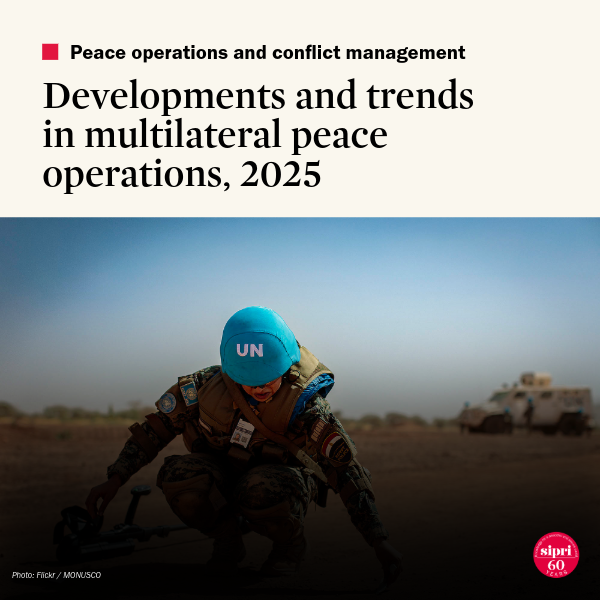 |
Developments and Trends in Multilateral Peace Operations, 2025
This SIPRI Fact Sheet presents the latest SIPRI data on multilateral peace operations, along with analysis of developments and trends in 2025. It finds that a total of 58 peace operations were active in 34 countries or territories during 2025. This was three fewer than in 2024. Personnel deployments to peace operations declined sharply to reach 78 633, just over half the number deployed in 2016 and the smallest number in at least 25 years. In the absence of multilateral responses to new and ongoing conflicts, the trend towards conflict management by ad hoc, often militarized bilateral or mini-lateral interventions continued in 2025.
Read the SIPRI Fact Sheet
|
|
 |
Cyber (Dis)armament in Practice: The EU’s Role in Governing Software Vulnerabilities in a Fragmented International Order
Cyber conflict poses fundamental challenges to traditional approaches to disarmament. This paper argues that one of the most plausible ways of pursuing cyber ‘disarmament’ in practice lies in the governance of software vulnerabilities, particularly through mechanisms for vulnerability disclosure. The paper examines the structure of the global vulnerability ecosystem and explains why international arms control and cyber norm processes have struggled to meaningfully engage cyber capabilities. Following a case study of Europe, the report concludes with recommendations for strengthening Europe’s vulnerability governance framework.
Read the EUNPDC report
|
|
|
|
|
Vacancies
|
- Internship with the Peace and Development research theme (31 May 2026)
Read more
|
|
|
|
|
|
Accurate, dependable information is more important than ever. Invest in the facts.
Support SIPRI
|
|
 |
| SIPRI is an independent international institute dedicated to research into conflict, armaments, arms control and disarmament. Established in 1966, SIPRI provides data, analysis and recommendations, based on open sources, to policymakers, researchers, media and the interested public. |
|
|