The independent resource on global security

Climate Change, Human Mobility and Security

Summary
This SIPRI Policy Brief explores the connected challenges of climate change, human mobility and security, highlighting how fragmented policies and misconceptions—such as the myth of mass climate migration—hinder effective responses. The brief contributes to addressing this gap by presenting findings on three underexplored dynamics across the mobility spectrum. It finds that urban migration can support adaptation but also strain urban conditions, involuntary immobility can heighten people’s vulnerabilities, and poorly designed climate action can lead to displacement, inequality or unrest. These dynamics show that governance determines the security outcomes of human mobility. To address this, the policy brief calls for safe, rights-based migration that facilitates climate adaptation; support for the most vulnerable, immobile populations; and people-led, democratic climate action.
I. Introduction
Climate change, human mobility and security together present a pressing policy challenge. As extreme weather events intensify and seasonal patterns change, policymakers need to address how these factors shape human mobility. However, policymaking is hampered by public debates informed by misconceptions, such as the myth that millions of ‘climate refugees’ will inevitably migrate north from the ‘Global South’.1 There is also a lack of coherence between climate, migration and security research, policy and practice.2 Governments and organizations have different interpretations of climate-related mobility and its risks. Some European Union (EU) policies frame migration as a failure to adapt, while the International Organization for Migration (IOM) highlights the importance of mobility in responding to climate change.3 The United Nations emphasizes human security risks, whereas EU member states and the United States respond to migration as a national security issue.4 These different perspectives have hindered the development of integrated strategies on managing climate-related mobility. Some regions have advanced common frameworks, such as the African Union’s Kampala Ministerial Declaration on Migration, Environment and Climate Change, which provides a framework for integrating climate-related human mobility into national legislation.5 Other major policy initiatives, however, such as the European Green Deal, overlook the implications of transitions and the reshaping of labour markets and land use on climate mobility.6
A more nuanced analysis is needed in order to design effective policy responses. This SIPRI Policy Brief highlights three underexplored dynamics across the mobility spectrum. First, climate-related migration can exacerbate socio-economic problems in urban areas, where migrants themselves bear the brunt of the risks. Second, people who are ‘trapped’, or unable to move, are highly exposed to climate change, illustrating that immobility can be just as dangerous as precarious movement.7 Third, while planned relocations are a necessary part of adjusting to global warming, climate action can also cause displacement that fuels political tensions. Together, these findings show that whether people move voluntarily, involuntarily or not at all, poorly governed climate-related mobility can deepen insecurity in different ways for different groups. The Brief concludes with recommendations on how to better integrate mobility and security into climate policy, strengthen adaptation in the most vulnerable areas and promote inclusive climate action.
II. Three Findings on Climate Change, Mobility and Security
The intersection of climate change and human mobility encompasses multiple forms of movement with different causes and consequences.8 Voluntary migration is often used as a temporary or permanent adaptation strategy that enables people to diversify income or seek safety.9 Displacement refers to forced movement triggered by sudden or slow-onset events such as floods and coastal erosion.10 A third category, immobility, occurs when people cannot move or choose not to move, due to a lack of resources, legal barriers or social and cultural ties.11
Research on climate mobility has limitations. It is difficult to accurately predict how many people will move or under what conditions.12 The World Bank estimates that up to 216 million people in Africa, Asia and Latin America could migrate internally by 2050.13 Climate change is rarely the sole driver of movement, however, and most people report economic or social factors alongside environmental stresses.14 Nonetheless, 45.5 million people were internally displaced by weather-related disasters in 2024—nearly double the annual average of the past decade, which is linked to global warming (see figure 1).15
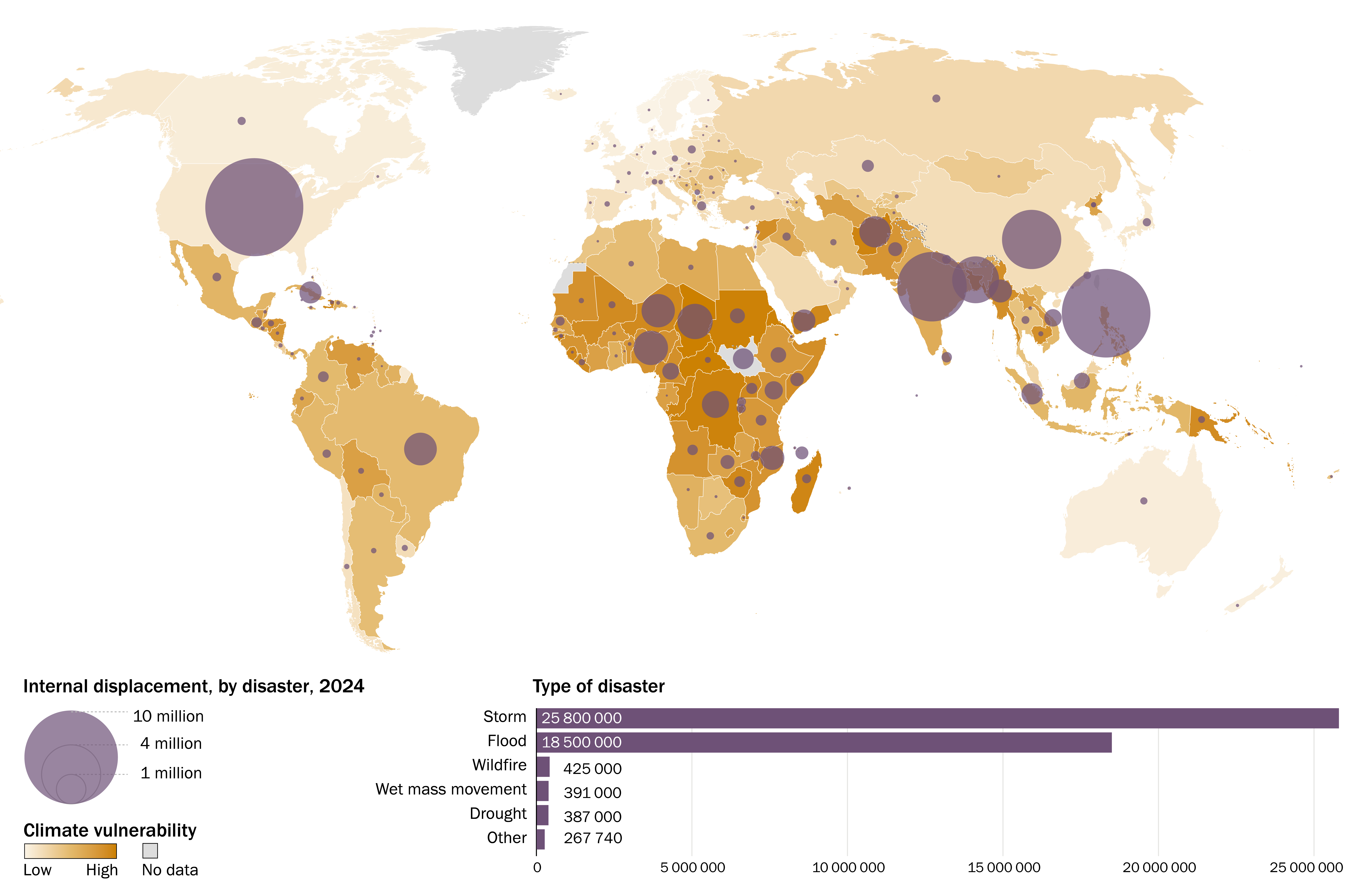
Figure 1. Map of global climate change vulnerability and disaster-related displacement
Sources: Notre Dame Global Adaptation Initiative (ND-GAIN), ‘ND-GAIN Country Index’, accessed 5 Nov. 2025; and Internal Displacement Monitoring Centre (IDMC), ‘Internal Displacement Updates’, accessed 5 Nov. 2025. The ND-GAIN Country Index captures a country’s vulnerability to climate change and other global challenges, and its readiness to improve resilience.
Gender also shapes human mobility. Women, men and gender-diverse people experience different constraints and opportunities depending on their access to financial resources, decision-making power and safe travel routes. Men more often migrate long distances, while women tend to migrate between national urban centres or to stay behind to care for dependents. Immobility is also gendered because women who stay behind (by choice or constraint) often face increased workloads, lower incomes and higher exposure to gender-based violence, particularly in fragile contexts.16
Insecurity adds another layer of complexity across mobility pathways. Cross-border movements can heighten concerns in receiving areas, particularly when new arrivals are perceived as competitors for resources, services or jobs, or when political actors exploit xenophobic narratives.17 A wide array of research has examined conflicts between farmers and migrant herders in Africa.18 This Policy Brief expands on that research with findings on other mobility-related dynamics and other regions by exploring three different scenarios: urban migration that compounds social instability, immobility that increases vulnerability to conflict and poorly-designed climate action that has unintended negative consequences.
Urban Migration and Social Instability
Climate change is undermining livelihoods and deepening poverty in many parts of the world.19 In response to these pressures, people migrate to pursue alternative incomes, making labour migration an important form of climate change adaptation. In Ethiopia, for example, drought has led smallholder farmers to send family members to nearby cities to earn income from remittances. This helps farmers endure hardship and continue farming, which makes it an effective adaptation strategy.20
Urban housing policies have not kept pace with human mobility, however, and the number of people living in informal settlements globally increased by 28 per cent between 1990 and 2015.21 This reflects how urban migrants are often placed in precarious conditions in informal settlements, which are often located in areas exposed to sea-level rise or floods, because they cannot access affordable, safe and secure housing.
Unplanned or unsupported urban migration can fuel perceptions that urban migrants, rather than political neglect or underinvestment, are responsible for declining services and inadequate infrastructure. In Jordan, some media outlets have blamed Syrian and Iraqi refugees for water shortages that are linked to rapid urbanization, prolonged water scarcity and governance failures.22 In Honduras and Pakistan, research findings highlight that urban instability is not a consequence of migration, but instead a reflection of policy failures to integrate new residents and ensure fair access to rights and resources.23
Immobility and Insecurity
Migration is not feasible for everyone and ‘trapped populations’ are highly exposed to the effects of climate change.24 Poverty, disability and age, as well as gender and security restrictions can trap people in dangerous conditions. Other groups make a choice not to migrate because of cultural ties to their homeland or a lack of trust in alternatives, as is the case with Palestinians who fear losing the right of return.25 This can also increase groups’ vulnerabilities as livelihood conditions deteriorate.
In Colombia, people are trapped in some rural border communities because armed groups limit people’s movement to control territory and to create a protective barrier from state incursion. This cuts people off from services, including humanitarian assistance, which increases their vulnerability to the effects of climate change.26 Following the military takeover in Myanmar in 2021, martial law led to restrictions on movement in urban and peri-urban areas where anti-military protests had taken place, increasing people’s exposure to rainy season flooding.27
Repeated droughts, floods and disease outbreaks erode livelihoods and coping capacities, creating a vicious circle of vulnerability.28 In Somalia, prolonged drought and conflict have left livestock herders with few options but to cut down trees so that they can feed the leaves to their livestock, even though they know deforestation degrades the soil.29 Trapped communities often face escalating natural resource disputes, as traditional management systems break down.30
Climate change also amplifies inequalities between people who are able to adapt and people who are not. Gender and power imbalances, notably unequal access to land titles, credit and early-warning information, can make immobility especially dangerous for women and marginalized groups.31
Mismanagement and Backdraft
Climate action is crucial but, if poorly designed, can create a ‘backdraft’ of new vulnerabilities, inequalities and tensions.32 Adaptation designed in a one-size-fits-all way fails to address the specific needs of different groups.33 In fragile contexts, perceptions of mismanagement can increase the risk of insecurity. In Syria, research has suggested that drought-related urban migration contributed to the outbreak of the Arab Spring protests. This analysis is contested but field interviews in Daraa have identified that people perceive that the social contract was ruptured in part because of the impact of the drought on farming communities and the government’s failure to support them.34
Climate action projects can disrupt livelihoods and fuel grievances. Expanded biofuel production, rare earths mining and clean energy projects have altered land values, displaced communities and eroded trust in the authorities. These projects can create significant land tenure and land distribution inequalities, which can be the drivers of conflict and climate-related vulnerabilities. In Central America, civil wars have been intricately linked to the control of land and the dispossession of vulnerable communities.35 If mismanaged, climate action can exacerbate poverty and political grievances. For example, lithium mining in Brazil’s Jequitinhonha Valley has been touted as part of the government’s climate policies, despite its profoundly negative effects on local communities and increasing push-back.36 In Alaska, Indigenous communities seeking to relocate have been frustrated by financial and bureaucratic obstacles, which has exacerbated colonial legacies of mistrust between Indigenous groups and the government.37
III. Recommendations
The findings from this SIPRI Policy Brief illustrate the complex links between climate change, mobility and security. Migration can support adaptation where climate change has deepened poverty but can also expose people to new risks. Involuntary immobility can entrench inequalities and exploitation, while climate action, if poorly managed, can itself create new vulnerabilities. These challenges call for integrated, people-centred responses that connect climate change, mobility and security. Three recommendations emerge:
Support Climate Adaptation Through Safe, Rights-Based Migration
Stronger policy coherence and implementation are needed to address climate-related human mobility. Existing global and regional frameworks, such as the Global Compact on Migration, the Pacific Framework for Climate Mobility and the Kampala Ministerial Declaration on Migration, Environment and Climate Change, provide a foundation.38 There is now a need to turn commitments into coordinated action.
Governments should prioritize actions that support safe, circular and rights-based labour migration as a practical form of climate change adaptation. This can be advanced by integrating climate mobility into development cooperation, trade and investment policies, and by strengthening institutional capacity, financing and technical cooperation on implementation.
At the national level, climate-smart urban planning can build resilience for migrants and host communities, notably through improved housing, water and sanitation, flood management and basic service provision. People-centred investments, such as cash transfers, education and healthcare, can also enhance resilience and reduce social tensions. Regional and bilateral cooperation should promote safe cross-border mobility.
Advance Climate Adaptation for the Most Vulnerable
Climate action should account for immobility and prioritize the most vulnerable, marginalized groups—especially where conflict and violence weaken adaptive capacities, systems and institutions.39 In practice, support should focus on protecting livelihoods and building community resilience to climate change, for example through regenerative agriculture, water management and ecosystem restoration.
To facilitate concrete action, policymakers should strengthen frameworks for climate action in conflict settings, including through community-based early-warning systems and data collection tools such as the IOM’s Transhumance Tracking Tool and Displacement Tracking Matrix, to anticipate risks and guide humanitarian and peacebuilding responses.40
Governments should also integrate human mobility into National Adaptation Plans (NAPs), Nationally Determined Contributions (NDCs) and other UN Framework Convention on Climate Change (UNFCCC) adaptation processes. This will ensure that mobility and immobility are systematically addressed in national and global adaptation planning.
Support Democratic and Inclusive Climate Action
Climate interventions that are designed or implemented in a top-down way can inadvertently harm communities, while inclusive processes are more likely to anticipate the social risks associated with transitions in energy, land and resource management. Policymakers should therefore support participatory and transparent decision making that places affected groups at the centre of climate action.
To advance this goal, governments and development partners should strengthen regulatory and accountability frameworks to ensure that climate action is advanced fairly, particularly in fragile and high-risk settings. Linking climate action to good and inclusive governance, for example through community-led conservation, participatory renewable energy projects and community-based resource management, can support adaptation and build trust between communities, local government and the private sector.41
Endnotes
- 1 The term ‘climate refugee’ has been used to draw attention to people whose movement is clearly forced by environmental degradation and climate change, but does not necessarily meet the legal definition of a refugee. See International Organization for Migration (IOM), ‘International Migration Law no. 34’, Glossary on Migration (IOM: Geneva, 2019); and Siegfried, K., ‘Climate change and displacement: The myths and the facts’, UNHCR, 15 Nov. 2023.
- 2 Natter, K. and Welfens, N., ‘Why has migration research so little impact? Examining knowledge practices in migration policy making and migration studies’, International Migration Review, vol. 58, no. 4; and Huber, J. et al., ‘Climate-related migration and the climate-security-migration nexus in the Central American Dry Corridor’, Climatic Change, vol. 176, no. 6 (June 2023).
- 3 Geddes, A., ‘Governing migration from a distance: Interactions between climate, migration, and security in the South Mediterranean’, European Security, vol. 24, no. 3 (July 2015); and Scissa, C. and Martin, S. F., Migration in the Context of Climate and Environmental Changes within Central Asia and to the European Union and the Russian Federation (International Organization for Migration: Geneva, 2024).
- 4 Butros, D., Gyberg, V. B. and Kaijser, A., ‘Solidarity versus security: Exploring perspectives on climate induced migration in UN and EU policy’, Environmental Communication, vol. 15, no. 6 (2021); Wirthová, L., ‘Environmentally driven migration in EU discourse: Norms, policies and realities’, UCL Open Environment, 26 Mar. 2024; and Telford, A., ‘A threat to climate-secure European futures? Exploring racial logics and climate-induced migration in US and EU climate security discourses’, Geoforum, vol. 96 (Nov. 2018).
- 5 African Union, Kampala Ministerial Declaration on Migration, Environment and Climate Change, 29 July 2022.
- 6 Schraven, B., Inclusion of Migration and Migrants in Climate-resilient Development Pathways in the Context of the European Green Deal (International Organization for Migration: Geneva, 2023).
- 7 Trapped populations are people who do not migrate but are located in areas under threat, or people at risk of becoming trapped or having to stay behind, where they will be more vulnerable to shocks and impoverishment. See International Organization for Migration (note 1).
- 8 Draper, J., Climate Displacement (Oxford University Press: Oxford, 2023); and McAdam, J. (ed.), Climate Change and Displacement: Multidisciplinary Perspectives (Hart Publishing: Oxford, 2010).
- 9 Brzoska, M. and Fröhlich, C., ‘Climate change, migration and violent conflict: Vulnerabilities, pathways and adaptation strategies’, Migration and Development, vol. 5, no. 2 (2015), pp. 190–210.
- 10 Kälin, W. ‘Conceptualising climate-induced displacement’, ed. J. McAdam, Climate Change and Displacement : Multidisciplinary Perspectives (Hart Publishing: Oxford, 2010).
- 11 Ayeb-Karlsson, S., Baldwin, A. and Kniveton, D., ‘Who is the climate-induced trapped figure?’, WIREs Climate Change, vol. 13, no. 6 (2022); and Farbotko, C. et al., ‘Relocation planning must address voluntary immobility’, Nature Climate Change, vol. 10 (2020), pp. 702–704.
- 12 Nguyen, Q. et al., ‘How sudden- versus slow-onset environmental events affect self-identification as an environmental migrant: Evidence from Vietnamese and Kenyan survey data’, PLOS ONE, vol. 19, no. 1 (Jan. 2024); and Rudolph, L., Koubi, V. and Freihardt, J., ‘Environmental change and migration aspirations: Evidence from Bangladesh’, Global Environmental Change, vol. 91 (May 2025).
- 13 Clement, V. et al., Groundswell Part 2: Acting on Internal Climate Migration (World Bank: Washington, DC, 2021).
- 14 Scoville-Simonds, M., Jamali, H. and Hufty, M., ‘The hazards of mainstreaming: Climate change adaptation politics in three dimensions’, World Development, vol. 125 (Jan. 2020); and International Organization for Migration (IOM), Data Tracking Mechanism, Aftershock: An Assessment of How Climate Change is Influencing Migration and Vulnerability in Libya (IOM: Geneva, 2023).
- 15 Internal Displacement Monitoring Centre (IDMC) and Norwegian Refugee Council, Global Report on Internal Displacement, 2025 (IDMC: Geneva, 2025); and Otto, F. et al., When Risks Become Reality: Extreme Weather in 2024 (Climate Central and World Weather Attribution: Princeton, NJ, 2024).
- 16 Myrttinen, H., ‘The complex ties that bind: Gendered agency and expectations in conflict and climate change-related migration’, Global Policy, vol. 8, no. S1 (2017).
- 17 Brzoska and Fröhlich (note 9); Elliot, L., ‘Climate migration and climate migrants: What threat, whose security?’, ed. J. McAdam, Climate Change and Displacement: Multidisciplinary Perspectives (Hart Publishing: Oxford, 2010); and Tarif, K. et al., Climate, peace and security research paper, Insights on Climate, Peace and Security (Stockholm International Peace Research Institute: Stockholm, Dec. 2023).
- 18 Nassef, M. et al., Causes of Farmer–herder Conflicts in Africa: A Systematic Scoping Review, SPARC, June 2023.
- 19 Intergovernmental Panel on Climate Change, Climate Change 2022: Impacts, Adaptation and Vulnerability, Contribution of Working Group II to the Sixth Assessment Report of the Intergovernmental Panel on Climate Change (Cambridge University Press: Cambridge, 2022).
- 20 Draper (note 8).
- 21 International Federation of Red Cross and Red Crescent Societies, Forced to Flee in a Changing Climate: Red Cross and Red Crescent Action Addressing Climate and Disaster Displacement in Africa (IFRC: Geneva, 2023), pp. 23.
- 22 A refugee is a person who is outside the country of their nationality due to a well-founded fear of persecution for reasons of race, religion, nationality, political opinion or membership of a particular social group, and who is unable or unwilling to avail himself of the protection of that country; or a person who does not have a nationality and, being outside their home country as a result of such events, is unable or unwilling to return to it. International Organization for Migration (note 1); Nagle Alverio, G., Sowers, J. and Weinthal, E., ‘Climate change, conflict, and urban migration’, Environment and Security, vol. 3, no. 2 (2024).
- 23 Knox, V., ‘Gang violence, GBV and hate crime in Central America: State response versus state responsibility’, Forced Migration Review, no. 62 (Oct. 2019); Nagle Alverio, Sowers and Weinthal (note 22); and Geddes (note 3).
- 24 Geddes (note 3).
- 25 Fassetta, G. et al., ‘Online teacher training in a context of forced immobility: The case of Gaza, Palestine’, European Education, vol. 49, no. 2–3 (2017), pp. 133–50; and Nagle Alverio, Sowers and Weinthal (note 22).
- 26 ACAPS, Colombia: Confinements and Mobility Restrictions in Chocó, Nariño and Arauca, Thematic Report, 2 May 2024.
- 27 Lin, K., ‘Myanmar workers and unions on the front lines in fight against coup’, Labor Notes, 26 Feb. 2021; and Prasse-Freeman, E., ‘Amid Myanmar violence, there is one township in Yangon that “scares the military”’, South China Morning Post, 4 Apr. 2021.
- 28 Geddes (note 3).
- 29 Participant in a focus group discussion, Beer Gadid, Somalia, 29 Jan. 2024. Tarif, K., Burning Ground: Tackling Climate Change and Conflict in South-Central Somalia (SIPRI: Stockholm, May 2024).
- 30 Brzoska and Fröhlich (note 9).
- 31 Detraz, N. and Windsor, L., ‘Evaluating climate migration: Population movement, insecurity and gender’, International Feminist Journal of Politics, vol. 16, no. 1 (Jan. 2014).
- 32 Dabelko, G. D. et al., Backdraft: The Conflict Potential of Climate Change Adaptation and Mitigation (Woodrow Wilson International Center for Scholars: Washington, DC, 2013).
- 33 Draper (note 8).
- 34 Fröhlich, C. J., ‘Climate migrants as protestors? Dispelling misconceptions about global environmental change in pre-revolutionary Syria’, Contemporary Levant, vol. 1, no. 1 (Jan. 2016).
- 35 Huber et al. (note 2).
- 36 Teixeira, B. M. and Oliveira, M. P., ‘“We are not Lithium Valley!”: In Brazil’s Jequitinhonha Valley, the promise of a green transition has brought more extractive violence, Communities are mounting resistance and reclaiming the right to shape their own future’, NACLA Report on the Americas, vol. 57, no. 3 (July 2025).
- 37 Draper (note 8).
- 38 United Nations, General Assembly, Global Compact for Safe, Orderly and Regular Migration,
A/RES/73/195, 19 Dec. 2019; Pacific Islands Forum Secretariat, Pacific Regional Framework on Climate Mobility, 10 Nov. 2023; and African Union (note 5). - 39 International Committee of the Red Cross (ICRC), Weathering the Storm: Reducing the Impact of Climate Risks and Environmental Degradation on People Enduring Armed Conflicts (ICRC: Geneva, Switzerland, 2023).
- 40 Federal Government of Somalia, Ministry of Environment and Climate Change, Third Generation Nationally Determined Contribution (NDC 3.0), p. 30; Draper, J., ‘Climate change and internal displacement’, Climate Displacement (Oxford University Press: Oxford, 2023); United Nations Network on Migration, Transhumance Tracking Tool; and IOM, Displacement Tracking Matrix, accessed 17 Oct. 2025.
- 41 Tarif, K. From Conflict to Collaboration: Co-funding Environmental Peacebuilding in South-Central Somalia, SIPRI Policy Brief (Stockholm International Peace Research Institute: Stockholm, 2024); and Böhle, A.-S. and Tarif, K., Solar Power and Environmental Peacebuilding in South-central Somalia, SIPRI Policy Brief (Stockholm International Peace Research Institute: Stockholm, 2025).
ABOUT THE AUTHOR(S)/EDITORS

Kheira Tarif was a Researcher in the SIPRI Climate Change and Risk Programme.