

(Stockholm, 3 November 2026) This week, more than 450 people from over 100 countries are gathering in Sweden’s capital for the 2026 edition of the Stockholm Forum on Peace and Development. Under the theme ‘From Rupture to Repair: New Visions for Peace and Development’, the Forum aims to move beyond crisis management and narratives of gridlock to focus on new visions and transformative solutions when addressing today’s global peace, security and development challenges. Watch today’s opening session here.
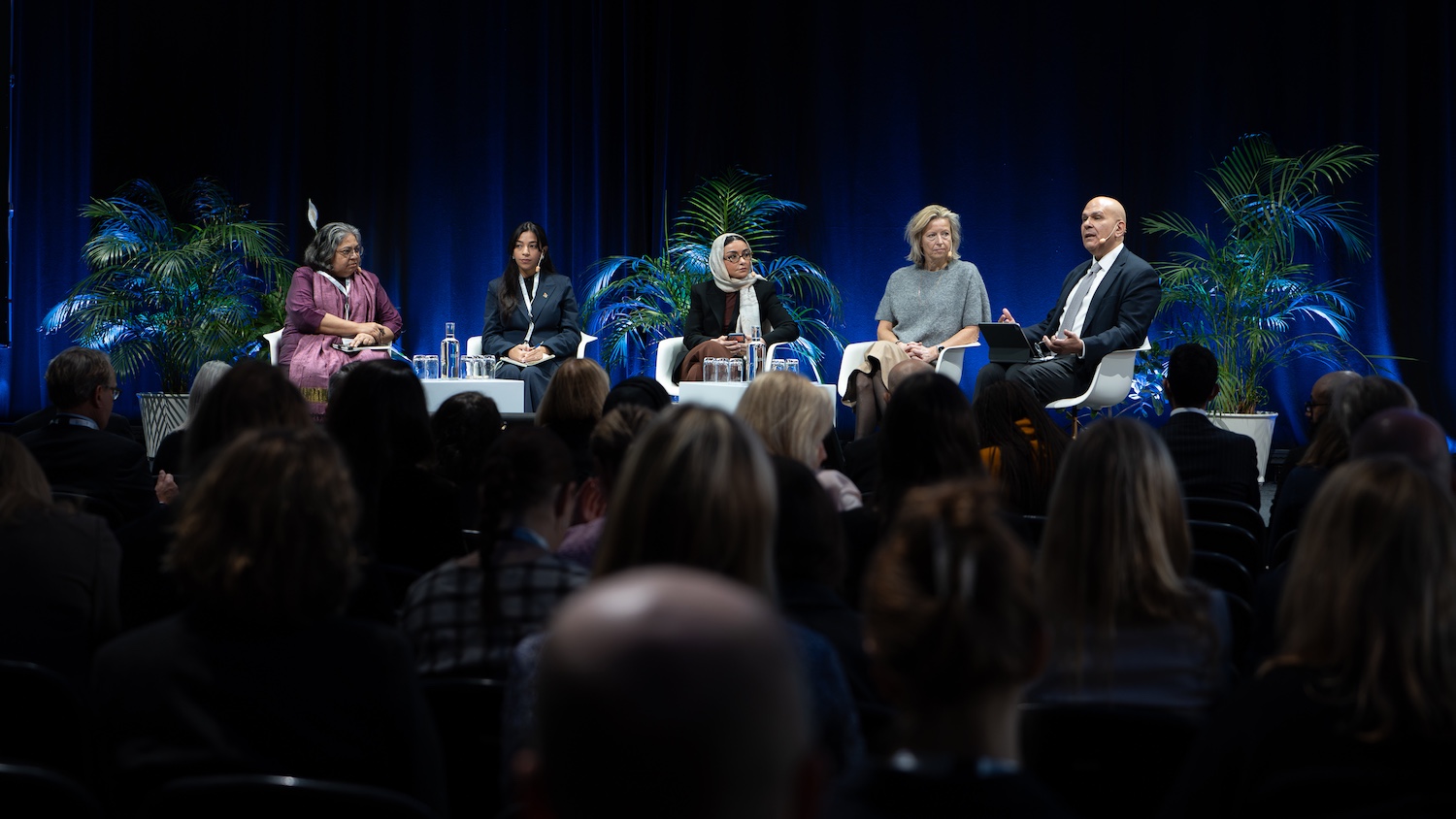
Opening panel, 2026 Stockholm Forum. Photo: Sanna Johannesson/Blackbox
At the opening of the 2026 Forum, Stefan Löfven, Chair of the SIPRI Governing Board, invited participants to use the next two days as an opportunity to share insights and experiences as a way of provoking new thinking and strengthening collective resolve. His welcome address acknowledged that the rupture in the global security architecture is not just a failure of diplomacy but also a failure to prevent conflict and protect civilians. However, it also presents an opportunity: ‘As many states turn to hard security and narrow national interest, we need to ensure that human-centred security is also on the agenda.’
The Forum’s opening panel, ‘After the Rupture: What Now?’, brought together leading voices to discuss the fracture in the global order and ask whether new ideas can emerge in that space to shape what comes next. Moderator Karim Haggag, SIPRI Director, described the split-screen reality we are living in where many conflicts are playing out across our screens at the same time and where universal laws are not being universally applied. He invited panellists to reflect on who is most affected by the breakdown in the global order and what questions need to be answered urgently.
Dr Manal Radwan, Advisor and Special Envoy to HH the Minister of Foreign Affairs for Negotiations and Peace Efforts, Ministry of Foreign Affairs, Kingdom of Saudi Arabia, opened the panel discussion by emphasizing that one size does not fit all when it comes to conflict resolution. With lack of trust at unprecedented levels, there needs to be a focus on conflict transformation and relationships and imagining a future that has not yet existed. ‘One of the most important lessons is the challenge of what we used to take for granted: confidence-building measures.’
Panellist Serena Awad, Program Officer, American Friends Service Committee, and member of the Youth Advisory Board launched at this year’s Forum, drew on the example of Gaza to state that it is too early to talk about the future when we cannot even cope with the present. She urged participants not to rebuild an international system that feels different at conferences but does not translate to the reality on the ground. ‘I believe that rebuilding is not about asking people to simply trust the international system but actually giving them a reason to do so.’
Kajsa Ollongren, Secretary-General, European External Action Service, underlined that the rules of the international system are not the problem; the problem is that they are not respected. She envisages the European Union (EU) as a uniting voice on the international stage. ‘How can we be effective in finding solutions to all the conflicts we have talked about this morning? I talked about the superpowers in the world. I think the EU should be one of those superpowers.’
Swarna Rajagopalan, Peace Educator, Political Scientist, Chaitanya Consultancy, underlined the role of young people in bringing about change. When discussing the most urgent questions to address, she challenged the audience to rethink peace without getting mired in its opposite. ‘What is peace, unfettered, unshackled, unburdened by conflict, violence, inequality? Do we have the power—and yes, we do—to imagine this?’
Next steps
The Forum’s closing plenary, ‘Making Peace the Rational Choice’, will bring together perspectives on political leadership, human behaviour, climate and security, and the role of trust in building sustainable peace. Reflecting the Forum’s theme of repair, the discussion will explore how institutions, relationships and approaches to security can be transformed to address the underlying drivers of conflict and division.
‘Decisions made in the name of security may seem rational and necessary. Yet, taken together, they risk reinforcing the very mistrust and divisions they seek to address. We need to challenge this logic and ask what it would take to make peace a realistic and rational political choice,’ says Per Olsson Fridh, Director-General of the Folke Bernadotte Academy (FBA), who will moderate the closing plenary.
Rewatch the live stream of the opening panel here.
Tune in at 16.15 CET tomorrow to watch the closing panel ‘Making Peace the Rational Choice’ here.
About the Forum
Held annually, the Stockholm Forum on Peace and Development is a leading platform for global dialogue. It convenes donors, government representatives, policymakers, practitioners, researchers and civil society actors to exchange ideas and develop practical responses to contemporary challenges in the development, humanitarian, peacebuilding and security spheres.
The 2026 edition of the Stockholm Forum is hosted by SIPRI and co-convened with FBA and the Swedish International Development Cooperation Agency (Sida).