The independent resource on global security

The Space–Nuclear Nexus in European Security

summary
The space–nuclear nexus is prominent in today’s European security environment, amid shifting alliance dynamics and developments in Russia’s war in Ukraine. This paper compares dependencies, priorities and strategic cultures of various actors in the space and nuclear domains, beginning with the North Atlantic Treaty Organization, the European Union and their three nuclear-armed states: France, the United Kingdom and the United States. These actors feature centrally in Russian threat perceptions and converge on the sources of threats—primarily Russia, and to a lesser degree China, Iran and North Korea—but diverge significantly on the level of threat. The paper consequently examines Russia and its bilateral cooperation on space and nuclear weapons with China, Iran and North Korea, noting convergences as well as divergences in each relationship.
The paper analyses how convergences and divergences in alliances and partnerships can impact stability and shape escalation risks at the space–nuclear nexus. The paper explores stabilizing effects, as well as destabilizing effects of these relationships. The latter include potential to drive escalatory and mirroring behaviours, distort threat perceptions, further blur red lines, legitimize attacks on space systems and encourage inaccurate perceptions of blocs that impede multilateral negotiations. Accordingly, the paper proposes a series of escalation management measures to curb the destabilizing effects of alliances and partnerships and minimize escalation risks at the space–nuclear nexus.
Acknowledgments
SIPRI and the authors express their sincere gratitude to the Ministry of Foreign Affairs of the Netherlands for their generous financial support of this project.
The authors thank the four external reviewers for their thoughtful feedback. The authors additionally thank Markus Schiller and Laetitia Cesari, SIPRI colleagues Wilfred Wan, Tytti Erästö and Barbara Kunz, and UCS colleagues Gregory Kulacki, Sulgiye Park and Robert Rust for their invaluable insights and support throughout the writing of this report. The authors are also grateful to the participants of the workshop organized by SIPRI in Stockholm on 13–14 March 2025 for sharing their knowledge and perspectives. Finally, the authors thank the SIPRI editorial department for their constructive comments.
Summary
The space–nuclear nexus is prominent in today’s European security environment, particularly amid visible shifts in alliance dynamics since Russia’s full-scale invasion of Ukraine in 2022. These changes are especially evident in approaches to the space and nuclear domains by the North Atlantic Treaty Organization (NATO), the European Union (EU) and their three nuclear-armed states—France, the United Kingdom and the United States—being actors which feature centrally in Russian threat perceptions. A comparison of their dependencies, priorities and strategic cultures regarding space and nuclear weapons exhibits varying capabilities, doctrines and engagement in space and nuclear policymaking. The USA’s shifting stance towards its European allies under the new administration is also a key development as some of its recent rhetoric and initiatives risk undermining both regional and global stability against the interest of its allies. These actors generally converge on their key sources of threats but diverge significantly as regards the level of threat. Their sources of threats are primarily Russia, with varying concerns about China, Iran and North Korea. Consequently, Russia, and its security ties with these states is important to assess. Analysis of Russia’s relationships with each of these states on space security and nuclear issues indicates that bilateral cooperation has intensified since Russia’s full-scale invasion of Ukraine but also reveals notable convergences and divergences in each relationship.
Such convergences and divergences in alliances and partnerships can have an impact on stability, with some stabilizing effects as well as concerning potential destabilizing effects. While alliance dynamics present some opportunities to discourage, de-escalate or even resolve conflicts, conversely, they can fuel escalation risks, particularly in the space and nuclear domains. Mutual defence commitments could deter an adversary from acting due to fear of a united response from multiple states, but it could also drive escalatory behaviours and trigger spirals of investment in offensive and defensive capabilities. Additionally, lack of a coordinated response from states that are formal allies or partners is dangerous because it may signal increasing acceptability or legitimacy regarding attacks in the space domain that are not clearly considered a use of force—such as cyber or electronic attacks. Alliance dynamics further encourage oversimplified, inaccurate perceptions of blocs, which impede multilateral negotiations and encourage space activities to be looked at through a purely securitized lens—in such cases, activities that might not have been perceived as threatening become so based on relationships with one actor and overarching political circumstances. Divergences in alliances also have tangible destabilizing effects, including the ability to distort threat perceptions and encourage mirroring behaviours, further blurring red lines and contributing to unclear responses.
Accordingly, there is a need for escalation management measures to curb the potential destabilizing effects of alliances and partnerships at the space–nuclear nexus. Recommendations emphasize the need for common understandings on the importance of space systems and appropriate responses to space threats, state exchange and views on applicable international law, specifically the legalities of the use of force and self-defence as it applies to the space–nuclear nexus. States should also address their differences in strategic perspectives, even internally at the national level. Related, states should avoid oversimplified bloc thinking about their sources of threats, as they do not necessarily align with allies and partners on threat levels, and inflating threats can be detrimental to their own security. Within formal nuclear alliances such as NATO, there is also an opportunity to de-emphasize nuclear weapons to reduce nuclear risk. Finally, avenues for dialogue on space and nuclear issues between China and the EU or European members of NATO should be pursued as they could more actively ensure regional—and in turn global—stability. More creative and culturally informed diplomacy with authentic assessments of national doctrines and domestic debates can additionally help contribute to more constructive exchanges in space and nuclear multilateral forums.
1. Introduction
Growing reliance on space for military missions, rapid advancement in capabilities, and worsening rivalries involving nuclear-armed states and their allies have increased risks of escalation at the space–nuclear nexus. The space–nuclear nexus refers to multiple connections and interactions between the space and nuclear weapon domains. This includes the overlap between ballistic missile and space launch technology, and the roles played by space systems in the nuclear deterrents of some states through intelligence, surveillance and reconnaissance (ISR) and monitoring arms control agreements; missile early warning and missile defence; command, control and communications; and missile guidance and navigation.1 Space systems also enable conventional military capabilities. The use of capabilities to disrupt, deny, degrade or destroy adversaries’ space systems can spark or exacerbate crises and the pursuit of these technologies can drive arms racing behaviours.2 In the worst case, such developments may escalate to nuclear threats, or even use.3
These dynamics have been evident for some time, first between the United States and the Soviet Union and subsequently the Russian Federation, and more recently China due to these states’ reliance on space systems for nuclear and non-nuclear missions, and their pursuit of offensive and defensive space weapon technologies. These escalation risks have become more acute since Russia’s full-scale invasion of Ukraine in February 2022 as the conflict risks drawing nuclear-armed rivals or adversaries and their allies into confrontation amid Russia’s repeated threats of nuclear use. The space domain is prominent in the ongoing war, as support to Ukraine from members of the North Atlantic Treaty Organization (NATO) and the European Union (EU) has included governmental and commercial space systems (despite Ukraine not being a member of the EU or NATO). For example, after the destruction of its Internet and communications infrastructure, Ukraine was able to use satellite-derived Internet access from the commercial Starlink system provided by the US company SpaceX, and the Ukrainian armed forces have also relied on US-supplied satellite imagery.4 Given the reliance on space systems in the war, there has been a rise in the number of cyber and electronic attacks against space systems.5 In 2024 space–nuclear escalation risks further grew, following reports from the USA that Russia was developing an on-orbit nuclear anti-satellite (ASAT) capability.6 Deploying such a system would be highly escalatory, due to its indiscriminate effects in orbit and clear violation of international law, particularly the 1967 Outer Space Treaty.7 These developments have occurred while the ongoing Russia–Ukraine War has fundamentally altered the European security environment. Given that the Russia–Ukraine War is taking place in Europe and given European states’ complicated relationships with China and the USA, various European states have been re-evaluating their positions on nuclear deterrence, including interest in hosting nuclear weapons.8 These regional security developments can have impacts on global stability, as the conflict can draw in other states and geographic regions (‘horizontal escalation’) and also involve new targets or weapons, expanding the magnitude of the conflict (‘vertical escalation’). Understanding the space–nuclear nexus in Europe is thus essential.
A key attribute of the European context is its complexity, including its stakeholders with convergences and divergences on threat perceptions and risk tolerance, and their varying approaches to nuclear deterrence. Europe includes nuclear-armed states, states allied with nuclear-armed states and other non-nuclear weapon states, each of which relies on space systems for civilian and military purposes in varying degrees. These complexities have an impact on the scope for escalation, as perceptions of alliances and partnerships can have destabilizing effects—including inflating threats and encouraging aggressive signalling—thereby adding layers of ambiguity and unpredictability to action–reaction dynamics.
This paper analyses alliance dynamics at the space–nuclear nexus in Europe. In chapter 2 it first focuses on NATO and the EU, paying particular attention to their three nuclear-armed states—France, the United Kingdom and the United States—to compare dependencies, priorities and strategic cultures regarding space and nuclear policies. Analysis of these cases is critical, as these states and their collective security relationships feature centrally in Russian threat perceptions. In comparison, contemporary threat perceptions of NATO and the EU are shaped primarily by Russia, with concerns about allies and partners of Russia. Chapter 3 accordingly examines Russia’s security ties with China, the Democratic People’s Republic of Korea (DPRK, or North Korea) and Iran. Chapter 4 then identifies convergences and divergences within these relationships to highlight implications for stability, including how misperceptions, misunderstandings and accelerated arms-racing behaviours contribute to escalation risks at the space–nuclear nexus. The paper concludes by using the analyses to propose in chapter 5 recommendations for space–nuclear escalation management.
2. Cooperation on space and nuclear weapons: The North Atlantic Treaty Organization and the European Union
NATO’s cooperation in the nuclear domain
NATO, presently comprised of 32 allies, has a mutual defence clause that includes a security guarantee in the form of the United States’ provision of extended nuclear deterrence. The original aim of NATO’s extended deterrence was preventing aggression by the Soviet Union during the cold war. Since 2022 it is once again perceived as being important for European security. As the two other nuclear-armed members of NATO—France and the United Kingdom—complicate adversary calculations with their own separate centres of decision-making, they are viewed by the alliance as providing an independent deterrent role of their own.9 Within NATO, policies associated with nuclear forces are discussed by the Nuclear Planning Group, which includes all members of the alliance except France.10 Notably, given the USA’s role, NATO’s nuclear doctrine is heavily influenced by US nuclear doctrine and mirrors a number of its elements, including retaining the option to use nuclear weapons first under certain conditions.11
According to the 2022 US Nuclear Posture Review (NPR), the USA would consider nuclear use ‘in extreme circumstances to defend the vital interests of the United States or its Allies and partners’.12 The USA aims to deter all forms of ‘strategic attack’; while this term is not defined in the 2022 NPR, it had earlier been linked to attacks on the civilian populations, infrastructure, nuclear forces, or the command-and-control, early-warning or attack-assessment capabilities of the USA, its allies or its partners.13 While it is presently unclear how US nuclear doctrine might evolve under the administration of US President Donald J. Trump, administration statements since he took office in January 2025 indicate that US security guarantees to partners and allies in Europe may not be as reliable or predictable as in the past.14 This has sparked concerns.
Following Russia’s invasions of Ukraine in 2014 and 2022, the emphasis on nuclear weapons in NATO has grown.15 There appears to be greater salience of nuclear weapons in Europe, as evidenced by the accessions of Finland and Sweden to NATO in 2023–24 (including an embrace of NATO’s nuclear dimension despite some previous ambivalence).
Both France and the UK are aligned with NATO policy but retain independent control of their nuclear forces. Since 2022 France has become increasingly vocal about leveraging its nuclear weapons to strengthen the deterrent of its allies in Europe. France views its nuclear weapons as essential for guaranteeing its ‘vital interests’; while not explicitly defined, it indicates that such vital interests have a ‘European dimension’.16 However, this raises questions, including whether France’s deterrent would be considered an addition or an alternative to the USA’s deterrent for European allies, and whether its decision-making processes could complement NATO’s Nuclear Planning Group without officially joining. Furthermore, not all EU states are members of NATO, and French nuclear forces are also considerably smaller than those of the USA.17 For these reasons, it remains to be clarified how France’s arsenal could constitute a credible deterrent for European states.18
In comparison to France and the USA, the United Kingdom’s nuclear doctrine states that it would consider using nuclear weapons ‘only in extreme circumstances of self-defence’ and explicitly includes ‘defence of NATO allies’.19 The UK has a unique relationship with the USA, underpinned by their bilateral 1958 Mutual Defense Agreement, which enables close cooperation on nuclear issues, including transfer of materials and training.20 This agreement was extended indefinitely in 2024 and indicates the UK’s dependence on the USA for maintaining its deterrent.21 The UK’s submarine-launched ballistic missiles (SLBMs) are supplied by the USA and require US maintenance.22 Nonetheless, the UK retains sole decision-making power over its nuclear weapons.
While NATO states are under the US nuclear umbrella, they differ in their implementation of nuclear deterrence practices. For instance, while some allies—Belgium, Germany, Italy, the Netherlands and Türkiye—host US nuclear weapons, others—such as Denmark, Iceland, Norway and Spain—prohibit the stationing of nuclear weapons on their national territories.23
Additionally, NATO prioritizes strategic partnerships, prominently with the European Union. This partnership has strengthened in recent years. However, the EU is not an alliance, and there is wide divergence in views regarding nuclear deterrence among its member states. For instance, Austria, Ireland and Malta are parties to the 2017 Treaty on the Prohibition of Nuclear Weapons, which seeks a comprehensive ban on nuclear weapons, including their use and threat of use.24 Despite these differences, the EU formally cooperates with NATO on defence and security, including in space (see below). This makes EU and NATO dependencies, threat perceptions and priorities highly relevant to dynamics at the space–nuclear nexus.
Cooperation in the space domain
The North Atlantic Treaty Organization
Space systems have always been critical for NATO—as early as the 1960s the United States provided space systems for missile early warning, ISR, navigation and communications.25 In 2005 NATO ceased acquiring and operating its own satellites and now relies on capabilities contributed by individual members. The USA is the largest provider of space capabilities, including the Wideband Global Satcom system, although European members of NATO also contribute some space capabilities, such as the UK’s Skynet, France’s Syracuse and Italy’s Sicral.26
NATO has been taking steps to advance space-based ISR and space situational awareness (SSA) capabilities by enhancing data-sharing among its members.27 Contributing allies operate their own systems and can select which members receive their services, which results in varying levels of access in the alliance. The ‘slow release’ of information from US systems has been cited by allies as a reason for developing their own national space capabilities.28 For example, France’s emphasis on independent space capabilities can reportedly be traced to the refusal of US officials to share satellite imagery during the 1991 Gulf War.29
NATO has increasingly sought to clarify its space policies and related organizational structures. This includes officially recognizing space as an operational domain and adopting a space policy in 2019.30 NATO has identified various threats to space systems and the need for responses to them, establishing a space operations centre in Germany and a centre of excellence in France. Notably, in 2021 NATO declared that an attack against space systems could lead to Article 5 of the North Atlantic Treaty being invoked for a collective response.31 Decisions on when to invoke Article 5 are made on a case-by-case basis, and there is no public indication of which cases might invoke a response, or what form the response would take. The role of commercial space capabilities in the Russia–Ukraine War has motivated NATO to develop a commercial space strategy to establish guidance for protection of industry partners, including enhancing cybersecurity of space systems.32
Allies’ dependence on space capabilities and their contribution of these capabilities to NATO are unbalanced. This, along with hierarchies in relations within the alliance, results in some misalignment of members’ views on space and nuclear issues. Such inconsistencies can have an impact on the potential for escalation because of differences in the perceived strategic importance of space systems. This, in turn, implies that NATO members would not necessarily respond in the same manner if a specific space system were threatened. These imbalances also influence how engaged allies are in discussions on space security and defence, including at the multilateral level—some European members of NATO are not active in discussions.33 France and the UK, however, actively participate in these negotiations due to their own priorities for space security (see tables 2.1 and 2.2).
The European Union
The European Union has considerable space capabilities of its own. While individual EU member states own and operate space systems, the EU also develops its own space systems (in contrast to the NATO approach of depending on contributions of individual state capabilities). These include Galileo and EGNOS for navigation; Copernicus for earth observation, ISR and SSA capabilities; and the planned IRIS2 constellation of satellites for secure communications and surveillance.34 Space initiatives are undertaken by both the European Space Agency (ESA), which has membership that overlaps with both the EU and NATO, and the EU Agency for the Space Programme (EUSPA).
In 2023 the EU adopted its own space strategy for security and defence, which took several unprecedented steps.35 These included adapting civilian-focused missions to more effectively serve military purposes (e.g. advancing Copernicus for ISR), particularly given the utility of space-based earth observation for Ukrainian armed forces in resisting Russian attacks. The strategy also provides a basis for shared threat assessments annually through the EU Single Intelligence Analysis Capacity (SIAC). In addition, it introduced measures to improve coordination of space defence among member states and linked space defence priorities to funding programmes that support research and development projects to enhance EU defence capabilities. This is accompanied by a clear trend towards an overall increase in EU investment in space defence initiatives. For instance, the European Defence Fund (EDF) has invested in studies on a European space-based missile early-warning architecture and is exploring ‘bodyguard satellites’ with autonomous SSA capabilities and a network of interoperable satellites in low earth orbit for a ‘responsive European architecture’ to detect and counter space threats.36
The EU is increasingly prioritizing cooperation on space security and defence with NATO as a whole, and the United States specifically. In December 2023 structured dialogues between NATO and the EU were launched for several new topics, including space.37
Several EU member states have recently adopted national space defence strategies. There is also a trend for EU member states to enhance cooperation for civilian space exploration missions with the USA, as indicated by multiple states individually joining the USA’s Artemis Accords. These accords are non-binding principles that aim to establish a common vision among signatories while advancing the USA’s lunar exploration programme.38 More than 20 of the 54 other states that have signed are members of the EU.
Comparing perceptions and priorities across NATO and the European Union
Member states of NATO and the European Union generally agree on which states they perceive as threats, but they differ in the extent to which they are concerned about them. These differences may lead to different reactions by NATO and EU states regarding developments in the space and nuclear domains.
Views on Russia
NATO views Russia as the ‘most significant and direct threat’ to its members.39 However NATO clarifies that it does not seek confrontation with Russia and even mentions that its members will retain channels of communication with Russia to mitigate risks.40 In contrast, the EU names Russia as a key threat to the European security order, raises concerns that Russia has made nuclear threats against Ukraine, and appears to have little appetite to communicate with Russian counterparts.41
France, the United Kingdom and the United States align closely on perceived threats from Russia, although the USA is more explicit and consistently names Russia as a key threat in its nuclear and space policies. Since 2022 these three states individually, along with NATO and the EU, have also expressed their concerns about Russia’s strategic cooperation with other states, including Belarus, China, Iran and North Korea. Following US reports in 2024 that Russia is developing a nuclear ASAT weapon, members of NATO and the EU joined the USA in expressing concerns about the impact of this development on the risk of escalation and about possible violations of international law. For example, they all supported the US-led United Nations General Assembly resolution that reiterated prohibitions against placing weapons of mass destruction (WMD) in orbit and urging states not to develop such WMD.42
Views on China
In 2022 NATO mentioned China in its strategic concept for the first time. While not explicitly naming China as a threat, the concept criticizes Chinese opacity about strategy, intentions and military build-up and also mentions that Chinese hybrid operations and rhetoric harm the security of NATO members.43 However, NATO states that it is open to ‘constructive engagement’ with China, including ‘to build reciprocal transparency’.44 In contrast, the EU has a more complicated relationship with China, its second largest trading partner. It has been more careful to articulate that the relationship is multilayered, naming China as ‘a partner for cooperation, an economic competitor and a systemic rival’.45
Arguably, NATO’s stronger framing of China as a threat suggests that NATO’s threat perceptions are influenced by US concerns. China is considered a key threat by the USA, which describes China’s activities as ‘the most comprehensive and serious challenge to US national security’ (with Russia characterized as an ‘acute threat’).46 While France and the UK also include China in their threat perceptions, they are relatively measured. For instance, the UK criticizes China’s ‘increasingly assertive and coercive behaviour’ and its rapid military modernization, but still implies openness to working with China, to convince China ‘to play a responsible global role in keeping with its status as a [permanent member of the UN Security Council] and a major security player’.47 France appears even more cautious, with its leadership even making statements about how ‘Europe should avoid getting dragged’ into a US–China confrontation over Taiwan.48
Other perceived threats
NATO’s 2022 strategic concept for the first time mentions Iran and North Korea, and specifically their nuclear and missile programmes. The EU also views Iran and North Korea primarily as proliferation threats, noting their possible impacts on regional dynamics.49 British and French perceptions about Iran and North Korea are similarly framed.50
In contrast, the USA—with its strong alliances and extended deterrence relationships in East Asia—considers North Korea’s ability to threaten the USA, Japan and the Republic of Korea (South Korea) with nuclear weapons and Iran’s increased capability to build a nuclear weapon if it chose to do so as ‘other persistent threats’.51 Based on this rationale, the USA fields a homeland missile defence system to defend against threats from Iran or North Korea. Long-standing US policy has been to rely on nuclear deterrence rather than missile defence to deal with peer or near-peer threats from China or Russia. However, in January 2025 the USA under the Trump administration signalled an end to restraint on such defences, with an executive order to build an ‘Iron Dome for America’ (subsequently renamed the ‘Golden Dome’), a homeland missile defence against all types of missile, including China’s and Russia’s strategic deterrent.52 The order requires plans for defence against peer, near-peer and ‘rogue’ adversaries and directs the development of space-based interceptors. The technical challenges to building such a system are well-documented, and the economic costs will be staggering, creating significant impediments to such a system being realized.53 This change has significant implications for the USA’s European allies through potential responses by China, Russia and even North Korea, and undermines multilateral efforts on arms control and space security. While the Canadian defence minister expressed interest in Canada joining the US Golden Dome, other NATO members and the EU have so far been conspicuously silent on the initiative.54
Threat perceptions of each of these actors have evolved more recently to include strategic partners and allies of Russia. This is most visible in the case of the USA, which has been especially vocal in its defence policies and security assessments about China–Russia strategic cooperation (see below). The UK has also raised concerns about deepening security ties between China and Russia, as well as Russia’s provision of weapons to North Korea and its growing cooperation with Iran.55 Concerns of EU and NATO members particularly about Russian cooperation with North Korea sharply rose in 2024, exhibited in a joint statement from the foreign ministers of Canada, France, Germany, Italy, the UK and the USA and the EU’s high representative for foreign affairs among others, which strongly condemned the formalization of North Korea–Russian military cooperation and North Korea’s deployment of troops in the Russia–Ukraine War.56 Echoing this sentiment, NATO’s secretary general branded the deployment of troops as ‘a significant escalation’ and a ‘dangerous expansion of Russia’s war’.57 Indeed, such cooperation includes supply of missiles by North Korea that enable Russia to keep Ukraine under heavy fire, and supply of technology by Russia to North Korea that circumvents international sanctions.58
Threat perceptions and priorities across NATO, the EU and the nuclear-armed states in these alliances thus exhibit alignment on sources of threats—China, Iran, North Korea and Russia—although the perceived threat levels vary significantly. Actions by these states in the space and nuclear domains can significantly shape understandings of risks and states’ preparedness to respond, affecting the overall strategic balance. The next chapter therefore assesses Russia’s ties with China, North Korea and Iran, focusing on cooperation on space and nuclear weapons.
3. Cooperation on space and nuclear weapons: Russia with China, North Korea and Iran
Just as NATO, the European Union and their member states perceive the Russian Federation as their primary threat, Russia views the United States as its key threat.59 Russia, using inflammatory rhetoric, refers to the USA’s allies as ‘satellites’, claims that most European states pursue an aggressive policy towards Russia, and names NATO, the EU and the Council of Europe as central concerns against which it needs to defend its national interests.60 Russian nuclear doctrine considers aggression by any member state of a ‘military coalition (bloc, alliance)’ against Russia or its own allies to be aggression by the coalition as a whole.61 Russia aims to deter not only nuclear threats but also use of strategic missile defences, high-precision non-nuclear weapons, anti-satellite weapons and space-based weapons.62
Russia’s nuclear doctrine specifies a goal of deterring aggression against its allies, although the only other state mentioned in its doctrine is Belarus. Russia is a member of the Collective Security Treaty Organization (CSTO)—a military alliance of six post-Soviet states: Armenia, Belarus, Kazakhstan, Kyrgyzstan, and Tajikistan as well as Russia. Article 4 of the 1992 Collective Security Treaty establishes that aggression against one of its parties is considered as aggression against them all.63 Russia’s economic and strategic isolation from EU and NATO states after its invasion of Ukraine from 2014 has led it to seek further partners, and its relationships with China, Iran and North Korea—states with significant nuclear and space capacities—have all deepened as a result. Given Russia’s centrality in the threat perceptions of NATO and the EU as well as the individual nuclear-armed states of France, the United Kingdom and the United States, assessing Russia’s cooperation with its partner states helps illuminate how alliance dynamics influence escalation risks at the space–nuclear nexus.
Cooperation between Russia and China
China and Russia have a history of mistrust, but they appear to have overcome key areas of disagreement. They now have a growing strategic relationship, if not a formal alliance. While China and Russia cooperate on diplomatic initiatives and conduct joint military exercises, material cooperation at the space–nuclear nexus appears to focus on space exploration and nuclear power, and potentially on missile early warning. Both states are concerned about US dominance in space and potential erosion of their nuclear deterrent by US strategic systems, many of which are enabled by space capabilities. Both states are also concerned about the influence of Western-led alliances in the international system, and their encroaching on core security concerns in their regions.
A major area of convergence between China and Russia is that both perceive the United States as being the primary source of threats. US military presence and its alliances in Asia are key concerns in Chinese doctrines.64 Similar to Russia, China opposes ‘further enlargement of NATO’ and criticizes NATO’s declaration of space as an operational domain.65 Alignment between China and Russia increased following the various political injunctions and economic sanctions imposed by the USA on Chinese and Russian space technologies and entities (see figure 3.1, which contains a timeline of key bilateral cooperation events). This includes the 2011 Wolf Amendment, a domestic law that strongly restricts US government agencies (including the US space agency, the National Aeronautics and Space Administration, NASA) from bilateral cooperation with China.66 Technical cooperation between China and Russia intensified following Russia’s annexation of Crimea in 2014, when sanctions reduced Russia’s market for exports of technologies and imports of critical high-technology goods. In May 2025 China and Russia jointly condemned the US Golden Dome proposal, claiming that it turns ‘space into an environment for placing weapons and an arena for armed confrontation’.67 It remains to be seen what the effects will be on strategic arsenals (given that Russia and China have already been modernizing their forces) and on the potential for arms control and constructive strategic dialogue.
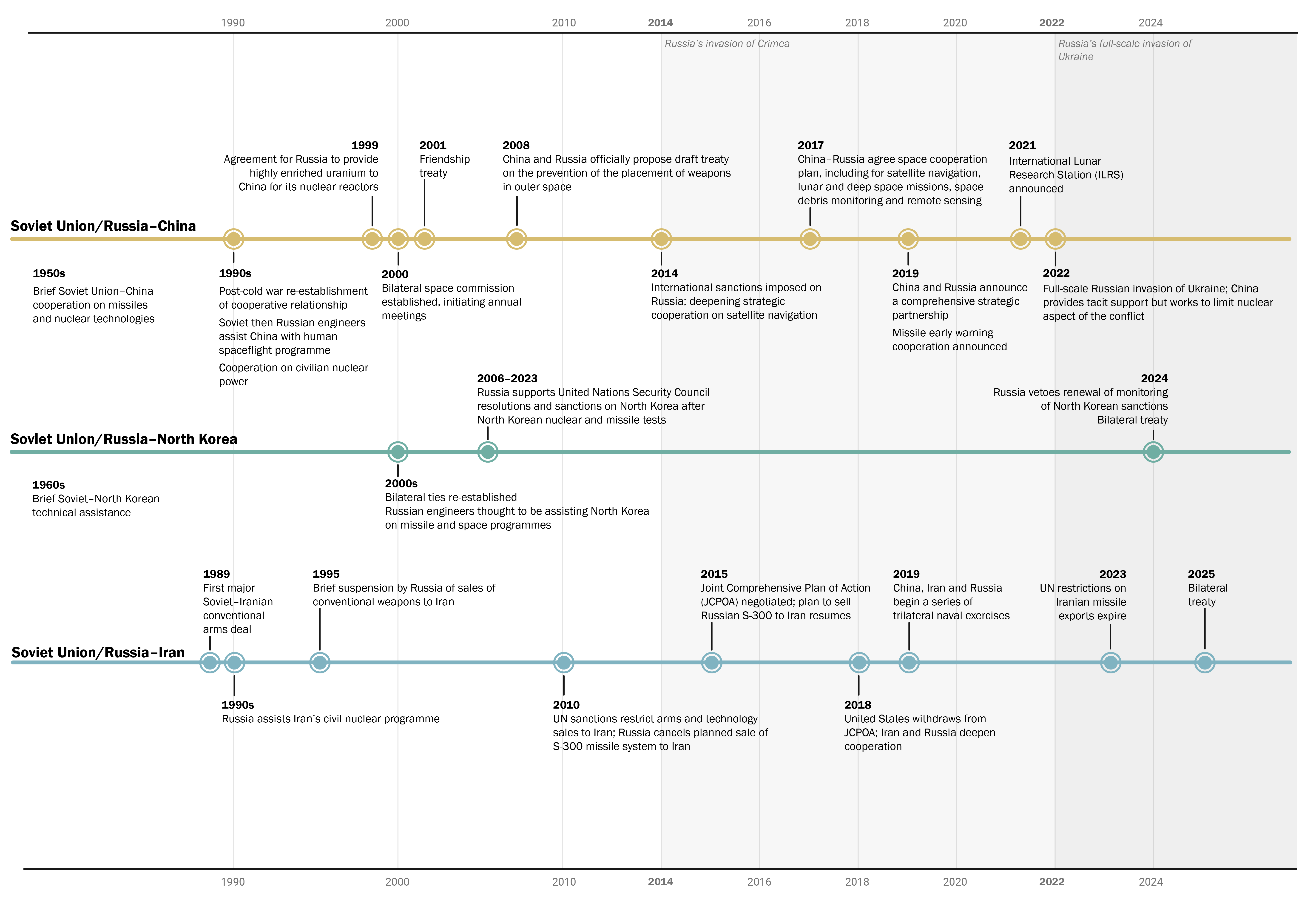
Figure 3.1. Timeline of key bilateral cooperation events
However, despite close cooperation, they are not entirely aligned in their military or diplomatic interests. Despite China’s apparent passivity regarding the Russian invasion of Ukraine, questions remain about whether the drawn-out nature of the war and Russian nuclear brinksmanship has weakened the relationship.68 Chinese President Xi Jinping continues to reaffirm the comprehensive strategic partnership between the two countries, but official Chinese language on the bilateral relationship has shifted away from characterizing it as ‘no limits’, as previously described in a joint statement on 4 February 2022.69 The reference to ‘no limits’ was absent from extensive March 2023 statements on deepening China and Russia’s strategic partnership, and from a 2024 joint statement.70 These developments suggest that their bilateral relationship may be evolving; despite shared concerns about threats from the USA, they still have their own distinct priorities.
Cooperation in the space domain
China and Russia have cooperated on numerous space exploration projects. They have adopted several bilateral agreements, including a 2014 agreement to make their satellite navigation systems interoperable (a common practice) and to set up ground stations in each other’s territory, a 2018 agreement on space debris monitoring and data exchange, and a 2021 memorandum of understanding to construct the International Lunar Research Station (ILRS) and a cislunar transportation facility.71 While Russia has a strong technical legacy, its space programme now appears cash-strapped.72 In comparison, China currently launches significantly more satellites than Russia and has several space initiatives underway, indicating a substantial space budget. China appears to be moving from being a junior partner to being a peer; given China’s technical leadership, it may even become a senior partner in future. An evaluation of 44 critical technologies found that China led globally in high-impact research in 57 of 64 technologies, including most space-related technologies.73
Diplomatically, China and Russia have been coordinating in international forums on space security, in particular to advance their joint draft treaty on the prevention of the placement of weapons in outer space (PPWT).74 From their diplomatic initiatives and space exploration plans, Chinese–Russian cooperation seemingly aims to establish an alternative track of space leadership to that steered by the USA, exemplified by its Artemis Accords. However, their interests and approaches are not always in sync. In May 2025 China and Russia signed a memorandum of cooperation to jointly build a nuclear power plant on the moon to support the ILRS.75 Yet, despite this step towards deepening cooperation, China’s recent statements on the ILRS emphasize that it is ‘China-initiated’ and do not mention Russia as a founding partner.76
Furthermore, in multilateral discussions on space security, China sometimes distances itself from Russian positions. This was visible in voting in the UN General Assembly and the UN Security Council in 2024 on proposed resolutions prohibiting WMD in space, prompted by the US reports of a Russian nuclear ASAT weapon. The General Assembly resolution was adopted by a majority of 167 states voting in favour, while China abstained and Russia, Iran and North Korea were among the 4 states that voted against.77 In the vote on the UN Security Council resolution on the same issue initiated by the USA and Japan, China abstained and Russia cast the sole veto.78 In addition, there were differences in Chinese and Russian objections to the discussion of international humanitarian law in the UN’s 2022–23 open-ended working group (OEWG) on reducing space threats. While Russia met the proposal with a blanket refusal, China argued that it was not meant to be discussed in the OEWG, citing certain legal challenges to applying international humanitarian law to outer space.79 In the first meeting of the 2025–28 UN OEWG on prevention of an arms race in outer space (PAROS), Russia’s repeated procedural objections to initiating substantive discussions were also more vocal than China’s.80
Given its increasing investments in and dependence on space for military and civilian missions, China would benefit from more stability in the space domain. It is unlikely that China would perceive development of a nuclear-armed ASAT weapon as anything other than a grave challenge to stability. That China has not presented a vigorous public denunciation of Russia’s alleged nuclear ASAT programme may be interpreted by its adversaries as tacit approval of its partner’s programme. Alternatively, it is possible that China is sceptical that such a programme exists and, given the lack of a trusted relationship between China and the USA, the likelihood of the USA sharing sensitive evidence with China is low. Nonetheless, due to its numerous civilian and military uses of the space domain, China is arguably more risk-averse than Russia.
Cooperation in missile defence
In 2019 Russia announced plans to help China with a missile early-warning system, although little detail has been publicly released.81 Such systems not only provide early warning but can also support missile defence. There has yet to be unambiguous indication that China is changing its doctrine to allow for launch on warning or related launch postures that shorten time to launch, although some readings suggest it is under serious consideration, and the USA has assessed that China will implement launch on warning for some missiles within the decade.82 The sensing systems may be intended to serve missile defence.83 Despite past joint military exercises, some of which included missile defence elements, and their bilateral missile launch-notification agreement, there is currently no evidence that China and Russia are planning to integrate their early-warning systems.84 While sharing such data could provide useful information, it would also more strongly tie together their strategic decision-making and also has the potential, if one were to be in conflict with the USA, to draw in the other.
The USA assessed in 2020 that China has used ‘Russian-developed missile defense systems while indigenously producing its own increasingly capable missile defenses and radars’.85 Russia has indeed exported missile defence systems and radars (including for space tracking) to China.86 Some analysts also note that China’s indigenous missile defences have strong similarities to Russian designs, potentially indicating continuing cooperation or the use of reverse-engineering.87 Both states have developed longer-range hit-to-kill technologies for missile defence and can also use these technologies to attack satellites—but there is no evidence of cooperation on this particular aspect. This is significant, as inflated perceptions of Chinese–Russian cooperation on missile defence can have an impact on strategic stability by driving adversary’s attempts to ‘solve’ perceived vulnerability through new capabilities.
Cooperation in the nuclear domain
China’s interest in fast-breeder reactors, which can produce high-quality plutonium, dates back to the 1960s. China has been cooperating with Russia on civilian nuclear power projects since the 1990s, including an agreement for Russia to assist in construction of such a reactor and to provide highly enriched uranium (HEU) for it.88 While the cooperation forbids use of plutonium derived from these systems for military purposes, the USA views China’s development of these reactors as a key piece of evidence that China is pursuing an expanded nuclear arsenal. In 2024 a US official described Russia as ‘literally’ fuelling China’s nuclear weapon programme, apparently referencing this relationship.89 It is also notable that their cooperation predates by two decades China’s building of new missile silos, which the USA views as the other key indicator of China‘s nuclear expansion.90 That China ceased annual voluntary reporting to the International Atomic Energy Agency (IAEA) on its civil plutonium stock in 2017 appears to have bolstered these concerns. The USA has since claimed that China is the only one of the five permanent members of the UN Security Council that is actively producing fissile material to be used in nuclear weapons.91
Cooperation between Russia and North Korea
Cooperation between North Korea and Russia intensified after Russia’s 2022 full-scale invasion of Ukraine, which North Korea is supporting politically and materially. North Korea aligns with Russia in seeing its primary source of threats as the USA. North Korea retains the option to use nuclear weapons pre-emptively.92 It has signalled that its potential targets include US military bases in the Asia-Pacific region, including in South Korea, Guam and Hawaii, and in the continental USA.93
In 2024 North Korea and Russia signed a comprehensive strategic partnership treaty, which includes mutual assistance in the event of aggression against one of the parties and expands economic and military cooperation.94 At the signing ceremony, the North Korean leader, Kim Jong Un, also expressed ‘unconditional support’ for ‘all of Russia’s policies’.95 North Korea subsequently deployed troops to support Russia in its war with Ukraine under the mutual defence clause.96 Russia has provided reciprocal material support, potentially contravening international sanctions.97 Their mutual diplomatic support has also grown. In 2024 Russia vetoed renewal of the mandate of the UN panel of experts monitoring the sanctions, removing a crucial view into North Korean activities (China abstained while others voted to continue the panel).98 This came at a critical moment in 2024, when North Korea officially abandoned a 50-year-old policy of peaceful unification with South Korea.99 Russia’s approval of North Korea’s positions is thus transitioning from tacit approval to active support. Direct military involvement of North Korea in the Russia–Ukraine War further undermines European security by sustaining the continued offence on Ukraine and introducing capabilities from another nuclear-armed actor into the conflict.
Cooperation in the space domain and on ballistic missiles
Analysts have long suggested that Russia has provided substantial assistance to North Korea’s ballistic missile programme, although there is disagreement on the precise extent. Some suggest that Russia has provided not only ongoing engineering support but also complete systems and components, minimizing the capability of North Korea to indigenously produce missiles.100 An alternative view is that the substantial assistance may have supported the development of robust indigenous programmes.
North Korea has attempted to launch satellites nine times since 1998, with three successes, in 2012, 2016 and 2023. In 2023, when the leaders of the two countries met at the Vostochny Cosmodrome in the Russian Far East, Russian President Vladimir Putin replied when asked whether Russia would help North Korea build satellites, ‘That’s why we came here’.101 South Korean politicians have also contended that Russia has assisted North Korea with analysis of its launch vehicle failures.102 While North Korea can mount effective offensive cyberattacks, advancing its counterspace capabilities with Russia’s help would allow it to threaten adversary space systems with more capabilities. Other Russian space systems may allow North Korea to more effectively target its adversaries.
Indeed, the year 2024 was an inflection point for the North Korean–Russia partnership, with cooperation not only deepening but being publicized, potentially to signal their joint military might to adversaries. In January 2025 the US secretary of state, Antony Blinken, warned that Russia ‘intends to share advanced space and satellite technology’ with North Korea.103 This followed a 2024 statement from the commander of the US armed forces’ Indo-Pacific Command that Russia will probably provide missile technology to North Korea.104 The framing of these statements indicates the USA is concerned about North Korea’s access to Russian technologies, but suggests either that US intelligence does not have evidence that Russia is currently sharing such technology with North Korea, or that the USA is unwilling to make accusations publicly.
Cooperation in the nuclear domain
The Soviet Union provided North Korea with some nuclear technical assistance in the 1960s, including building a research reactor. Today, North Korea has limited reserves of uranium: according to the final report of the UN panel of experts, North Korea obtains sufficient uranium to support its nuclear weapon programme, but would need to expand mining to support a nuclear power programme.105 Meanwhile, Russia has an abundance of uranium and is the leading exporter of enriched uranium.106 There is no public evidence to indicate that Russia is exporting HEU to North Korea, although it would be difficult to detect.
Notably, some US officials have expressed concern that, while Russia has been committed for decades to denuclearizing the Korean Peninsula and voted with consistency in favour of UN Security Council sanctions, it now ‘may be close’ to accepting North Korea’s nuclear weapon programme.107 Overall, space–nuclear cooperation between North Korea and Russia—and perceptions thereof—magnifies the risk of escalation by consolidating the military and diplomatic resources of two actors that are challenging international systems and threatening regional adversaries. This development can impoverish the toolbox for managing behaviours by interfering with remedies such as sanctions regimes and compliance mechanisms.
Cooperation between Russia and Iran
Iran and Russia have a complicated history. Their bilateral cooperation intensified following failed efforts to implement the 2015 Joint Comprehensive Plan of Action (JCPOA) on Iran’s nuclear programme, which left Iran subject to continued Western sanctions.108 Since 2022 Iran has emerged as a key partner for Russia, providing it with both military and political support and in January 2025 they entered into a formal strategic partnership.109
Iran has provided Russia with material support in the Russia–Ukraine War, particularly uncrewed aerial vehicles (UAVs) such as the Shahed-136 and Shahed-131.110 They are jointly building a factory in south-eastern Russia to produce Iranian-designed UAVs.111 This ostensibly provides a low-cost means for Russia to target Ukrainian infrastructure and missile defences while its inventories of cruise missiles are being depleted.
These developments highlight intensifying military interdependence between the two states, particularly at a time when Russia is waging war on Ukraine and Iran faces escalating hostilities with Israel. Iran is not a nuclear-armed state and maintains that its uranium-enrichment programme is for peaceful uses. However, it is considered a nuclear threshold state as it has all the capabilities needed to develop nuclear weapons if it chooses to. Amid increasing confrontations with Israel—which is a nuclear-armed state—particularly over Gaza, perceptions about Russia’s cooperation with Iran can have a significant impact on regional security and overall global stability. While Iran’s immediate concerns are other states in the region, it converges with Russia in regarding the USA as a source of threats.
Diplomatically, Iran and Russia have been increasingly aligned in space security negotiations, including the 2022–23 UN OEWG on reducing space threats, the 2023–24 UN group of governmental experts (GGE) on PAROS and various UN General Assembly resolutions. Iran echoes Chinese and Russian concerns about SpaceX and the role of the private sector in military operations, with Iran’s additional concerns that the USA supports the illegal provision of Starlink Internet services within Iran.112 Iran also criticizes NATO for defining space as an operational domain, arguing that such military alliances ‘enhance combat readiness in space’.113 Iran notably voted against the 2024 General Assembly resolution on WMD in space, along with Russia, North Korea and Syria.114
Iran–Russia alignment in space security negotiations may exacerbate the tendency for China, Iran and Russia to be treated by their rivals as a collective bloc in multilateral discussions.
Cooperation in the space domain and on ballistic missiles
Iran has consistently invested in research programmes to develop its capacity to build, launch and operate satellites. It has also developed ground infrastructure and multiple space launch sites. Iran may have a variety of motivations to pursue such a programme including international prestige, national security and civilian needs. For example, Iran’s widely dispersed population in a developing economy and vulnerability to earthquakes (as one of the most seismically active countries) make space-based services crucial for disaster response, search, rescue and recovery.115 At the same time, such capabilities also allow monitoring of its regional adversaries. While Iran could procure commercial satellite imagery (potentially through a chain of intermediaries if companies are unwilling to sell to a state under sanctions), these may not be reliable or sufficient for its perceived needs.
Iran has successfully launched several small satellites on its own indigenously produced launchers. However, its space programme has struggled to make progress amid setbacks, including a fire and a rocket explosion at the Imam Khomeini Spaceport in 2019.116 In addition, Israel reportedly bombed a spaceport during its retaliatory strike on Iran on 26 October 2024.117 Russia builds and launches satellites for Iran, most recently launching two small satellites in November 2024.118 Of the 10 Iranian satellites currently in operation, 5 were launched by Russia and 5 indigenously, with some built by Iran and some by Russia. Western intelligence indicates that Iran has also been in discussions with China to obtain high-resolution satellites, suggesting Iran–Russia cooperation on satellites is not an exclusive relationship.119 The 2025 Iran–Russia treaty also mentions future cooperation on information and communications technology (ICT) and ‘exchange of views and experience’ on space exploration.120
There is currently no public evidence that Russia is assisting the Iranian ballistic missile programme. However, in 2024 Iran reportedly provided Russia with 200 Fath-360 satellite-guided short-range ballistic missiles.121
Bilateral cooperation on space and missiles is thus primarily Iranian provision of UAVs and missiles to Russia that enables its war, Russia’s technical support for Iran’s civilian space programme, and diplomatic alignment on space security priorities.
Cooperation in the nuclear domain
Russia has assisted Iran’s civil nuclear programme by providing technical assistance for nuclear reactors and supplying fuel.122 Their 2025 bilateral treaty expressly mentions future ‘joint projects in the field of peaceful use of nuclear energy, including construction of nuclear energy facilities’.123
Russia has previously supported UN Security Council resolutions imposing sanctions on Iran and publicly opposes Iran’s acquisition of a nuclear weapon.124 In 2024 British and US representatives reportedly raised concerns that Russia was sharing technology with Iran, including nuclear and space technology.125 However, there is no public evidence that Russia has provided Iran with support for development of nuclear weapons. Some states in the Gulf have previously indicated an interest in acquiring nuclear weapons should Iran become a nuclear-armed state.126
4. The impact of alliance dynamics on stability in the space and nuclear domains
The assessment of the relationships in chapter 3 identifies a number of convergences and divergences among participating states. These convergences and divergences can have aspects that are stabilizing and some that are destabilizing for the space–nuclear nexus. They may provide opportunities for discouraging conflicts from starting, managing them when they have started and resolving them quickly. Conversely, they can contribute to escalation risks, notably in the space and nuclear domains, by fuelling unpredictability, ambiguity and uncertainty, and by broadening the scope for misunderstandings, misperceptions and miscalculations. The latter aspects of alliance dynamics may place greater strain on international law governing space activities, highlighting the need for participating states to be aware of them and to act accordingly. This chapter assesses how the implications of convergences and of divergences in alliances affect stability in the space and nuclear domains.
Implications of convergences
States in NATO and the European Union converge largely on their assessment of threats from Russia, and to a lesser degree China, Iran and North Korea. There is parallel convergence on sources of threats among Russia, China, Iran and North Korea. These convergences can have both stabilizing and destabilizing effects.
First, they may encourage alliance relations and activities to be looked at through a purely securitized lens. This is a significant risk in the space and nuclear contexts, since many relevant technologies have dual military and civil dimensions. Activities that might not have been perceived as threatening become so based on relationships with one actor and overarching political circumstances. For example, Russia’s long-standing assistance for China’s civilian nuclear power sector now appears threatening for the USA with the deepening of the relationship between China and Russia and the deterioration of the USA’s relationships with both, and now that China is expanding its nuclear arsenal. Similarly Russia’s and Iran’s pointed mentions of military alliances as particularly threatening suggests that they view Western partnerships and alliances as security blocs that act in unison. Viewing relationships through a purely securitized lens in this way can magnify worst-case scenario thinking. It can lead actors to mislabel even civilian initiatives as threatening and to neglect opportunities for cooperative activities that could have had stabilizing impacts—such as cooperation on civilian space exploration missions. Such thinking can instead drive rivals to respond with aggressive rhetoric, irresponsible posturing and arms racing behaviours.
Second, alliance mutual assistance relationships can create both stabilizing and destabilizing dynamics. The relationships described here take a variety of approaches to mutual defence, from the explicit nuclear-backed guarantees of NATO to the non-alliance friendship between China and Russia. Mutual defence clauses could have a stabilizing effect by deterring an adversary from acting from a fear of a united response from multiple states. However, these clauses can also drive escalatory behaviour, particularly in the space domain. Outer space is a challenging environment in which to operate. Space systems are expensive and difficult to maintain. Objects in orbit move extremely fast and are exposed to hazards such as space weather, potential collisions with other space objects and intentional attacks from adversaries. Some attacks—particularly cyber and electronic attacks—are difficult to attribute, so technical malfunctions or accidents may even be mistaken as hostile. In this environment, mutual defence clauses may prepare states to respond quickly to a perceived threat to a space system, compressing timescales and encouraging responses that may even entail use of offensive counterspace capabilities. An adversary may conduct offensive cyber operations or electronic attacks that test the boundaries between what is legally acceptable and what is provocative and, in doing so, may inadvertently (or intentionally) provoke a response. Mutual defence may introduce complex scenarios of possible ‘anticipatory’ or pre-emptive self-defence if an ally’s space system is threatened—an issue that is still contested in international law. This possibility is heightened if the threatened system is strategically important.
Third, and related to the above, alliances can create the assumption that a potential adversary would face the combined capabilities of the alliance. While this mutual defence is central to alliances and, in NATO’s case, an underlying principle of nuclear deterrence, it can also drive spirals of investment in offensive and defensive capabilities to offset those capabilities, even to the point of undermining mutual security. An important example is that the USA increasingly considers deterring the combined arsenals of China and Russia and fighting simultaneous conflicts with them as a requirement for its nuclear posture.127 Another instance is reflected in how Russia’s growing partnership with Iran may create the perception, even before it is warranted, that Russia is assisting Iran with a nuclear weapon programme. This could drive other states in the Middle East to seek new capabilities for their security or to bolster their missile defences, thereby compounding existing tensions or creating new regional security dilemmas. If Russia is perceived by its rivals as a proliferator for China, Iran or North Korea, this consequently undermines European—and global—security by introducing additional challenges to the multilateral non-proliferation regime.
Fourth and finally, convergence regarding postures or doctrines can be stabilizing because they signal commitment on the part of that alliance or partnership. However, a lack of coordinated response to adversary activities may convey the opposite, and so can encourage further destabilizing activities. For instance, if an alliance does not organize a collective response to, or even politically condemn, a cyber or electronic attack against a space system, it could signal increasing acceptability and legitimacy of such attacks.
Implications of divergences
Distorting threat perceptions and mirroring behaviours
Differences in threat perception due to geography, history, economic relationships and strategic culture can have important consequences—both negative and positive—for stability. Threat levels can be affected if one actor in a relationship is more powerful politically or militarily, potentially leading to a perception of an actor as being more adversarial or aggressive than it necessarily is. While the USA’s consideration of China as its key threat clearly influences the threat perceptions of its NATO partners, China is still considered a critical partner in EU foreign policy. EU states and European members of NATO have their own nuanced attitudes towards China, such as the willingness of France and the UK to engage China directly on important security issues. If one member of an alliance distorts the threat perceptions of the whole alliance, this can induce dangerous miscalculations. For example, US assertions that Russia is aiding China’s nuclear production for its arsenal could influence NATO’s calculations and elevate the alliance’s preparedness to respond with force in potential scenarios involving China—even though the individual members of NATO might have differing perceptions regarding China.
Additionally, despite NATO’s conventional military superiority to Russia, not all European NATO states feel as secure as others. This has led to calls in Poland to host tactical nuclear weapons, and the withdrawal of several European members of NATO from the 1997 Anti-Personnel Mine (APM) Convention.128 Such actions may encourage responsive or mirroring behaviours from adversaries, further weakening the multilateral arms control and non-proliferation frameworks and driving arms-racing. This can also inflate threat levels before any direct confrontation or conflict has occurred. Accordingly, inflated threats could portray false willingness to escalate from a group of states despite some actors preferring more stable relations for their own national security interests, and could even drive confrontations where others in the alliance want none. The USA’s shift in strategic focus from Europe to Asia and a signalled rapprochement with Russia now leave the USA’s European partners concerned that the USA may broker a peace deal between Russia and Ukraine that would not account for the priorities of those European partners.
Threat perceptions also differ among Russia, China, Iran and North Korea. For example, both China and Russia are concerned by NATO, although Russia is more directly concerned with its expansion in Europe, and China is more concerned by the engagement of NATO with states in East Asia, particularly Japan and South Korea. In contrast, there is no mention of NATO or the EU in the Iran–Russia treaty or the North Korea–Russia partnership treaty, despite Iran’s concerns about military alliances in the space domain.129 These divergences can result in overestimating threats from a perceived bloc of states and can close avenues for dialogue with all participating states in that group. These attitudes also minimize opportunities to de-escalate during crisis.
Non-existent red lines
Current public versions of states’ security doctrines indicate few clear red lines as regards attacks on strategic space systems. This is despite the fact that certain types of attack may be inherently escalatory, while others would be considered escalatory depending on their effects and consequences.130 At a national level, states may prefer not to demarcate red lines and maintain strategic ambiguity. Within alliances, there is even less indication of red lines for the space domain. This ambiguity could be strategic but also possibly suggests disagreement or a lack of coordination within alliances.
However, a broad strategy to deter all attacks on all space systems cannot be feasibly implemented (let alone among a formal alliance such as NATO that has such a notable imbalance in space priorities and capabilities) and may actually be ineffective in deterring threats or attacks on space systems. In addition, overreliance on strategic ambiguity can encourage an adversary to conduct attacks that have not been explicitly classified as a use of force under international law. For example, it could conduct cyberattacks on space systems with increasing severity and target critical infrastructure. NATO’s assertion that Article 5 can be triggered in the event of an attack on an ally’s space systems thus has limited utility and credibility in the absence of common understandings of the value and strategic significance of the space systems concerned. Deterrence and reassurance strategies specifically adapted to the space domain are therefore critical.
Unclear responses
As a result of varying levels of risk tolerance, varying dependences on space and varying nuclear assets, there is not enough clarity on how states in an alliance or partnership would respond to a perceived threat in the space domain. While it is clear that members of both NATO and the EU anticipate the possibility that their satellites will be attacked, there is considerable uncertainty about legitimate and proportionate responses to an attack, and under what conditions an individual NATO or EU member would consider undertaking its own attack on a satellite. Some may already have internal strategies for responses to space threats and their own views on escalation management. As noted above, France is increasingly exploring defensive space technologies. A potential adversary could, however, perceive defensive investments as investment in offensive technologies. An ally may therefore risk direct confrontation in space, crossing the threshold with which others in its alliances are comfortable. Furthermore, it is not always clear whether states in alliances or partnerships view space systems as strategic assets with the same sensitivities. Even within each state, these questions are not settled. This is exacerbated by the fact that no public systematic consultation on the roles and value of space systems has so far been conducted among any actors in any of the above-mentioned alliances or partnerships. Given that technology trends reduce the time available to make relevant decisions if an asset is threatened, lack of coordination may either render responses too late or encourage states in an alliance to respond individually without consulting partners.
These ambiguities are exacerbated because the types of commitment in each of these alliances vary. Only some of them have a mutual defence clause, and even those with one do not necessarily share views on scenarios when mutual defence could be invoked.
Different aversion to risk
A state’s reaction to a perceived threat can differ from that of its allies or partners, based on differences in risk aversion. Varying levels of risk aversion magnify uncertainty and can fuel miscalculations, including for operations involving the space and nuclear domains. A key example is Ukraine’s targeting of Russian early-warning radars in May 2024.131 This sparked significant concerns in the USA regarding potential nuclear escalation, given the role of these radars in Russia’s nuclear deterrent. Ukraine is not in a formal alliance with NATO or the USA, but adversaries could nonetheless perceive it as such: Ukraine’s targeting of Russian nuclear infrastructure could thus have been perceived by Russia as being supported (or even encouraged) by the USA. In this scenario, the USA appeared more risk-averse than Ukraine. Ukraine’s UAV strikes against Russian air bases on 1 June 2025, which also targeted several Russian strategic bombers, raise similar questions about states’ varying levels of willingness to escalate.132
There are also indications that China might be more risk-averse than Russia in some scenarios. China has been palpably silent on the 2024 treaty between North Korea and Russia. Given its own priorities for regional stability, experts have highlighted China’s reluctance to be considered in a trilateral alliance with North Korea and Russia.133 Advancements in North Korean capabilities would have significant security implications for China, which has concerns that Japan and South Korea will respond by further strengthening their alliances with the USA and potentially introducing new capabilities into the region.134 These differences in risk aversion can provide avenues for one state in a cooperative relationship to rein in the worst impulses of others. A notable example is China’s key role in publicly warning Russia in 2022 against using nuclear weapons in the Russia–Ukraine War and in joining the German chancellor, Olaf Schulz, in calling for peace talks.135
Impeding multilateral negotiations
A perception that strategic partners or allies are all aligned can impede multilateral negotiations by fuelling assumptions that a group of actors are negotiating in bad faith. This leaves little room for constructive discussions at a time when multilateral negotiations on space and nuclear issues are extremely challenging.
As noted above, NATO and EU members do not perform consistently in space security forums; some take active leadership roles on space issues and others participate little. There is also a distinction in rhetoric, a key example being the USA’s continued framing of outer space as a ‘warfighting’ domain, compared with NATO’s reference to it as an ‘operational’ domain.136 The EU also refers to space as an operational domain but emphasizes its ‘strategic’ nature.137 Despite these differences, Russia continues to refer to NATO and other European actors having conflated their respective positions in space security negotiations.138
There is a similar tendency among states in NATO and the EU to treat Russia, China, Iran and North Korea as a collective and entirely aligned unit in multilateral discussions, despite their differing views and priorities. For example, in a joint statement at the 2022 Review Conference of the Non-Proliferation Treaty (NPT), France, UK and the USA frame themselves as ‘responsible custodians’ of nuclear weapons, which they describe as ‘especially relevant’ following Russia’s full-scale invasion of Ukraine.139 The statement’s silence on China arguably implies that the three states view China as an ‘irresponsible’ nuclear-armed state, grouped together with Russia.
Such tendencies to group states propel assumptions that they jointly undermine multilateral negotiations. Given substantial challenges in negotiations, these assumptions further narrow already slim opportunities for constructive discussion with some actors on the basis of perceived political alignment.
Gap between threat perceptions and capability investments
Investments in military research and capabilities may not necessarily be informed by, or in certain cases even linked with, states’ threat perceptions
For example, NATO integrated the European Phased Adaptive Approach (EPAA) missile defence system—consisting of a radar in Türkiye, interceptor launch sites in Romania and Poland, and a command centre in Germany—as a system for defence against future Iranian missiles, even though Iran does not figure centrally in NATO’s threat perceptions.140
A possible role for the system is to reassure eastern NATO members of the USA’s commitment. However, the EPAA increased Russia’s perceptions of threat: the system was perceived as potentially undermining Russia’s nuclear deterrent and triggered further concerns that the missile defence facilities in Europe could be used as a launchpad for cruise missile attacks.141
Clear rationale for such investments is thus essential, or they risk driving further arms-racing behaviours that can heighten risk of confrontation and raise the prospect of nuclear use.
5. Conclusions and recommendations
The European security environment today exhibits a weakening of transatlantic ties and efforts to enhance self-reliance for regional security priorities. Russia’s full-scale invasion of Ukraine and its consequent estrangement from Western states have also motivated Russia to strengthen its own bilateral relationships, notably with nuclear-armed China and North Korea and nuclear-threshold Iran. As outlined in chapter 4, convergences and divergences in each of these relationships affect stability in the space and nuclear domains by introducing additional layers of ambiguity and unpredictability. Inconsistencies and the overlapping nature of these relationships—both allied and adversarial—also broaden the scope for misperceptions and miscalculation, heightening potential for escalation.
In the light of these trends, all affected states should be aware of the risks and adopt measures to enhance stability, including at the space–nuclear nexus. While doing so, states in alliances or partnerships should reinforce the importance of international law, especially when a partner takes steps to undermine it. Given the tendency to assume that all allied or partner states align, one state’s silence may signal tacit approval of a partner’s misstep. If individual states fail to act, then the deterioration of international law, including the multilateral space treaties, and heightened nuclear risk will become self-perpetuating.
The following recommendations propose measures for escalation management that a state can apply domestically as well as within its alliances or partnerships. Proposed measures also indicate steps to reduce nuclear escalation in space with potential adversaries.
Recommendations for escalation management
Seek common understandings on the importance of space systems and appropriate responses to space threats
Allies may have divergent perspectives on how threatening an action in space is depending on who the actor is, what the action is and what specific system is being threatened. Members of an alliance should seek common understandings about these issues in order to identify where perspectives align and where they do not. This will allow them to more effectively deter unwelcome or escalatory actions from an adversary and to respond in a relevant timescale with appropriate defensive or offensive actions.
Such an alignment will also support robust strategic security dialogues and the coordinated development of multilateral agreements that could address space and nuclear challenges. In addition, alignment within an alliance will inform better-grounded national decisions and prioritization of military investments. In particular, scenario exercises designed to elaborate possible nuclear escalation scenarios in space can help the alliance or partnership to identify potential red lines and identify proportionate, legitimate responses consistent with all participating states’ views. Some relationships already have avenues for such exchanges, for instance through the NATO–EU structured dialogue on space. Alternatively, these discussions can occur between the nuclear policy units of partnering states, to ensure shared views on sensitivities, risks and appropriate responses.
States in alliances should also exchange detailed views on international law, specifically on the legalities of the use of force and self-defence as it applies to the space–nuclear nexus. These exchanges will simultaneously help states prepare for discussions in international forums and encourage more active participation in negotiations. Questions on expanding interpretations of the use of force and the right to self-defence continue to be debated in international law.142 Consensus has yet to be established on how these laws apply in the space domain. Within alliances and partnerships with mutual defence clauses, states should conduct dedicated internal exchanges to articulate national positions on when and under what circumstances the use of force and right to self-defence can be lawfully exercised in the space domain. In particular, these states should discuss the legalities of anticipatory self-defence; if or when it may be lawfully exercised in response to a specific space system under threat. The potential for anticipatory action—possibly even pre-emptive nuclear use—is high, considering a scenario where a nuclear-armed state views one of its nuclear command, control and communications (NC3) satellite to be threatened.
Address differences in strategic perspectives
The exchanges suggested above are sure to bring to the surface areas where allied states are not in alignment, given the identified differences in threat perceptions, priorities, nuclear deterrence policies and practices. The USA’s Golden Dome initiative and how it may harm European interests is a key example. A Russian official stated that implementation of this US initiative ‘puts an end to the prospects of strategic offensive arms reduction’ and Russia ‘may face the need for moving away from restrictions on nuclear and missile arsenals in favor of their quantitative and qualitative increase’.143 Later statements appeared to soften criticism, emphasizing the need for arms control.144 China’s criticism of the initiative has been consistently harsh in comparison. The initiative could possibly trigger similar initiatives from both states, exposing EU and NATO members to further insecurity in the space domain. In addition, this US initiative would also contradict and undermine statements on responsible behaviour by the USA and its European allies in space security negotiations. Other states in NATO and the EU should therefore conduct closed consultations with the USA to express concerns about the political implications and technical infeasibility of the initiative and encourage the USA to reconsider these elements. Publicly, these states should also distance themselves from the Golden Dome initiative and other inflammatory rhetoric (e.g. labelling space as a domain for ‘warfighting’) to ensure preservation of their own interests.
As another example, it is unclear how France distinguishes between ‘offensive’ and ‘defensive’ counterspace capabilities. Perceptions of France’s interest in these capabilities could have an impact on the interests of its European partners, including those that are engaging in discussions on responsible behaviours in space. France could take steps to articulate its thinking and ensure careful rhetoric in this regard.
An opportunity to clarify and address differences in strategic perspectives also arises in China’s position on Russia’s cooperation with North Korea. China is invested in upholding the NPT framework. Introduction of more capabilities in the Korean Peninsula through the Japan–USA or South Korea–USA alliances in response to increased North Korean threats are against Chinese interests. China could thus consider how to further encourage North Korea towards restraint.
De-emphasize nuclear weapons in security arrangements to reduce nuclear risk
Nuclear-allied states can de-emphasize nuclear weapons in formal alliances or partnerships in order to reduce the risk of their potential use. For instance, experts have argued for greater restraint in NATO’s declaratory policy, including adopting the principle of no first use of nuclear weapons.145 This is based on the reasoning that, even if a state allied to a nuclear power believes in the need for nuclear weapons as a last resort, this does not require readiness by the nuclear-armed state to use nuclear weapons first.146 This should be discussed by NATO as well as by Russia and those states under its nuclear umbrella. These discussions would also provide an opportunity for non-nuclear armed states to more actively shape discussions on nuclear arms control and disarmament in a manner that minimizes escalation risks.
States should also examine critically whether and how to adopt technology trends that introduce additional risk into the space–nuclear nexus. These could include uses of artificial intelligence (AI) that create risks of misinformation or that speed up response times; cyber capabilities that introduce attribution ambiguity; use of commercial systems such as Starlink for military purposes; and on-orbit technologies that serve simultaneous military and civil purposes, such as those that allow close approach of satellites.
Avoid oversimplified bloc thinking
States should avoid inaccurate oversimplification of blocs when assessing actions of their adversaries and calculating responses. Within NATO, for instance, the member states can steer discussions in a manner that does not simply mirror US threat perceptions, particularly as the relations of EU and NATO states with China vary and differ from that of the USA. This is necessary to disentangle security priorities in alliances and partnerships. In particular, it is essential that EU and NATO states consider Chinese and Russian postures in context. Indeed, one expert has cautioned that failure to do so misses nuances of Chinese and Russian national doctrines and strategies and also ‘has the effect of driving the two even closer together out of exasperation at being treated as a strategic unit’.147 Similarly, statements from China, Russia and Iran should reduce emphasis on military alliances. Ensuring that states avoid such oversimplified bloc thinking requires states to not only coordinate within alliances, but also domestically among national units, as views can differ even across various national ministries.
Pursue dialogue between China and Europe
Developments in Chinese interests following the increase in cooperation between North Korea and Russia and the changes in US policy towards Europe indicate some alignments with interests of EU states and European members of NATO, including on the Russia–Ukraine War, that open avenues for dialogue. China does not necessarily benefit from being grouped into a trilateral alliance with North Korea and Russia. This would also compromise its relationships with other European states, particularly as these become important amid trade wars initiated by the USA. Exchanges on strategic stability that focus on China–EU cooperation, for instance, could be more constructive than the more adversarial China–USA relationship. It could build bridges that help defuse emerging crises involving China’s other partners.
Space security talks may be a particularly fruitful venue for this dialogue, including the 2025–28 United Nations OEWG on PAROS, given China’s particular interests in space. Suggested areas for dialogue include exchanges on policies, doctrines and perceptions, and sharing domestic debates on space security and strategic stability. Such insights remain less understood at the multilateral level, especially Chinese military and technical perspectives. European states could also seek to develop stronger, more institutionalized practices for information-sharing with China on space security developments, including notifications of launches. For example, China has not subscribed to the Hague Code of Conduct against Ballistic Missile Proliferation (HCOC), but there could be avenues for further bilateral agreements with individual EU or NATO states to issue pre-launch notifications.148 While these may be more ambitious, a starting point could be specific bilateral commitments to implement the Outer Space Treaty, including enhancing information-exchange during space exploration missions.
Given China’s silence on Russia possibly pursuing a nuclear-armed ASAT weapon and how this would harm Chinese space security interests, a European ally that has relationships with both China and the USA could also explore policy solutions to this issue. Exploring protections for strategically relevant space systems can also be pursued through this dialogue. As there are positive precedents in previous bilateral arms control treaties that included provisions not to interfere with national technical means of verification, including space-based sensors, the sensitivity of strategic satellites is not a new concept and can be explored between European and Chinese counterparts.
Undertake creative and culturally informed space and nuclear diplomacy
While multilateral discussions on nuclear weapons and space security face challenges largely due to political will of key actors, productive discussions in official and non-governmental venues are further hampered by poor translations and misunderstandings of certain strategic concepts. For example, experts have undertaken reviews of Chinese defence white papers to interpret domestic notions of ‘active defence’ and whether or not this includes pre-emptive action.149 There is ambiguity in the meaning of certain characters, for example, ‘the character “犯” that is translated . . . as “attack” can also be read as violate, offend or assail’.150 Frequent references to arms control as providing a ‘guardrail’ is also poorly received by some Chinese audiences, as it is interpreted as being intended to constrain China, potentially unfairly; ‘safety net’ is the preferred metaphor. Nuanced assessments of doctrines in their original languages, and within the context of domestic debates, can help provide more clarity to state exchanges in multilateral forums.151
Undertaking more creative and active forms of diplomacy also requires states to resist overreliance on alliance or partnership positions and to develop their own positions in space and nuclear diplomacy. This highlights the opportunity for the EU and European members of NATO to lead discussions in multilateral forums on space security and nuclear weapons. For example, they could take up prior, constructive US-led initiatives (e.g. the ban on destructive ASAT testing) that may be abandoned by the new US administration. Such states could also harness their convening power to build consensus in upcoming negotiations and serve as a bridge between the positions of the USA, China and Russia. Similarly, China is poised to advance its own space diplomacy interests, more detached from Russia, and undertake multilateral initiatives for space exploration with other actors. Rather than feeding rival perceptions of blocs, states could drive implementation of provisions of the space treaties where there has been little to none, which would be in their own interests. For instance, states in alliances and partnerships can demonstrate best practices by opining on their interpretations of ambiguous provisions under the Outer Space Treaty.
States in alliances or partnerships can also create opportunities for strategic stability dialogues that are comprehensive and include both space and nuclear issues, such as those identified above. Nuclear-allied and non-nuclear weapon states may be able to convene discussions to facilitate frank exchanges that could serve the development of more successful arms control, and transparency and confidence-building measures at the space–nuclear nexus.
Closing remarks
Nuclear risks have magnified in the wake of the Russia–Ukraine War. These risks now exhibit horizontal escalation to include other states in the conflict, and vertical escalation to include space and nuclear elements. The war has increased Russia’s economic and political estrangement from Western states and consequently intensified its bilateral relationships with China, North Korea and Iran. Meanwhile, the new US administration has signalled changes in US alliance practices and a strategic pivot away from Europe to Asia. These developments will test the already complex issue of managing nuclear escalation in space.
This paper analyses the space–nuclear nexus in this European security environment, focusing on how alliance and partnership dynamics affect stability, with consequences for escalation risks at the space–nuclear nexus. Such relationships may enhance stability—but only with development of nuanced strategies to deter attacks on strategic assets in space in addition to clear steps to uphold international law. These relationships also have dynamics that can be destabilizing, including encouraging all space activities by an alliance or partners to be viewed through a securitized lens, falsely signalling willingness to escalate, distorting threat perceptions and encouraging escalatory mirroring behaviour from rivals.
To defuse destabilizing dynamics, states must think critically about their threat perceptions, revisit fundamental assumptions and ensure that perceptions within each relationship are not inflated. This entails steps at the national level and within each alliance or partnership. Defusing these dynamics also requires states to consider measures for constructive engagement with adversaries to minimize risks, including more intentional and culturally informed diplomacy.
Finally, the space–nuclear nexus in European security today highlights the intertwined nature of alliances, partners and adversaries. These linkages underscore the need for non-nuclear weapon states, including those allied to nuclear-armed states, to take a more active role in maintaining stability and to avoid self-perpetuating risks of escalation.
Endnotes
- 1 Raju, N. and Erästö, T., ‘The role of space systems in nuclear deterrence’, SIPRI Background Paper, Sep. 2023.
- 2 Grego, L., ‘Outer space and crisis risk’, eds C. Steer and M. Hersch, War and Peace in Outer Space: Law, Policy, and Ethics (Oxford University Press: Oxford, 2020).
- 3 Raju, N. and Wan, W., ‘Escalation risks at the space–nuclear nexus’, SIPRI Research Policy Paper, Feb. 2024.
- 4 Radin, A. et al., Lessons from the War in Ukraine for Space: Challenges and Opportunities for Future Conflicts (Rand Corp.: Santa Monica, CA, 2025).
- 5 Saalman, L., Dovgal, L. and Su, F., ‘Mapping cyber-related missile and satellite incidents and confidence-building measures’, SIPRI Insights on Peace and Security no. 2023/10, Nov. 2023.
- 6 Samson, V. and Cesari, L., Global Counterspace Capabilities: An Open Source Assessment (Secure World Foundation: Broomfield, CO, Apr. 2025), pp 02-15–02-16.
- 7 Raju, N., ‘Space security governance’, SIPRI Yearbook 2025: Armaments, Disarmament and International Security (Oxford University Press: Oxford, 2025); and Treaty on Principles Governing the Activities of States in the Exploration and Use of Outer Space, Including the Moon and Other Celestial Bodies (Outer Space Treaty), opened for signature 27 Jan. 1967, entered into force 10 Oct. 1967.
- 8 Erästö, T., ‘The role of umbrella states in the global nuclear order’, SIPRI Insights on Peace and Security no 2023/06, June 2023, pp. 12–13.
- 9 NATO, ‘NATO 2022 strategic concept’, 29 June 2022, para. 29.
- 10 NATO, ‘Nuclear Planning Group (NPG)’, 9 May. 2022.
- 11 NATO (note 10).
- 12 US Department of Defense (DOD), 2022 National Defense Strategy of the United States of America (DOD: Washington, DC, Oct. 2022), 2022 Nuclear Posture Review, p. 9.
- 13 US Department of Defense (DOD), Nuclear Posture Review 2018 (DOD: Washington, DC, Feb. 2018), p. 21.
- 14 E.g. Vance, J. D., US Vice President, Remarks, 2025 Munich Security Conference, 14 Feb. 2025.
- 15 Erästö (note 8), pp. 7–8.
- 16 Macron, E., French President, Speech on defence and deterrence strategy, 7 Feb. 2020.
- 17 Kristensen, H. M. and Korda, M., ‘World nuclear forces’, SIPRI Yearbook 2025 (note 7).
- 18 Maitre, E., ‘The French nuclear deterrent in a changing strategic environment’, Fondation pour la recherche stratégique (FRS) Note no. 04/2025, 11 Mar 2025.
- 19 British Government, Integrated Review Refresh 2023: Responding to a More Contested and Volatile World, CP 811 (HM Stationery Office: London, Mar 2023).
- 20 British–US Agreement for Cooperation on the Uses of Atomic Energy for Mutual Defense Purposes, signed 3 July 1958, entered into force 4 Aug. 1958, Treaty Series no. 41, Oct. 1958.
- 21 Rathbone, J. and Fisher, L., ‘US and UK plan indefinite extension of nuclear weapons co-operation pact’, Financial Times, 3 Sep 2024.
- 22 Kristensen and Korda (note 17).
- 23 Erästö (note 8), pp. 7–8.
- 24 Treaty on the Prohibition of Nuclear Weapons (TPNW), opened for signature 20 Sep. 2017, entered into force 22 Jan. 2021.
- 25 Bateman, A., Weapons in Space: Technology, Politics, and the Rise and Fall of the Strategic Defense Initiative (MIT Press: Cambridge, MA, 2024).
- 26 NATO, ‘Satellite communications’, 23 Apr 2021.
- 27 On e.g. the Alliance Persistent Surveillance from Space (APSS) programme see NATO, ‘Allies launch strategic initiatives to enhance capabilities’, 9 June 2024.
- 28 McClintock, B. et al., Allied by Design: Defining a Path toward Thoughtful Allied Space Power (Rand Corp.: Monterey, CA, 2024).
- 29 McClintock et al. (note 28).
- 30 NATO, ‘NATO’s overarching space policy’, 27 June 2019.
- 31 NATO, North Atlantic Council, Brussels Summit communique, 14 June 2021; and North Atlantic Treaty (Treaty of Washington), signed 4 Apr. 1949, entered into force 24 Aug. 1949, Article 5.
- 32 NATO, ‘NATO explores ways to better protect commercial partners in space’, 4 Oct. 2024.
- 33 E.g. UN Open-ended Working Group on Reducing Space Threats, Statements by participating states, 2022–23.
- 34 Bataille, M., ‘The EU as a key player in multilateral forums on space security: Perspectives for the OEWG 2025–28’, EU Non-Proliferation and Disarmament Consortium, Non-proliferation and Disarmament Papers no. 96, Apr. 2025 p. 5.
- 35 European Commission, High Representative of the Union for Foreign Affairs and Security Policy, ‘European Union space strategy for security and defence’, Joint communication to the European Parliament and the Council, JOIN(2023) 9 final, 10 Mar. 2023.
- 36 European Commission, ‘European Defence Fund: Odin’s Eye II’, 2023; and European Commission, ‘European Defence Fund: Bodyguard’, 2023.
- 37 European External Action Service (EEAS), ‘Ninth progress report on the implementation of the common set of proposals endorsed by EU and NATO councils on 6 December 2016 and 5 December 2017’, EEAS(2024) 691, 3 June 2024, p. 15.
- 38 US National Aeronautics and Space Administration (NASA), ‘Artemis Accords’, 15 May 2025.
- 39 NATO (note 9), para. 8.
- 40 NATO (note 9), para. 9.
- 41 European External Action Service (EEAS), A Strategic Compass for Security and Defence (EEAS: Brussels, Mar. 2022).
- 42 UN General Assembly Resolution 79/18, ‘Weapons of mass destruction in outer space’, 2 Dec. 2024.
- 43 NATO (note 9), para. 13.
- 44 NATO (note 9), para. 14.
- 45 European External Action Service (note 41), p. 16.
- 46 US Department of Defense (note 12), pp. 4–5.
- 47 British Ministry of Defence (MOD), Defence’s Reponse to a More Contested and Volatile World, CP 901 (HM Stationery Office: London, 18 July 2023), p. 5.
- 48 Anderlini, J. and Caulcutt C., ‘Europe must resist pressure to become “America’s followers”, says Macron’, Politico, 9 Apr. 2023.
- 49 European External Action Service (note 41), p. 22.
- 50 French Government, National Strategic Review 2022 (General Secretariat for Defence and National Security: Paris, 2022), p. 12; and British Ministry of Defence (note 47), p. 56.
- 51 US Department of Defense (note 12), p. 5.
- 52 The White House, ‘Iron dome for America’, 27 Jan. 2025.
- 53 On the technical challenges see Lamb, F. et al., American Physical Society (APS) Panel on Public Affairs, Strategic Ballistic Missile Defense: Challenges to Defending the US (APS: College Park, MD, Feb. 2025); and Grego, L., ‘Do technology advances allow missile defences to make up ground?’, Journal of Strategic Studies, vol. 48, no. 2 (Apr. 2025). Even with dramatically reduced launch costs, estimates for space-based missile defence amounted to US$161–542 billion. See Swagel, P. L., ‘Re: Effects of lower launch costs on previous estimates for space-based, boost-phase missile defense’, Letter to members of the US Congress, Congressional Budget Office, 5 May 2025.
- 54 Yousef, N., ‘Carney says Canada in talks to join Trump’s Golden Dome defence system’, BBC, 22 May 2025.
- 55 British Ministry of Defence (note 47), p. 6 ; and British Ministry of Defence (MOD), Strategic Defence Review—Making Britain Safer: Secure at Home, Strong Abroad (MOD: London, 2025), p. 28.
- 56 Joint statement from foreign ministers condemning North Korea–Russia cooperation, European External Action Service (EEAS), 16 Dec. 2024.
- 57 Rutte, M., NATO Secretary General, Doorstep statement, NATO, 28 Oct 2024.
- 58 George, M. et al., ‘Trends in international arms transfers, 2024’, SIPRI Fact Sheet, Mar. 2025.
- 59 ‘The concept of the foreign policy of the Russian Federation’, Approved by Russian Presidential Decree no. 229, 31 Mar. 2023, English translation, Russian Ministry of Foreign Affairs.
- 60 ‘The concept of the foreign policy of the Russian Federation’ (note 59).
- 61 ‘Fundamentals of state policy of the Russian Federation on nuclear deterrence’, approved by Russian Presidential Decree no. 991, 19 Nov. 2024, para. 10.
- 62 ‘Fundamentals of state policy of the Russian Federation on nuclear deterrence’ (note 61), para. 11.
- 63 Collective Security Treaty, signed 15 May 1992, as amended 10 Dec. 2010, Article 4. As relationships between Russia, Belarus and the CSTO are still evolving, they are not analysed here.
- 64 Chinese State Council, China’s Military Strategy (Chinese State Council Information Office: Beijing, May 2015).
- 65 Chinese–Russian joint statement on international relations entering a new era and global sustainable development, Kremlin, 4 Feb. 2022; and United Nations, General Assembly, Open-ended Working Group on Reducing Space Threats, ‘Submission of China pursuant to United Nations General Assembly Resolution 75/36’, Working paper submitted by China, A/AC.294/2022/WP.9, 13 May 2022.
- 66 US Department of Defense and Full-year Continuing Appropriations Act 2011, US Public Law 112-signed into law 15 Apr. 2011, section 1339.
- 67 Chinese–Russian joint statement on global strategic stability, Kremlin, 8 May 2025.
- 68 Ivanova, P. et al., ‘Vladimir Putin acknowledges Chinese “concerns” on Ukraine’, Financial Times, 15 Sep. 2022; and Lau, S., ‘China’s Xi warns Putin not to use nuclear arms in Ukraine’, Politico, 4 Nov. 2022.
- 69 Chinese–Russian joint statement (note 65).
- 70 Putin, V., President of Russia, and Xi, J., President of China, Press statements, 21 Mar. 2023; and Chinese Ministry of Foreign Affairs, ‘President Xi Jinping and Russian President Vladimir Putin jointly meet the press’, 16 May 2024.
- 71 ‘Roscosmos chief discusses plans for GLONASS, Beidou’, TASS, 4 Sep. 2014; China National Space Administration (CNSA), ‘CNSA and ROSCOSMOS have signed agreement on cooperation on space debris monitoring and practical use of gathered data’, 26 Nov. 2018; and China National Space Administration (CNSA), ‘China and Russia sign a memorandum of understanding regarding cooperation for the construction of the International Lunar Research Station’, 9 Mar. 2021. For a list of the 13 ILRS partners see Secure World Foundation, ‘Artemis Accords & International Lunar Research Station (ILRS) signatories tracking sheet’, [n.d.].
- 72 Luzin, P., Russia’s Space Program after 2024 (Foreign Policy Research Institute: Philadelphia, PA, July 2024.
- 73 Wong-Leung, J., Robin, S. and Cave, D., ASPI’s Two-decade Critical Technology Tracker: The Rewards of Long-term Research Investment (Australian Strategic Policy Institute: Canberra, 2024).
- 74 Conference on Disarmament, Draft treaty on the prevention of the placement of weapons in outer space, the threat or use of force against outer space objects, Submitted by China and Russia, CD/1985, 12 June 2014.
- 75 ‘Roscosmos, CNSA sign memorandum of cooperation to build lunar power plant’, Interfax, 12 May 2025.
- 76 Chinese State Council, ‘International Lunar Research Station attracts more partners: CNSA’, 24 Apr 2025; and Chinese State Council, Information Office, ‘China outlines blueprint for international lunar research station’, 6 Sep. 2024.
- 77 United Nations, ‘Threat of mass-destruction weapons in space, new technology in military domain inform General Assembly’s adoption of 72 first committee texts’, Meeting coverage, GA/12660, 2 Dec. 2024; and UN General Assembly Resolution 79/18 (note 42).
- 78 United Nations, Security Council, 9616th meeting, S/PV.9616, 24 Apr. 2024, p. 5.
- 79 Raju, N., ‘Developments in space security governance’, SIPRI Yearbook 2024: Armaments, Disarmament and International Security (Oxford University Press: Oxford, 2024).
- 80 West, J., ‘Open in name only: The OEWG on PAROS stumbles through its first session’, Project Ploughshares, Apr 2025.
- 81 ‘Kremlin: Russia, China to create missile attack warning system for China on time’, TASS, 4 Oct. 2019.
- 82 Chinese State Council, China’s National Defense in the New Era, White paper (State Council Information Office: Beijing, 2019). See also Kulacki, G., ‘China’s military calls for putting its nuclear forces on alert’, Union of Concerned Scientists, Jan. 2016; and US Department of Defense (DOD), Military and Security Developments Involving the People’s Republic of China 2024, Annual report to Congress (DOD: Washington, DC, Dec. 2024), p. 110.
- 83 Korolev, A., ‘China–Russia cooperation on missile attack early warning systems’, East Asia Forum, 20 Nov. 2020; and Stefanovich, D., ‘Russia to help China develop an early warning system’, The Diplomat, 25 Oct. 2019.
- 84 Gady, F.-S. ‘China and Russia to hold first computer-enabled missile defense exercise in May’, The Diplomat, 2 May 2016.
- 85 US Department of Defense, ‘Chinese and Russian missile defense: Strategies and capabilities’, [28 July 2020].
- 86 Zhao, T. and Stefanovich, D., Missile Defense and the Strategic Relationship among the United States, Russia, and China (American Academy of Arts & Sciences: Cambridge, MA, 2023), pp. 45–46.
- 87 Pollpeter, K. et al., China–Russia Space Cooperation: The Strategic, Military, Diplomatic, and Economic Implications of a Growing Relationship (Air University, China Aerospace Studies Institute: Montgomery, AL, May 2023), p. 22.
- 88 Park, S. and Rust, R., ‘Is Russia helping China expand its nuclear weapons program?’, The Equation, Union of Concerned Scientists, 19 Sep. 2024.
- 89 Narang, V., ‘Nuclear threats and the role of allies’, Transcript, Center for Strategic and International Studies (CSIS), 1 Aug. 2024.
- 90 US Department of Defense (DOD) (note 90).
- 91 NPT Review Conference, Preparatory Committee, Statement by the USA, 1 May 2025.
- 92 Korea Central News Agency (KCNA), ‘Law on DPRK’s policy on nuclear forces promulgated’, 9 Sep. 2022.
- 93 Kristensen, H. et al., ‘North Korean nuclear weapons, 2024’, Bullet of the Atomic Scientists, vol. 80, no. 4 (July 2024).
- 94 North Korean–Russian Comprehensive Strategic Partnership Treaty, signed 19 June 2024, entered into force 4 Dec. 2024 (in Russian).
- 95 Thomson Reuters, ‘Russia, North Korea say they’ve strengthened ties, including mutual defence pact’, CBC, 19 June 2024.
- 96 Korea Central News Agency (KCNA), ‘WPK Central Military Commission highly praises combat sub-units of armed forces of DPRK for performing heroic feats in operations to liberate Kursk area of Russian Federation’, 28 Apr. 2025.
- 97 United Nations, Security Council, Final report of the panel of experts established pursuant to resolution 1874, S/2024/215, 7 Mar. 2024. See also Byrne, J., Byrne, J. and Amenzoni, A., ‘Refined tastes: Russian oil deliveries to Pyongyang breach the million barrel mark’, Open Source Centre, 22 Nov. 2024.
- 98 United Nations, Security Council, ‘Security Council fails to extend mandate for expert panel assisting sanctions committee on Democratic People’s Republic of Korea’, Meeting coverage, SC/15648, 28 Mar. 2024.
- 99 ‘NK constitution “clearly” defines S. Korea as “hostile” state: KCNA’, Korea Herald, 17 Oct. 2024.
- 100 E.g. Schiller, M., ‘The scope of foreign assistance to North Korea’s missile program’, Science and Global Security, vol. 27, no. 1 (2019).
- 101 ‘Putin meets Kim, says Russia will help North Korea build satellites’, Reuters, 13 Sep. 2023.
- 102 Shin, H., ‘North Korea received Russia aid for satellite launch—South Korea lawmakers’, Reuters, 23 Nov. 2023.
- 103 Saric, I., ‘Russia may share advanced satellite tech with North Korea, Blinken warns’, Axios, 6 Jan. 2025.
- 104 Demarest, C., ‘Paparo: Growing Russia–China ties and global aid dull US firepower’, Axios, 27 Nov. 2024.
- 105 United Nations, S/2024/215 (note 97), p. 9.
- 106 Dolzikova, D., ‘Power plays: Developments in Russian enriched uranium trade’, Royal United Services Institute (RUSI) Special report, Mar. 2024, p. 1.
- 107 Saric (note 103).
- 108 Wan, W. et al., ‘Nuclear disarmament, arms control, non-proliferation and security’, SIPRI Yearbook 2025 (note 7) , pp. 251–53.
- 109 Iranian–Russian Treaty on Comprehensive Strategic Partnership, signed 17 Jan 2025, not yet in force (in Russian).
- 110 SIPRI Arms Transfers Database, <https://www.sipri.org/databases/armstransfers/>.
- 111 Thomas, C., Iran: Background and US Policy, Congressional Research Service (CRS) Report for Congress R47321 (US Congress, CRS: Washington, DC, 30 Dec. 2024).
- 112 United Nations, General Assembly, Open-ended Working Group on Reducing Space Threats, Statement by Iran, 31 Jan. 2023.
- 113 United Nations, General Assembly, Open-ended Working Group on Reducing Space Threats, Statement by Iran, 14 Sep. 2022.
- 114 United Nations, GA/12660 (note 77).
- 115 E.g. Torres, L., ‘From floods to fires: How Latin America is tackling disasters with technology’, Planet Pulse, 17 Oct. 2024; and Rutkoŭskaja, K., ‘Space technology for earthquake disaster response and relief’, Groundstation, 7 Feb. 2023.
- 116 ‘Iran says “technical error” caused rocket explosion’, Al Jazeera, 2 Sep. 2019.
- 117 ‘Russian rocket launches Iranian satellites into orbit as Moscow and Tehran expand ties’, AP, 5 Nov. 2024.
- 118 ‘Russian rocket takes Iranian satellites into orbit as ties grow closer’, Al Jazeera, 5 Nov. 2024.
- 119 Warrick, J. and Mekhennet, S., ‘Iran seeks China’s help with surveillance satellites, officials say’, Washington Post, 16 Aug. 2024.
- 120 Iranian–Russian Treaty on Comprehensive Strategic Partnership (note 109), Article 31 (in Russian; author translation).
- 121 SIPRI Arms Transfers Database (note 110); and Deutsch, A., Balmforth, T. and Landay, J., ‘Exclusive: Iran to deliver hundreds of ballistic missiles to Russia soon, intel sources say’, Reuters, 10 Aug. 2024.
- 122 Grisé, M. and Evans. A. T., ‘The drivers and outlook for Russian–Iranian cooperation’, Rand Corp., Oct. 2023.
- 123 Iranian–Russian Treaty on Comprehensive Strategic Partnership (note 109), Article 23 (in Russian; author translation).
- 124 Notte, H. and Azizi, H., ‘Where are Russia’s red lines on Iran’s nuclear brinksmanship?’, Carnegie Endowment for International Peace, 19 Feb. 2021.
- 125 Sabbagh, D., ‘Alarm in US and UK over possible Iran–Russia nuclear deal’, The Guardian, 14 Sep. 2024.
- 126 Borger, J., ‘Crown prince confirms Saudi Arabia will seek nuclear arsenal if Iran develops one’, The Guardian, 21 Sep. 2023.
- 127 US Department of Defense (note 12), 2022 Nuclear Posture Review; and Congressional Commission on the Strategic Posture of the United States, America’s Strategic Posture: Final Report of the Congressional Commission on the Strategic Posture of the United States (Institute for Defense Analyses: Alexandria, VA, 2023).
- 128 Borger, J., ‘Poland suggests hosting US nuclear weapons amid growing fears of Putin’s threats’, The Guardian, 5 Oct. 2022; Genovese, V., ‘EU countries’ withdrawal from anti-landmine convention sparks controversy’, Euronews, 10 Apr. 2025; and Convention on the Prohibition of the Use, Stockpiling, Production and Transfer of Anti-Personnel Mines and on their Destruction (APM Convention), opened for signature 3 Dec. 1997, entered into force 1 Mar. 1999.
- 129 United Nations, Statement by Iran (note 113).
- 130 Raju, N., ‘Parameters to assess escalation risks in space’, SIPRI Research Policy Paper, Feb 2025.
- 131 Liang, X., ‘Ukraine strikes Russian early-warning radars’, Arms Control Today, vol. 54, no. 6 (Jul/Aug 2024).
- 132 Basmat, D., ‘Reuters: Ukraine struck fewer Russian bombers during Operation Spiderweb than estimated, US officials claim’, Kyiv Independent, 5 June 2025.
- 133 Zhao, T., ‘Beyond the Putin–Kim alliance: How can the international community engage China to contain nuclear risks over the Korean Peninsula?’, Carnegie Endowment for International Peace, 10 July 2024.
- 134 Zhao, T., ‘China’s dilemmas over stalled North Korean denuclearization talks’, Journal for Peace and Nuclear Disarmament, vol. 3, no. 1 (May 2020).
- 135 Lau, S., ‘China’s Xi warns Putin not to use nuclear arms in Ukraine’, Politico, 4 Nov. 2022.
- 136 US Department of Defense (DOD), Defense Space Strategy Summary (DOD: Washington, DC, June 2020); and NATO (note 30).
- 137 European Commission, JOIN(2023) 9 final (note 35).
- 138 See e.g. the references to ‘the United States and its allies’ and ‘Western countries’ in United Nations, General Assembly, Open-ended Working Group on Reducing Space Threats, Statement by Russia, 12 Sep. 2022.
- 139 NPT Review Conference, ‘Principles and responsible practices for nuclear-weapon states’, Working paper submitted by France, the UK and the USA, 29 July 2022; and Treaty on the Non-Proliferation of Nuclear Weapons (Non-Proliferation Treaty, NPT), opened for signature 1 July 1968, entered into force 5 Mar. 1970.
- 140 Sankaran, J., The United States’ European Phased Adaptive Approach Missile Defense System: Defending Against Iranian Missile Threats Without Diluting the Russian Deterrent (Rand Corp.: Santa Monica, CA, 2015).
- 141 National Academy of Sciences, Regional Ballistic Missile Defense in the Context of Strategic Stability (National Academies Press: Washington, DC, 2021).
- 142 E.g. Hathaway, O. A., ‘How the expansion of “self-defense” has undermined constraints on the use of force’, Just Security, 18 Sep. 2023.
- 143 ‘Russia may drop caps on nuclear arms, if US pushes ahead with missile defense effort—MFA’, TASS, 30 Jan. 2025.
- 144 AFP, ‘Kremlin walks back criticism of “Golden Dome” missile defense plan’, Moscow Times, 21 May 2025.
- 145 Erästö, T., ‘Reducing the role of nuclear weapons in military alliances’, SIPRI Insights on Peace and Security no. 2024/01, June 2024, p. 24.
- 146 Erästö (note 145).
- 147 Saalman, L., ‘Navigating Chinese–Russian nuclear and space convergences and divergences’, EU Non-proliferation and Disarmament Consortium, Non-proliferation and Disarmament Papers no. 78, May 2022.
- 148 Hague Code of Conduct against Ballistic Missile Proliferation (HCOC), annexed to United Nations, General Assembly, A/57/724, 6 Feb. 2003.
- 149 Saalman (note 147).
- 150 Saalman (note 147).
- 151 E.g. Kulacki, G., ‘The US Congress needs facts, not hyperbole, on China’s space program’, The Diplomat, 21 Nov. 2019.
ABOUT THE AUTHOR(S)/EDITORS

Nivedita Raju is a Senior Researcher in the SIPRI Weapons of Mass Destruction Programme.

Laura Grego is a Senior Scientist and Research Director at the Global Security Program at the Union of Concerned Scientists. She works at the intersection of science and public policy, in particular nuclear weapons, missile defence and space security issues.